Layer 2 Crypto Networks: How Arbitrum, Base and Optimism Are Changing Trading
Estimated Reading Time: 15 minutes
Don’t invest unless you’re prepared to lose all the money you invest. This is a high-risk investment and you are unlikely to be protected if something goes wrong. Take 2 minutes to learn more
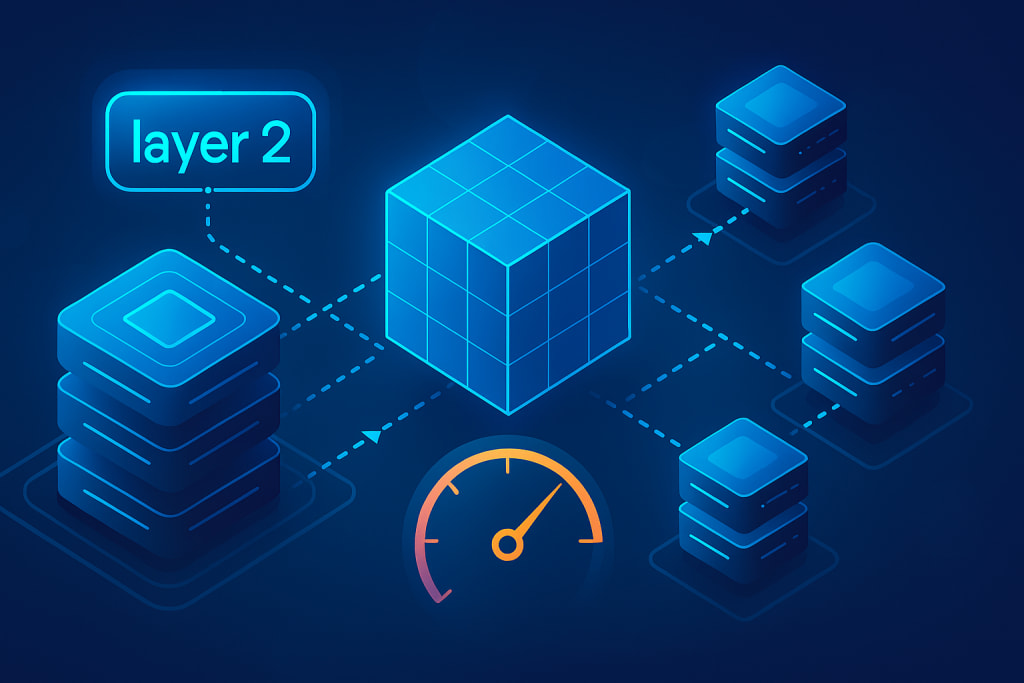
If you’ve only traded on Ethereum mainnet or centralized exchanges, you’re paying for a problem that Layer 2 networks already solved. Gas fees, slow confirmation times, and the inability to execute small trades profitably — these stopped being necessary evils somewhere around 2023, when Arbitrum and Optimism shipped production-grade rollups. Yet a surprising number of active traders still haven’t moved meaningful activity to L2s, either because they don’t trust the bridges, don’t understand how the security model works, or simply haven’t done the comparison math.
Layer 2 networks have evolved from experimental side projects into ecosystems with deeper liquidity than many standalone Layer 1 blockchains. Arbitrum alone hosts over $2 billion in total value locked across DeFi protocols that mirror everything on Ethereum mainnet — perpetual DEXs, lending markets, options platforms, and liquid staking. Base, Coinbase’s L2 built on Optimism’s OP Stack, brought millions of retail users into on-chain trading through the Coinbase app ecosystem. And Optimism itself, through the Superchain vision, is stitching together a network of interoperable L2s that share security and liquidity.
Here’s what matters for traders: cheaper execution, faster settlement, new opportunities, and risks you need to account for.
Key Takeaways
- Layer 2 rollups execute transactions off-chain and post compressed data to Ethereum, cutting gas costs by 90–99% compared to mainnet while inheriting Ethereum’s security
- Arbitrum leads in DeFi-native trading infrastructure; Base dominates retail onboarding through Coinbase integration; Optimism’s Superchain is building unified liquidity across multiple L2s
- Trading on L2s opens access to perpetual DEXs, lending markets, and yield strategies that are economically unviable on mainnet due to gas costs
- Bridge risk, sequencer centralization, and fragmented liquidity across L2s are the key risks to understand before moving capital
How Layer 2s Actually Work
“Layer 2” is a catch-all term for scaling solutions that sit on top of a base blockchain — in this case, Ethereum. The dominant architecture today is the optimistic rollup. Arbitrum, Optimism, and Base all use variations of this approach: transactions are executed on the L2, batched together, and posted to Ethereum as compressed data. Ethereum doesn’t re-execute every transaction. It stores the data and allows a challenge period — typically seven days — during which anyone can submit a fraud proof if the L2 sequencer posted invalid state transitions.
The economic model is simple. Instead of every trade competing for Ethereum block space, thousands of L2 transactions share a single Ethereum data posting. The cost per transaction drops from dollars to fractions of a cent. On Ethereum mainnet, a Uniswap swap might cost $15–50 in gas during normal conditions and $100+ during congestion. The same swap on Arbitrum costs $0.02–0.10. That’s not a marginal improvement — it’s a different product category.
This cost difference changes what’s possible for traders. On mainnet, if you’re deploying less than $5,000 in a strategy, gas costs eat a meaningful percentage of your returns. On an L2, you can trade $100 positions profitably. You can compound yields daily instead of weekly. You can adjust stop-losses and take-profits without mental math about whether the gas cost justifies the adjustment. These sound like small differences, but compounded over hundreds or thousands of trades, they’re the difference between an edge that works and an edge that leaks away to execution costs.
The Sequencer Question
One caveat matters: L2 sequencers — the component that orders and batches transactions — are currently centralized for all major rollups. Arbitrum’s sequencer is run by Offchain Labs. Optimism’s is run by OP Labs. Base’s is run by Coinbase. If the sequencer goes down, the chain stops producing blocks. This has happened — Arbitrum had a sequencer outage in December 2023 that halted the network for over an hour.
The security backstop is that L2s have a “forced transaction” mechanism: even if the sequencer is offline, users can submit transactions directly to Ethereum that the L2 must include within a defined window. In practice, this escape hatch is clunky, and most users don’t know how to use it. The sequencers are moving toward decentralisation — Arbitrum’s Timeboost and Optimism’s fault-proof upgrades are steps in this direction — but for now, you’re trusting a single entity to keep the chain running.
For traders, the practical risk is timing. If you have a position on an L2 perpetual DEX and the sequencer goes down during a volatility spike, you can’t close or adjust your position until it comes back. This is unlikely to happen often — the sequencers have strong uptime incentives because their revenue depends on it — but it’s a failure mode that doesn’t exist on Ethereum mainnet.

Free Crypto Signals Channel
 Free Telegram Channel
Arbitrum: The DeFi Trader’s L2
Arbitrum launched in August 2021 and quickly established itself as the DeFi hub among L2s. The network’s compatibility with Ethereum tooling was near-perfect from day one — any Solidity contract that runs on mainnet runs on Arbitrum with minimal or no modification. This attracted a wave of DeFi protocol deployments: GMX (the largest perpetual DEX by volume), Uniswap, Aave, Radiant, Pendle, Camelot, and dozens more.
For a trader, Arbitrum’s depth is the selling point. GMX alone routinely processes $500 million to $2 billion in daily perpetual volume, offering leverage on BTC, ETH, and a rotating selection of altcoins with a unique liquidity model: instead of an order book, GMX pools liquidity from LPs who earn fees from trader P&L. When traders lose, LPs win. When traders win consistently, LPs take the hit. Some professional trading firms run directional strategies specifically to extract value from GMX’s pool-based model — it’s a cat-and-mouse game that has produced sophisticated on-chain trading dynamics.
Arbitrum also hosts a thriving options ecosystem through platforms like Dopex and Lyra, lending markets where you can borrow against your positions with a few clicks, and yield strategies that auto-compound through protocols like Beefy. The transaction cost on Arbitrum makes these composable — you can deposit ETH into Aave as collateral, borrow USDC, deploy it into a GMX LP position, and auto-compound the rewards through Beefy, all without any single leg of the strategy costing more than a few cents in gas. On mainnet, that strategy would cost $200+ just to set up.
The ARB Token and Governance
Arbitrum’s governance token, ARB, launched via airdrop in March 2023 to early users of the network. ARB holders vote on protocol upgrades, treasury allocations, and the selection of the Security Council that oversees emergency actions. From a trading perspective, ARB itself has been a volatile asset — it launched around $1.20, spiked above $2 briefly, and has traded in a wide range since as the market prices in ecosystem growth against token unlocks and dilution.
The practical trading point: governance tokens on L2s are a distinct asset class. They’re not equity, they’re not utility tokens in the traditional sense, and their value is loosely tied to network adoption metrics — TVL, active addresses, transaction count. If you’re trading ARB, OP, or similar L2 governance tokens, you’re betting on ecosystem growth metrics, not protocol revenue. That’s a fundamentally different thesis than trading ETH (which generates fee revenue from network activity) or DeFi tokens tied to protocols with revenue-sharing mechanisms.
Base: Retail and the Coinbase Funnel
Base launched in August 2023 as Coinbase’s answer to the L2 market, built on Optimism’s OP Stack. The differentiation is obvious: Coinbase has over 100 million verified users, a mobile app installed on millions of phones, and the ability to onboard users directly into the Base ecosystem with a frictionless fiat-to-crypto experience. No other L2 has that distribution channel.
For traders, Base matters in two ways. First, it brings fresh capital into on-chain markets. When a Coinbase user buys ETH through the app and bridges it to Base with one click, that’s new liquidity flowing into the DEXs, lending protocols, and perpetual platforms on the network. Second, Base has become the dominant chain for meme coin trading — as covered separately, tokens on Base benefit from lower fees than Solana for large trades and access to the Coinbase user funnel.
The trading infrastructure on Base is growing fast. Aerodrome, a fork of Velodrome (Optimism’s dominant DEX), became the liquidity hub for Base, hosting deep pools for ETH, USDC, and top ecosystem tokens. Synthetix deployed its perpetual futures protocol on Base, bringing a mature derivatives platform to the chain. Morpho Blue, a lending primitive that separates risk management from lending pool creation, launched on Base with custom markets that let traders borrow against less liquid collateral.
Why Base Matters for Traders Who Don’t Use It
Even if you never touch Base, the chain affects your trading. Coinbase’s push into L2 infrastructure reshuffled competitive dynamics across the entire Ethereum ecosystem. When Base launched, Optimism’s OP Stack gained credibility because the largest US crypto company was betting on it. The Superchain concept — a network of interoperable L2s sharing security and, eventually, liquidity — became the dominant scaling narrative in Ethereum.
This matters for price action on ETH and related assets. L2 adoption drives ETH demand because rollups pay Ethereum for data availability, creating a structural bid for blockspace. If Base processes 10 million transactions per day and posts the compressed data to Ethereum, that’s a steady stream of ETH burned through EIP-1559. Over time, successful L2s are net positive for ETH’s token economics, even if they reduce direct mainnet usage.
 Most Popular
- 2-5 Signals Daily
- 82% Success Rate
- Entry, Take Profit & Stop Loss
- Amount To Risk Per Trade
- Risk Reward Ratio


Optimism and the Superchain Vision
Optimism was the first production optimistic rollup, launching in December 2021. Its early lead in DeFi was overtaken by Arbitrum’s broader protocol adoption, but Optimism pivoted to a different strategy: the OP Stack, a modular toolkit for building custom L2s that share Optimism’s security model and governance framework.
The Superchain is the vision: instead of one L2 fighting for market share against dozens of competitors, Optimism provides the infrastructure for many L2s that interoperate seamlessly. Base is the flagship Superchain member. Other chains built on the OP Stack include Zora (NFT-focused), Worldcoin’s World Chain, and a growing roster of project-specific rollups. For a trader, the practical promise is unified liquidity — eventually, you’ll be able to trade across Superchain members without bridging, meaning the fragmented liquidity problem that plagues L2s could resolve.
OP, Optimism’s governance token, distributes revenue from the sequencer to the Optimism Collective treasury, which funds public goods and ecosystem development. OP has gone through several airdrop rounds to active network users, creating an incentive for traders to use Optimism-based protocols even if Arbitrum offers slightly deeper DeFi markets on a standalone basis.
The L2 Trading Stack in Practice
If you’re moving from centralized exchange trading to on-chain L2 trading, here’s the practical stack:
First, bridge assets from Ethereum mainnet or a CEX directly. Coinbase supports direct withdrawals to Arbitrum, Optimism, and Base — no need to touch mainnet. Other CEXs vary. If you’re bridging from mainnet, Arbitrum’s native bridge and Optimism’s official bridge are the safest but slowest (up to 7 days for withdrawals back to mainnet, though deposits take minutes). Third-party bridges like Across and Hop Protocol use liquidity pools to provide instant transfers at a small fee.
Second, pick your trading venue. For perpetuals, GMX on Arbitrum and Synthetix on Base/Optimism are the leaders. For spot DEX trading, Uniswap V3 is deployed everywhere, and chain-native DEXs like Camelot (Arbitrum) and Aerodrome (Base) often offer better rates for ecosystem tokens due to deeper liquidity concentration.
Third, manage your gas. L2s use ETH for gas, same as mainnet, but you need ETH on the L2 network, not on mainnet. Most bridges let you receive a small amount of ETH with your initial deposit to cover early transactions. Keep at least 0.01 ETH on each L2 you actively trade on — running out of gas mid-trade is the on-chain equivalent of a power outage during a move.
Risks Specific to L2 Trading
The benefits of L2 trading — low fees, fast confirmation, deep DeFi access — come with risks that don’t apply to CEX trading or Ethereum mainnet.
Bridge risk. The bridge that moves your assets between Ethereum and the L2 is a smart contract. If the bridge is exploited — as happened with the Nomad bridge ($190 million), Wormhole ($326 million), and Ronin ($625 million) — assets can be stolen. Official rollup bridges (Arbitrum’s and Optimism’s native bridges) have the strongest security model because they inherit Ethereum’s security directly: the bridge contract is on Ethereum mainnet, and withdrawing assets through it requires the fraud-proof window to pass. Third-party bridges are faster but add a separate trust assumption — you’re trusting the bridge’s smart contract and its operators.
Sequencer downtime. As discussed, if the sequencer goes offline, you can’t transact. The forced-transaction escape hatch exists but is not user-friendly. For active traders, this means having a backup plan: don’t put your entire trading portfolio on a single L2, and keep some capital on mainnet or a CEX for hedging if the L2 goes down during a volatile period.
Fraud-proof assumptions. Optimistic rollups rely on at least one honest validator to challenge invalid state transitions during the challenge window. In theory, this is robust because anyone can run a validator. In practice, most users don’t, and if no honest party challenges a fraudulent batch, invalid transactions could be finalised. No major rollup has experienced a successful fraud event, but the risk is non-zero, and it increases as L2s introduce protocol upgrades that change the validation logic.
MEV and sandwich attacks. L2s have lower transaction costs, which means MEV bots can afford to run more aggressive strategies. Sandwich attacks — where a bot front-runs your trade, pushes the price up, and sells into the higher price — are common on L2 DEXs, especially on tokens with thin liquidity. Using DEX aggregators and setting tight slippage tolerances reduces but doesn’t eliminate this risk.
Fragmented liquidity. Every new L2 fragments the pool of capital. A trader who wants to access a particular perpetual market or lending pool might need to bridge to a specific L2, maintain multiple gas token balances, and track positions across several chains. This is the inefficiency that chain abstraction and intent-based protocols are trying to solve, but as of mid-2026, the solution is still under development.
Conclusion
Layer 2 networks are no longer the future of crypto trading — they’re the present. Arbitrum, Base, and Optimism collectively process more transaction volume than Ethereum mainnet, with fees that make active on-chain trading viable for capital amounts that would be eaten alive by mainnet gas costs. The on-chain trading experience — perpetual DEXs with deep liquidity, lending markets for leverage and hedging, yield strategies that compound at frequencies mainnet can’t justify — is richer on L2s than anywhere else in crypto.
That doesn’t mean L2s are risk-free. Bridge security, sequencer centralization, and liquidity fragmentation are real issues that every trader should understand before moving significant capital. But for most active traders, the cost savings alone — turning $30 swaps into $0.03 swaps — justify the effort of learning the L2 landscape. The traders who adapt to this infrastructure early are the ones who will compound edges that mainnet and CEX-native traders literally cannot access.
Educational content only. Not financial advice. Always do your own research.