
Proof of Work vs Proof of Stake: What’s the Difference?
Estimated Reading Time: 6 minutes
Don’t invest unless you’re prepared to lose all the money you invest. This is a high-risk investment and you are unlikely to be protected if something goes wrong. Take 2 minutes to learn more
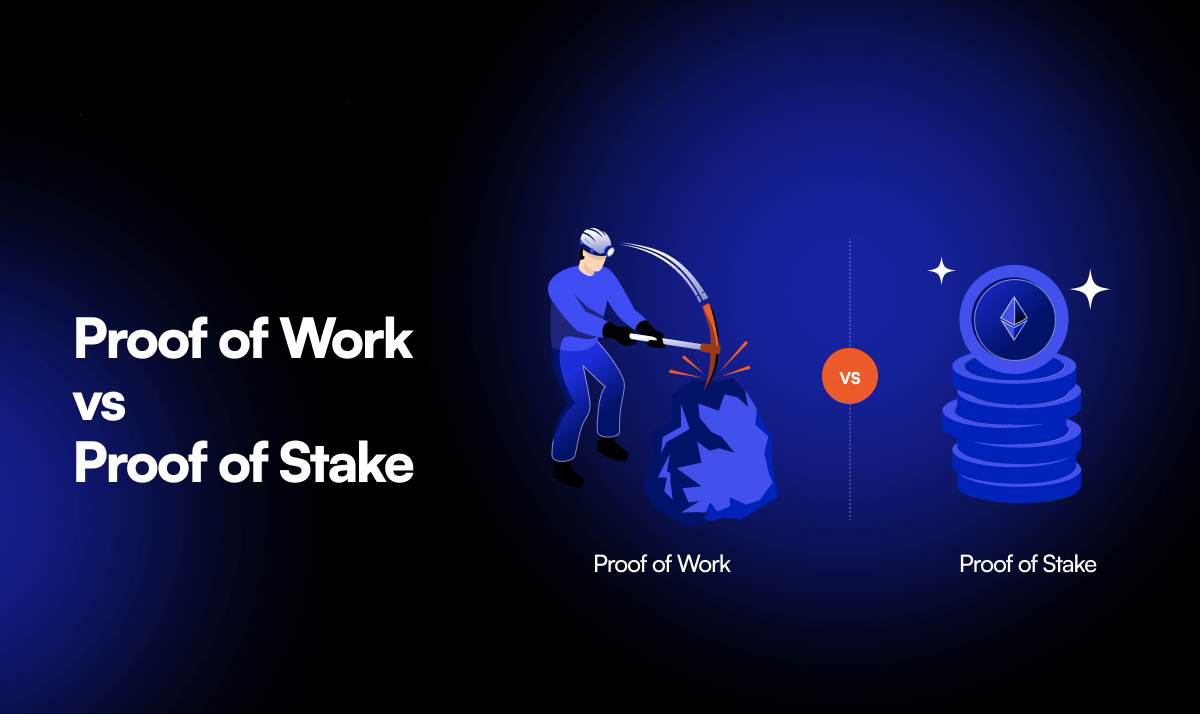
The Engine Room of Blockchain
Every blockchain needs a way to agree on which transactions are valid — without a central authority making the decision. This is called a consensus mechanism.
The two most important consensus mechanisms are Proof of Work (PoW) and Proof of Stake (PoS). Understanding the difference is fundamental to understanding how crypto works.
What Is Proof of Work?
Proof of Work is the original consensus mechanism, used by Bitcoin.
In PoW, computers on the network — called miners — compete to solve a complex mathematical puzzle. The first one to solve it gets to add the next block of transactions to the blockchain and earns a reward.
How It Works:
1. New transactions are broadcast to the network
2. Miners race to solve a cryptographic puzzle
3. The winner adds the block and earns newly created Bitcoin (+ fees)
4. Other nodes verify the solution and accept the block
5. The process repeats with a new puzzle
The “work” in Proof of Work is the computational effort (and energy) required to solve the puzzle. This is what makes it secure — attacking the network requires owning more computing power than everyone else combined (a 51% attack), which is prohibitively expensive.
Used by:
– Bitcoin (BTC)
– Litecoin (LTC)
– Monero (XMR)

Free Crypto Signals Channel
 Free Telegram Channel
What Is Proof of Stake?
Proof of Stake is the newer consensus mechanism, now used by Ethereum (since “The Merge” in 2022).
Instead of competing with computing power, validators lock up (stake) cryptocurrency as collateral. The network randomly selects validators to propose and attest to new blocks, weighted by how much they’ve staked.
How It Works:
1. Validators deposit (stake) crypto as collateral
2. The protocol randomly selects a validator to propose the next block
3. Other validators attest (vote) that the block is valid
4. The proposer and attesters earn rewards
5. Dishonest validators have their stake “slashed” (reduced) as punishment
The “stake” replaces the “work” — instead of wasting electricity, validators risk losing their own money if they cheat.
Used by:
– Ethereum (ETH)
– Cardano (ADA)
– Solana (SOL)
– Avalanche (AVAX)
– Polkadot (DOT)
PoW vs PoS: Head-to-Head Comparison
| Feature | Proof of Work | Proof of Stake |
|---|---|---|
| Security mechanism | Computing power | Staked capital |
| Energy use | Very high | ~99% lower |
| Attack cost | Buy 51% of hashrate | Buy 51% of staked coins |
| Barrier to entry | Expensive hardware | Capital to stake |
| Decentralisation | Mining pools dominate | Validator concentration risk |
| Rewards | Block rewards + fees | Staking rewards + fees |
| Track record | 15+ years (Bitcoin) | Newer, less battle-tested |
| Environmental impact | Significant | Minimal |
The Energy Debate
One of the biggest criticisms of Proof of Work is its energy consumption.
Bitcoin’s network uses roughly as much electricity as some medium-sized countries — most of it for mining. Critics argue this is wasteful.
Defenders argue:
– An increasing share of Bitcoin mining uses renewable energy
– The energy expenditure is what makes Bitcoin genuinely secure
– The cost of attack is real and physical, not just financial
Ethereum’s switch to Proof of Stake reduced its energy consumption by approximately 99.95% — one of the most dramatic reductions in any major technology’s footprint.
 Most Popular
- 2-5 Signals Daily
- 82% Success Rate
- Entry, Take Profit & Stop Loss
- Amount To Risk Per Trade
- Risk Reward Ratio


Which Is More Secure?
Both have strong security properties, just achieved differently.
PoW security: To attack Bitcoin, you’d need to acquire more mining hardware than the rest of the network combined — billions of dollars of physical equipment.
PoS security: To attack Ethereum, you’d need to acquire 51%+ of all staked ETH — also billions of dollars, plus your stake would be slashed if you tried.
PoW has a longer track record (Bitcoin has never been successfully attacked in 15+ years). PoS is theoretically efficient but has less history to draw on.
Other Consensus Mechanisms
PoW and PoS are the most common, but others exist:
– Delegated Proof of Stake (DPoS): Token holders vote for delegates who validate (EOS, TRON)
– Proof of History (PoH): Solana’s unique mechanism using cryptographic timestamps
– Proof of Authority (PoA): Trusted validators — used in private/enterprise blockchains
– Proof of Space: Uses storage capacity instead of computing power (Chia)
Key Takeaways
– Consensus mechanisms allow blockchains to agree on valid transactions without a central authority
– Proof of Work uses competitive computation (mining) — used by Bitcoin
– Proof of Stake uses locked capital (staking) — used by Ethereum and most modern blockchains
– PoS uses ~99% less energy than PoW
– Both are secure — PoW has more history, PoS is more efficient
– Ethereum switched from PoW to PoS in September 2022 (“The Merge”)
The Bottom Line
The debate between Proof of Work and Proof of Stake is one of the most important in all of crypto. It touches on security, decentralisation, environmental impact, and the fundamental design philosophy of blockchain systems.
Bitcoin’s PoW is battle-hardened and deliberately energy-intensive. Ethereum’s PoS is efficient and scalable. Both are valid approaches to the same problem — how to build trustless agreement at global scale.
NOT FINANCIAL ADVICE. Always do your own research (DYOR) before investing in any cryptocurrency.