


Hyundai’s Stablecoin Move Could Be a Major Win for Avalanche
Estimated Reading Time: 3 minutes
Don’t invest unless you’re prepared to lose all the money you invest. This is a high-risk investment and you are unlikely to be protected if something goes wrong. Take 2 minutes to learn more

Key Takeaways:
- Hyundai tested stablecoin payments on Avalanche.
- The pilot strengthens Avalanche’s enterprise use case.
- AVAX price has yet to reflect the adoption.
When a global automaker with operations in over 200 countries completes its first stablecoin payment pilot on a public blockchain, the significance extends well beyond the transaction itself. It is a proof of concept — and Avalanche just became the chain it was proven on.
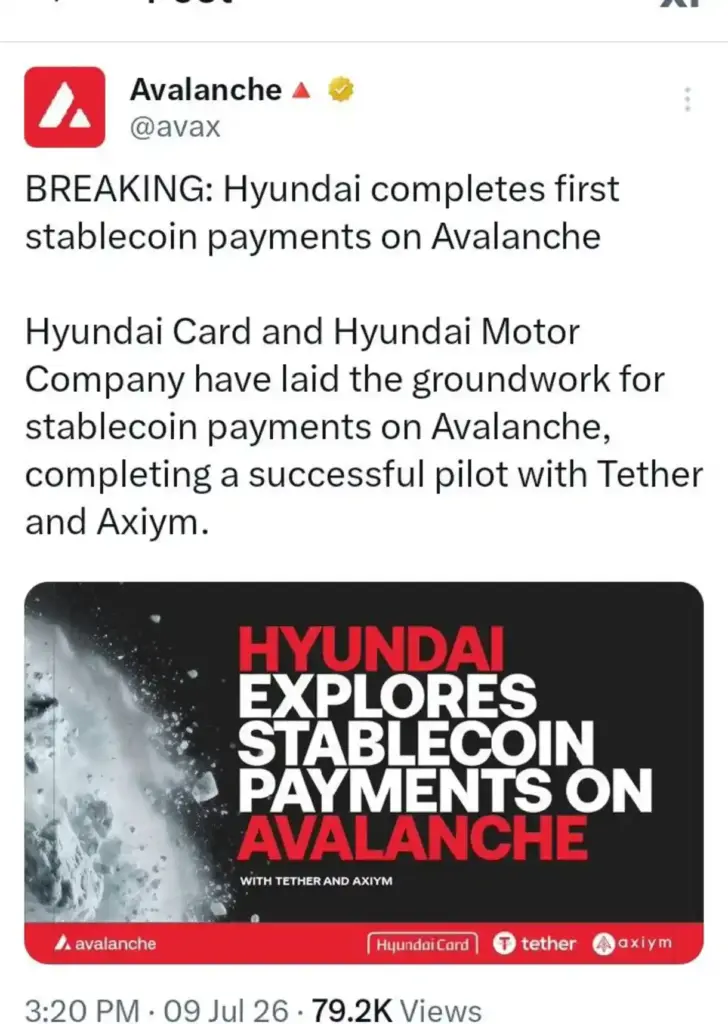
Avalanche announced on July 9, 2026 that Hyundai Card and Hyundai Motor Company have completed a successful stablecoin payment pilot on Avalanche, in partnership with Tether and Axiym. The pilot lays the groundwork for stablecoin-based payments to be embedded into Hyundai’s broader financial and automotive infrastructure — a use case that, at scale, would mean one of the world’s largest vehicle manufacturers processing payments on-chain through Avalanche’s network.
Why This Partnership Is Bigger Than It Looks
Hyundai is not a fintech startup testing a new idea. Hyundai Card is one of South Korea’s largest credit card issuers. Hyundai Motor Company sells millions of vehicles annually across global markets. A stablecoin payment infrastructure built on Avalanche by entities of this scale carries commercial implications that go far beyond a press release.
If the pilot converts into live deployment, it would represent one of the largest real-world stablecoin payment integrations in automotive history — and Avalanche would be the settlement layer underneath it.
The choice of Tether as the stablecoin partner is also telling. USDT remains the most liquid and widely held stablecoin in the world. Integrating it into Hyundai’s payment rails through Avalanche creates a direct bridge between the traditional consumer payments ecosystem and blockchain infrastructure — removing several layers of friction that have historically kept enterprise adoption slow.
A Token That Has Not Caught Up to Its Fundamentals Yet
Data pulled from CoinGecko on July 11, 2026 at approximately 9:44 UTC shows AVAX trading at $6.71, down 2.1% over seven days. The weekly chart reflects a market still digesting earlier losses. AVAX opened near $7.00 on July 4, sold off sharply on July 8 to $6.40, then recovered to consolidate in a tight range between $6.60 and $6.80 from July 9 onward. The recovery off the $6.40 low is holding, but conviction from buyers remains limited. AVAX is stabilising rather than accelerating.
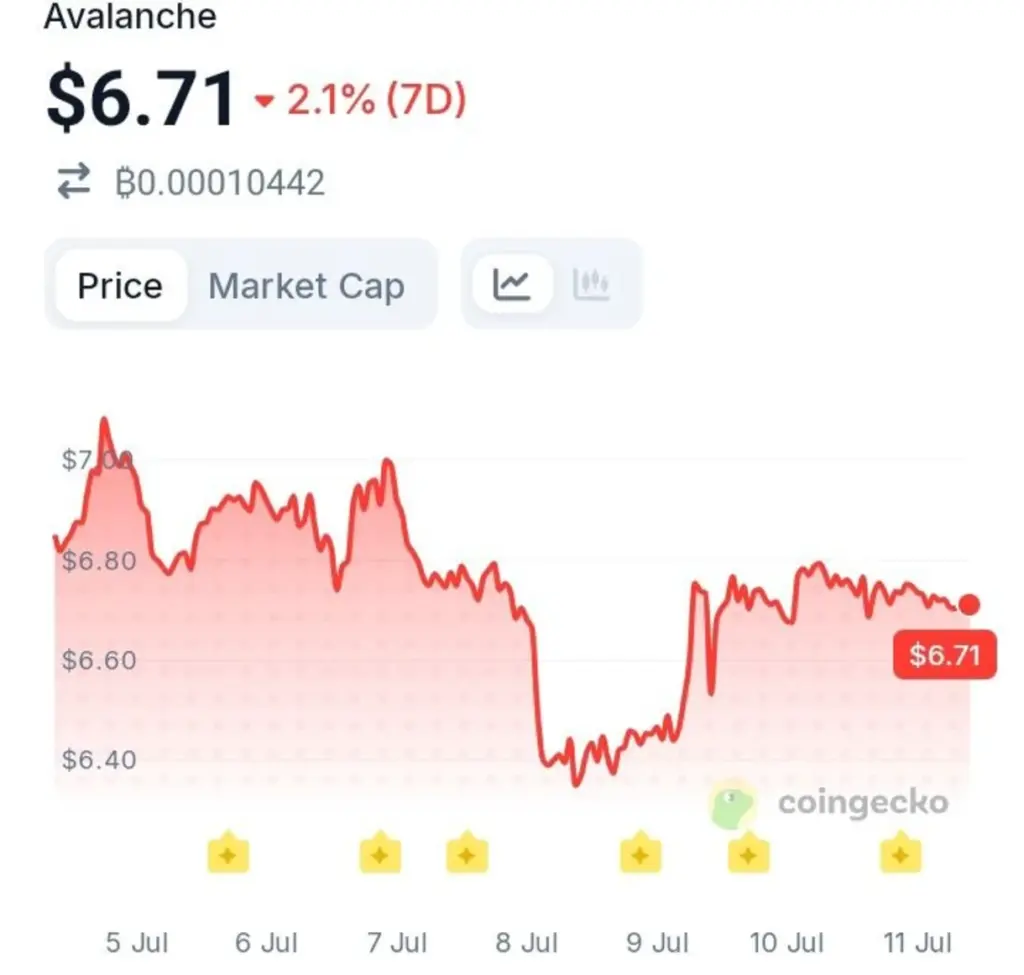
The gap between what Avalanche is building at the enterprise level and what the token is trading at remains one of the more striking disconnects in the current market. Transaction growth has quadrupled in twelve months. RWA inflows sit at $317 million. Hyundai has now completed a stablecoin pilot on its network. And AVAX is trading at $6.71.
Fundamental developments of this calibre have historically preceded token repricing — not immediately, but eventually. The Hyundai pilot adds another data point to a growing case that the market has not yet priced in what Avalanche is quietly becoming.