


Hitachi’s Hedera Adoption Signals a Bigger Shift Toward Enterprise Blockchain
Estimated Reading Time: 4 minutes
Don’t invest unless you’re prepared to lose all the money you invest. This is a high-risk investment and you are unlikely to be protected if something goes wrong. Take 2 minutes to learn more
Key Takeaways:
- Hitachi is actively helping govern and build on Hedera.
- Its role strengthens Hedera’s enterprise credibility.
- Real-world adoption will be the key test going forward.
A blockchain network’s credibility with enterprises isn’t proven by press releases — it’s proven by who shows up to actually govern it. Hedera counts a Fortune 500 industrial giant among the companies doing exactly that, and the relationship has had time to mature into something more concrete than a headline.
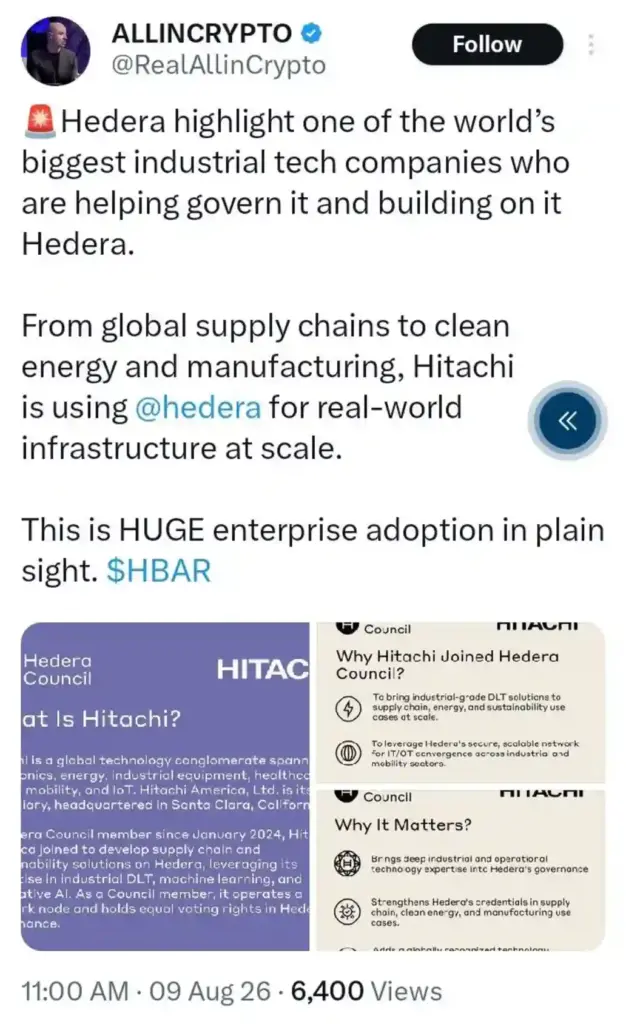
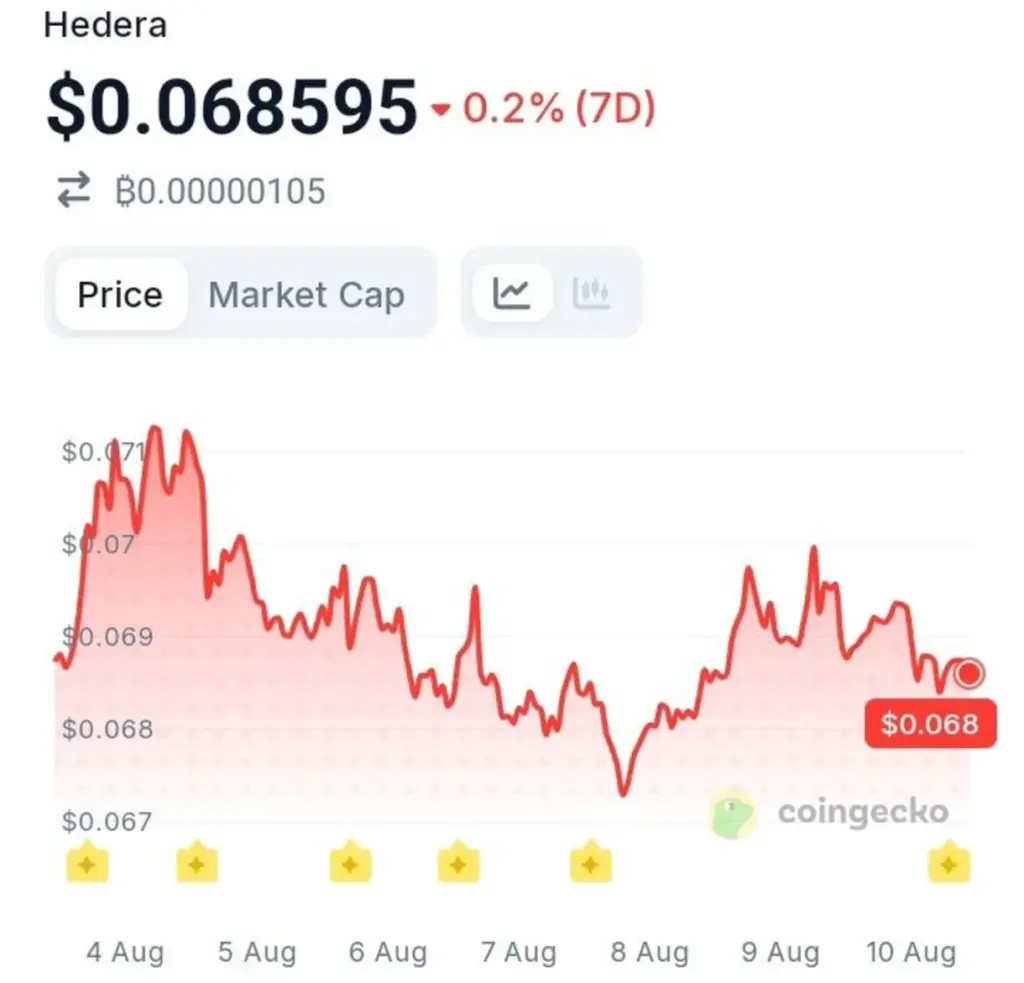
ALLINCRYPTO highlighted on August 9, 2026 that Hitachi is helping govern and build on Hedera, spanning use cases from global supply chains to clean energy and manufacturing. HBAR trades at $0.068595, down 0.2% over the past seven days, according to CoinGecko.
Why Hitachi’s Role Carries Real Weight
Hitachi America joined the Hedera Governing Council specifically to bring industrial, supply chain, and clean energy expertise into the network’s governance process, helping shape how Hedera’s distributed ledger technology gets applied across IT, operational technology, and industrial use cases at scale.
Unlike a typical partnership announcement, Council membership means Hitachi holds an equal vote in decisions about Hedera’s software and services, and operates one of the network’s governing nodes — a structurally different level of commitment than simply building an application on top of the chain.
Part of a Council Built From Fortune 500 Names
Hitachi’s presence isn’t an isolated case — it sits alongside a governing body that includes Google, IBM, Boeing, Deutsche Telekom, DBS Bank, and Standard Bank, among roughly 30 other global enterprises sharing equal governance rights over the network.
That structure is central to Hedera’s pitch to institutions: rather than relying on anonymous validators, the network is run by a rotating council of large, identifiable organizations, each with direct commercial reasons to keep the infrastructure reliable for real-world deployment.
What the Chart Shows
Looking at the seven-day chart, HBAR spent the week drifting in a narrow band, sliding from around $0.070 on August 4 to a low near $0.067 by August 8, before a modest recovery brought price back to $0.068595. The muted price action reflects a market that hasn’t reacted sharply to renewed attention on Hitachi’s role — enterprise governance participation tends to be a slow-moving fundamental story rather than a short-term catalyst.
Why Enterprise Governance Matters More Than Price Action
Council members like Hitachi aren’t just token holders — they’re expected to build real proof-of-concept work in areas like supply chain resiliency and sustainability tracking, the kind of infrastructure decisions that take years to fully materialize into visible network usage.
For a network competing to become the settlement layer of choice for large enterprises, having an industrial conglomerate the size of Hitachi actively shaping governance is a stronger signal of institutional trust than transaction volume alone. Whether that trust eventually converts into measurable on-chain activity from Hitachi’s own supply chain and energy initiatives is the next milestone worth tracking.