


How Much Risk Was Zcash Exposed to For Four Years Before AI Discovered This Flaw?
Estimated Reading Time: 4 minutes
Don’t invest unless you’re prepared to lose all the money you invest. This is a high-risk investment and you are unlikely to be protected if something goes wrong. Take 2 minutes to learn more

KEY TAKEAWAYS:
- Zcash had a serious hidden bug for 4 years, now patched, with no confirmed exploitation.
- Market reacted sharply, with ZEC falling about 29% in the aftermath.
- Bigger concern is trust: AI-driven vulnerability discovery raises fears of more unseen protocol risks.
The answer, according to developers, is that nobody yet knows — and that uncertainty may be the most damaging part of the story. A critical vulnerability in Zcash’s Orchard privacy pool sat undetected for four years before being uncovered on May 29 by security engineer Taylor Hornby using Anthropic’s Claude Opus 4.8 AI model. The bug, present since Orchard’s activation in May 2022, could have theoretically allowed an attacker to mint unlimited counterfeit ZEC with no cryptographic trace. An emergency patch was deployed by June 1. Shielded Labs confirmed no evidence of on-chain exploitation has been found. The market, however, did not wait for reassurance.
What the Vulnerability Actually Meant
The technical severity is difficult to overstate. Zcash’s core value proposition is its zk-SNARK privacy architecture — the cryptographic guarantee that shielded transactions are both private and valid. A flaw that could allow undetected counterfeit minting does not merely threaten the price of ZEC. It threatens the foundational assumption that the protocol’s cryptography is trustworthy.
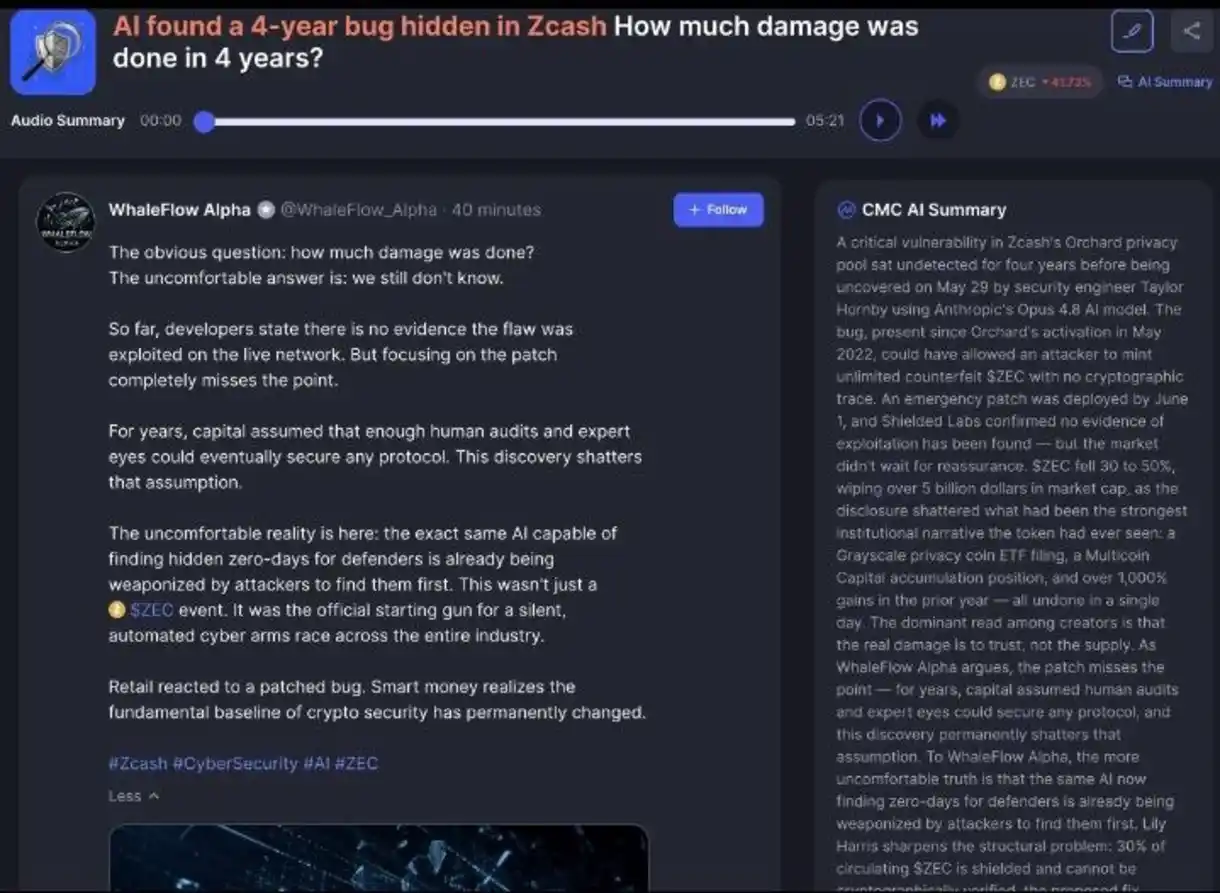
Approximately 30% of circulating ZEC sits in shielded pools that cannot be externally verified — meaning the four-year exposure window created a scenario where the integrity of a significant portion of the supply was theoretically unauditable. Developers state there is no evidence the flaw was exploited on the live network. But as WhaleFlow Alpha observed, focusing on the patch completely misses the point — for four years, the industry operated on the assumption that human audits and expert eyes could secure any protocol. That assumption has now been permanently shattered.
“Retail reacted to a patched bug. Smart money is reckoning with the possibility that the security baseline of crypto has permanently changed.”
What the Price Chart Shows
The CoinGecko 30-day chart captured at approximately 12:30 UTC on June 7, 2026 is a clinical illustration of institutional conviction evaporating in real time. ZEC had been trading with unusual strength through most of May — reaching highs above $650 around May 21–25 — driven by a Grayscale privacy coin ETF filing and a visible Multicoin Capital accumulation position that had pushed sentiment to its most bullish reading in over a year. Then the bug disclosure arrived.
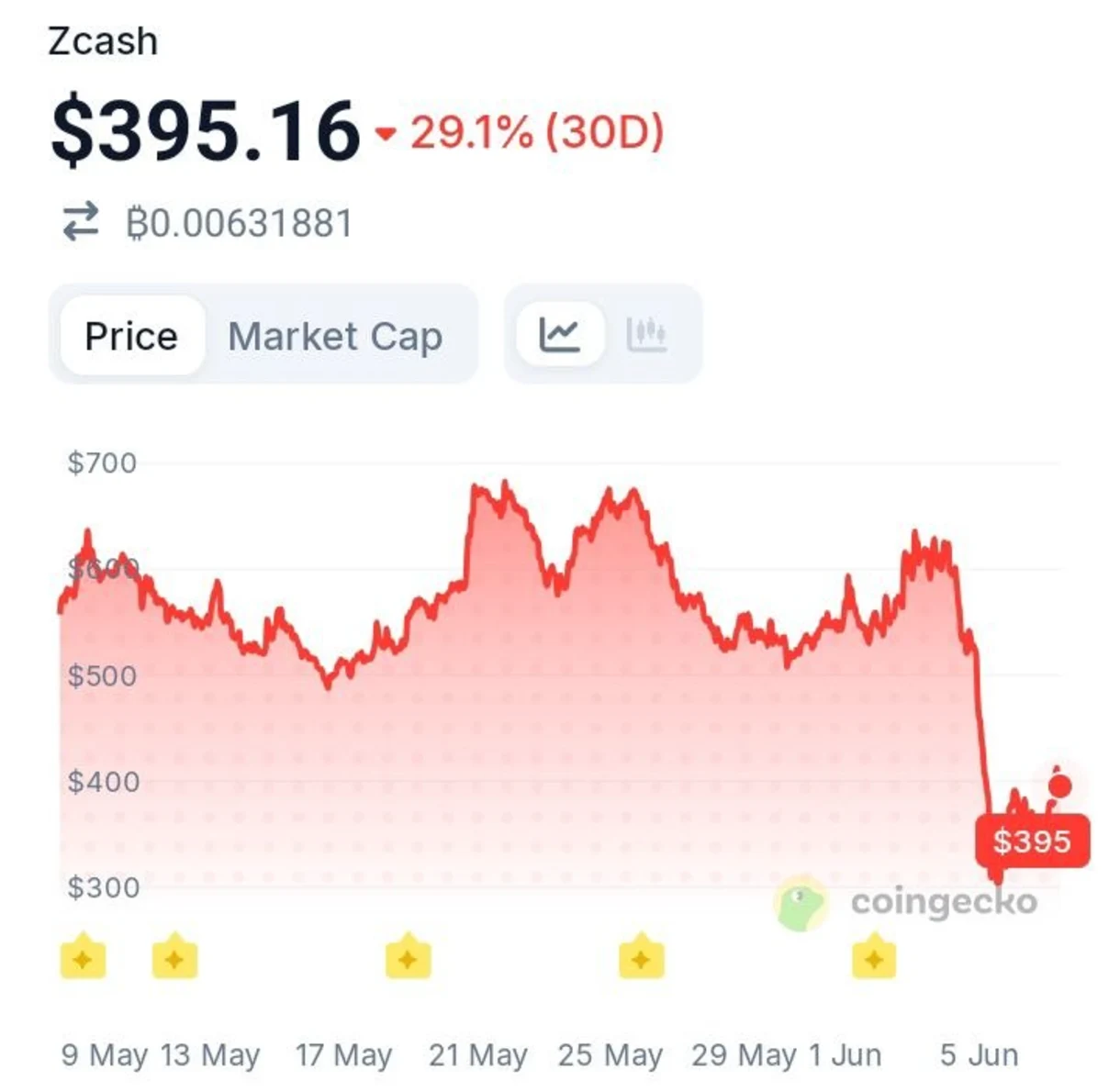
The subsequent decline was not gradual — it was vertical. From above $600, ZEC collapsed through $500, $450, $400, and currently sits at $395.16, down 29.1% over thirty days with the majority of that loss concentrated in the final week. Over $5 billion in market cap was erased. Every institutional thesis built on Zcash’s privacy guarantee was called into question simultaneously.
The Larger Question Nobody Wants to Answer
WhaleFlow Alpha’s most uncomfortable observation is not about Zcash specifically — it is about the industry. The same AI capable of finding zero-days for defenders is already being weaponised by attackers to find them first. This was not simply a Zcash event. It was the opening shot of a silent, automated cyber arms race across the entire crypto security landscape. Every privacy protocol, every zero-knowledge proof system, every shielded pool that has never been stress-tested by AI-assisted vulnerability scanning now carries an asterisk that did not exist before May 29.
The patch is deployed. The network appears intact. But the question that will define Zcash’s recovery — and the broader privacy coin sector’s credibility — is not whether this bug was exploited. It is how many others like it are still waiting to be found.