


Monad Investors Reject $60M Exit as Network Growth Accelerates
Estimated Reading Time: 6 minutes
Don’t invest unless you’re prepared to lose all the money you invest. This is a high-risk investment and you are unlikely to be protected if something goes wrong. Take 2 minutes to learn more

Monad, an Ethereum rival, recently gave some of its earliest investors a chance to cash out before their MON tokens became freely tradable. Almost all of those approached rejected the offer.
The Monad Foundation had set aside up to $60 million to buy locked MON from selected early investors at a discount. The program essentially offered investors a choice: take cash now at a lower price or keep their tokens locked and wait for the normal unlocking schedule.
Monad has not disclosed how much it ultimately spent, how many investors accepted, or the size of the discount.
That makes the decision interesting, but it should not automatically be viewed as a bullish signal. Investors may believe MON will be worth more later, but they may also have simply considered the proposed discount too low. Without knowing the offer price, it is difficult to determine exactly why most investors chose to hold.
Still, the timing is worth watching because Monad’s network is showing signs of growing activity.
What Makes Monad Different?
Monad is a Layer-1 blockchain designed to run applications compatible with Ethereum while offering much higher transaction-processing capacity.
Its main attraction is performance. Monad uses parallel execution and other architectural changes to process transactions more efficiently than traditional Ethereum-style execution. The network targets up to 10,000 transactions per second, with sub-second block times and finality.
The important point is that Monad is not simply trying to become another blockchain disconnected from Ethereum.
Its EVM compatibility means developers familiar with Ethereum can build and deploy applications on Monad using familiar tools and smart contracts.
That could give Monad an advantage in areas such as decentralized finance, gaming and consumer applications where speed and transaction costs can become important.
But technology alone is not enough.
A fast blockchain still needs developers, users, liquidity and applications. That is why the growth of Monad’s ecosystem may be more important than its technical specifications.
Mon Price Struggles While Network Activity Grows
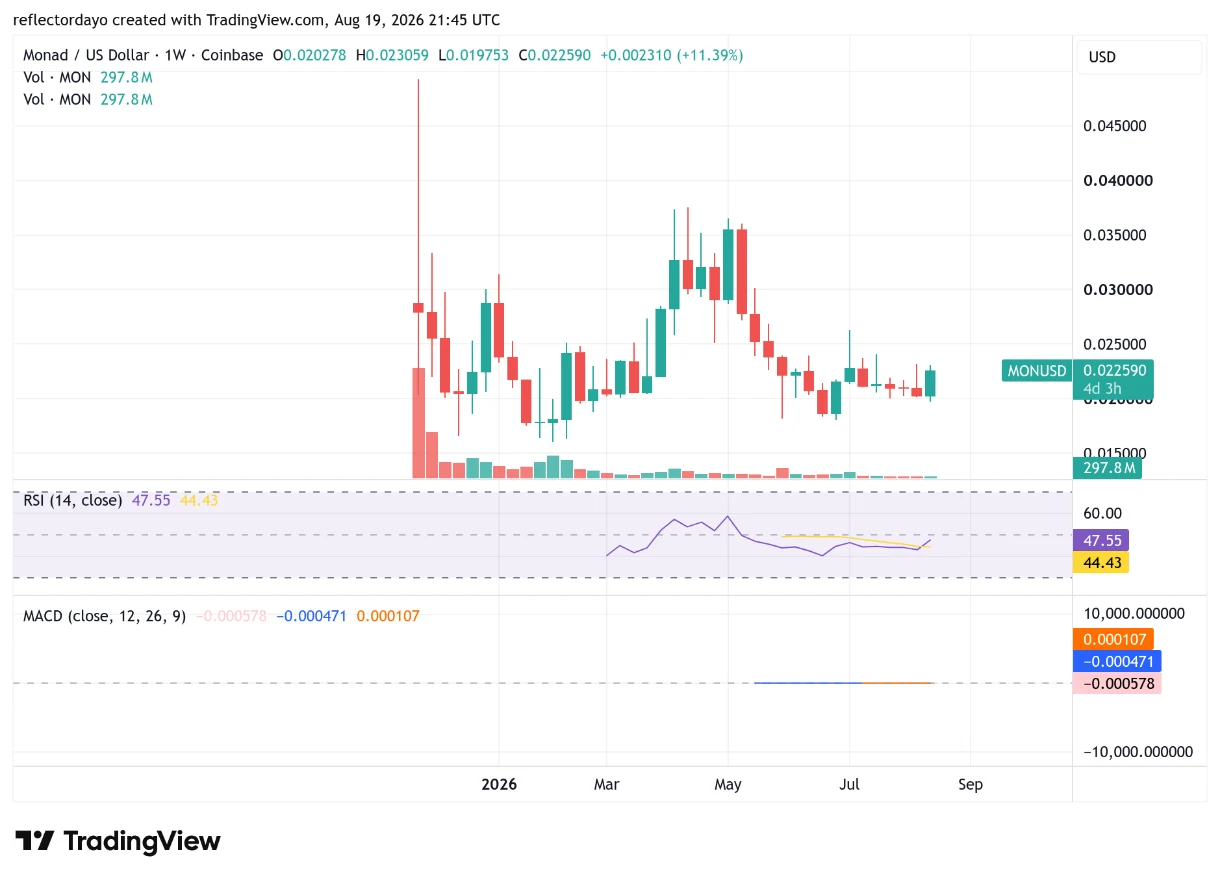
MON has been trading below its $0.025 public-sale price, with the token around $0.021 in the figures reported.
Yet activity on Monad has been moving in the opposite direction.
The amount of money deposited into Monad-based DeFi applications increased from roughly $360 million on July 2 to about $895 million. That represents an increase of almost 150% in roughly six weeks.
Stablecoins on the network were worth approximately $707 million, while decentralized exchanges handled around $79 million in trading over the preceding day.
This creates an interesting situation:
MON’s price has struggled, while activity on the blockchain has grown rapidly.
That does not necessarily mean MON is undervalued. Growing TVL and trading activity do not automatically translate into higher demand for a blockchain’s native token.
However, sustained ecosystem growth could eventually change the market’s perception of the network.
Mon Price Struggles While Network Activity Grows MON?
The investment question is not simply whether Monad can process more transactions than Ethereum.
The bigger question is whether it can turn that technical advantage into lasting adoption.
MON is the native token of the Monad network. It is used to pay transaction fees and help secure the blockchain. If more developers build applications on Monad and more users transact on the network, the economic importance of the ecosystem could increase.
That creates a potential path for MON.
If network activity continues growing, liquidity remains on the blockchain and developers continue choosing Monad, investors could eventually begin assigning greater value to the network and its native token.
But there are significant risks.
Monad is competing not only with Ethereum but also with numerous other high-performance blockchains. Ethereum itself continues to improve its scalability, while competing networks are also trying to attract developers and users.
There is also no guarantee that Monad’s recent growth will continue. A temporary increase in TVL or trading volume is not the same as sustainable adoption.
For investors, the more important metrics to watch are therefore users, TVL, stablecoin liquidity, transaction activity and developer adoption.

The Bigger MON Question
The $60 million exit offer provides an interesting glimpse into how some early investors are positioning themselves, but it is not enough to predict where MON is heading.
The more significant development may be happening underneath the token price.
Monad is attempting to combine Ethereum compatibility with higher performance, while its DeFi ecosystem is already attracting substantial capital.
If that growth continues and translates into real, sustained usage, the current MON price could eventually look different.
That does not mean a rally is guaranteed.
Instead, Monad presents an interesting possibility for investors: a relatively young blockchain whose token has struggled even as activity across its ecosystem has expanded.
The question now is whether that network growth can become strong enough to change the market’s view of MON.
For now, that is something worth watching rather than assuming.