


Solana’s Biggest Capacity Upgrade Yet Is Nearly Here — Will It Change the Game?
Estimated Reading Time: 4 minutes
Don’t invest unless you’re prepared to lose all the money you invest. This is a high-risk investment and you are unlikely to be protected if something goes wrong. Take 2 minutes to learn more

Key Takeaways:
- Solana is raising block capacity by 66%, from 60M to 100M compute units.
- The upgrade could boost DeFi and other high-demand applications.
- SOL’s price remains weak, making post-upgrade network performance key to watch.
A blockchain’s speed limit isn’t fixed forever — it’s a governance decision, and Solana just voted to raise its own by two-thirds in under a day.
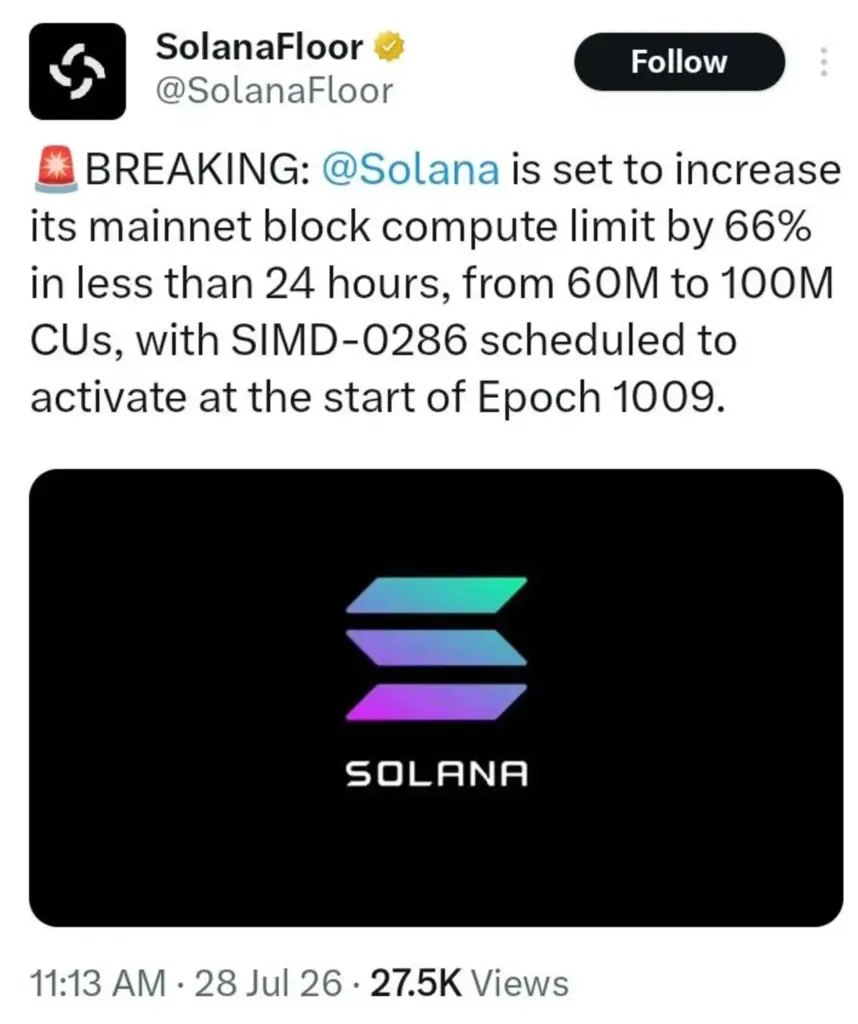
SolanaFloor reported on July 28, 2026 that Solana is set to increase its mainnet block compute limit by 66% in less than 24 hours, from 60 million to 100 million compute units, with the upgrade under proposal SIMD-0286 scheduled to activate at the start of Epoch 1009.
What a Compute Unit Increase Actually Changes
Compute units function as the processing budget each block gets to execute transactions within roughly 400 milliseconds. A higher ceiling means more transactions, more complex smart contract calls, and denser decentralized application activity can fit into a single block without hitting execution limits.
SIMD-0286 only raises the total compute allowed per block — other constraints, like the maximum writable accounts per block, remain unchanged, meaning the added headroom benefits parallelizable transaction types such as DeFi swaps and NFT mints most directly.
The Second Increase in a Short Window
This upgrade doesn’t arrive in isolation. It follows a prior increase from 50 million to 60 million compute units that had already lifted the network’s sustained throughput to around 1,700 transactions per second during peak traffic. Demand from restaking protocols, order-book DEXs, and real-world asset platforms has continued to press against that ceiling, which is what’s driving developers to push the limit higher again so soon after the last adjustment.
The proposal itself was authored by Jito Labs, one of the more influential infrastructure teams in the Solana ecosystem, reflecting how directly validator-side infrastructure providers are shaping the network’s capacity roadmap.
Price Action Doesn’t Reflect the Upgrade Yet
Looking at the seven-day chart, SOL has been under consistent pressure, sliding from highs near $79 on July 22 down to a low near $74 by July 25, followed by a brief recovery toward $77 on July 27 before dropping sharply to $73.35 by July 28 — the same day this upgrade news broke.
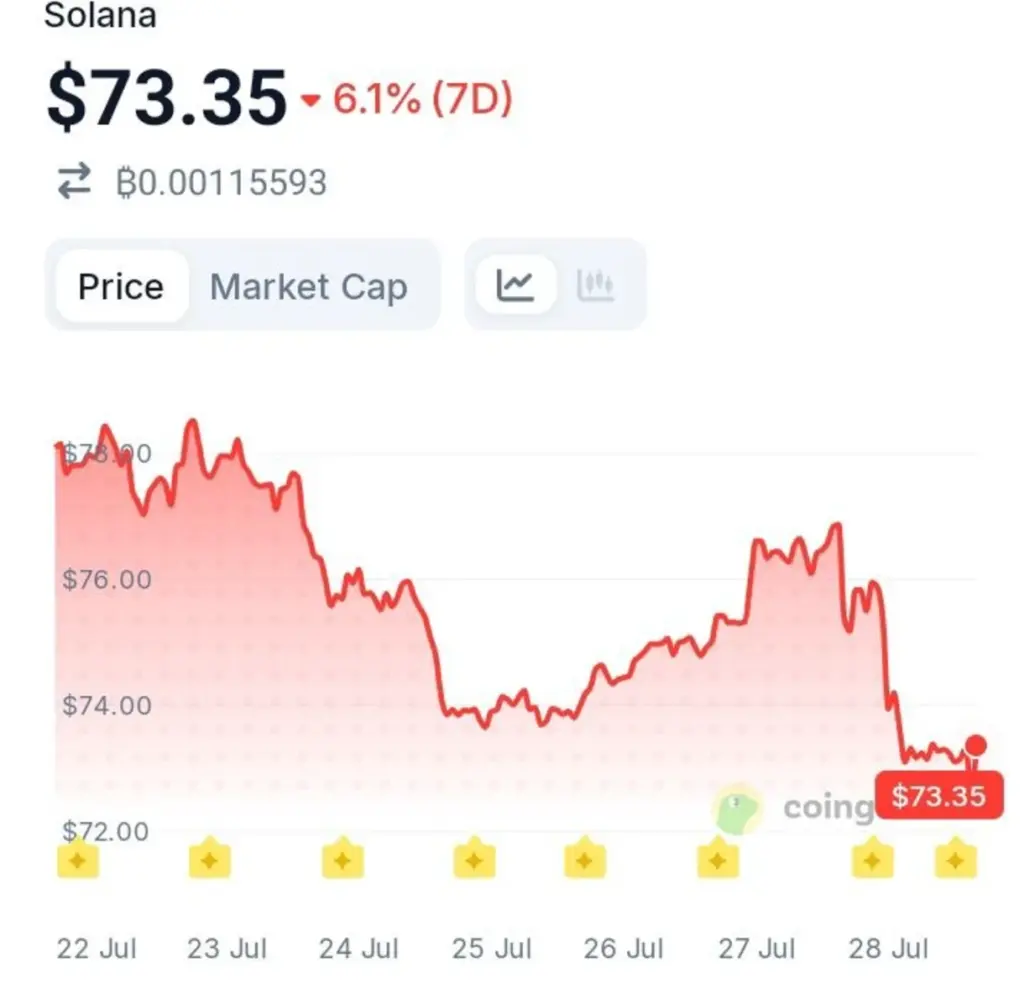
That disconnect is worth noting: a substantial capacity upgrade landed on a day when price moved in the opposite direction, underscoring that infrastructure improvements and short-term price sentiment don’t always move together.
What to Watch Once Epoch 1009 Begins
The real test comes after activation, not before it. Validator metrics in the 48 to 72 hours following the epoch transition — skip rates, block production consistency, and transaction success rates — will show whether the network’s infrastructure can handle the higher ceiling in practice rather than just on paper. Solana’s governance process keeps approving more ambitious throughput targets; whether the underlying hardware and validator set keep pace is the question this upgrade is about to answer in real time.