Crypto Overtrading: The Silent Killer of Profitable Portfolios
Estimated Reading Time: 12 minutes
Don’t invest unless you’re prepared to lose all the money you invest. This is a high-risk investment and you are unlikely to be protected if something goes wrong. Take 2 minutes to learn more
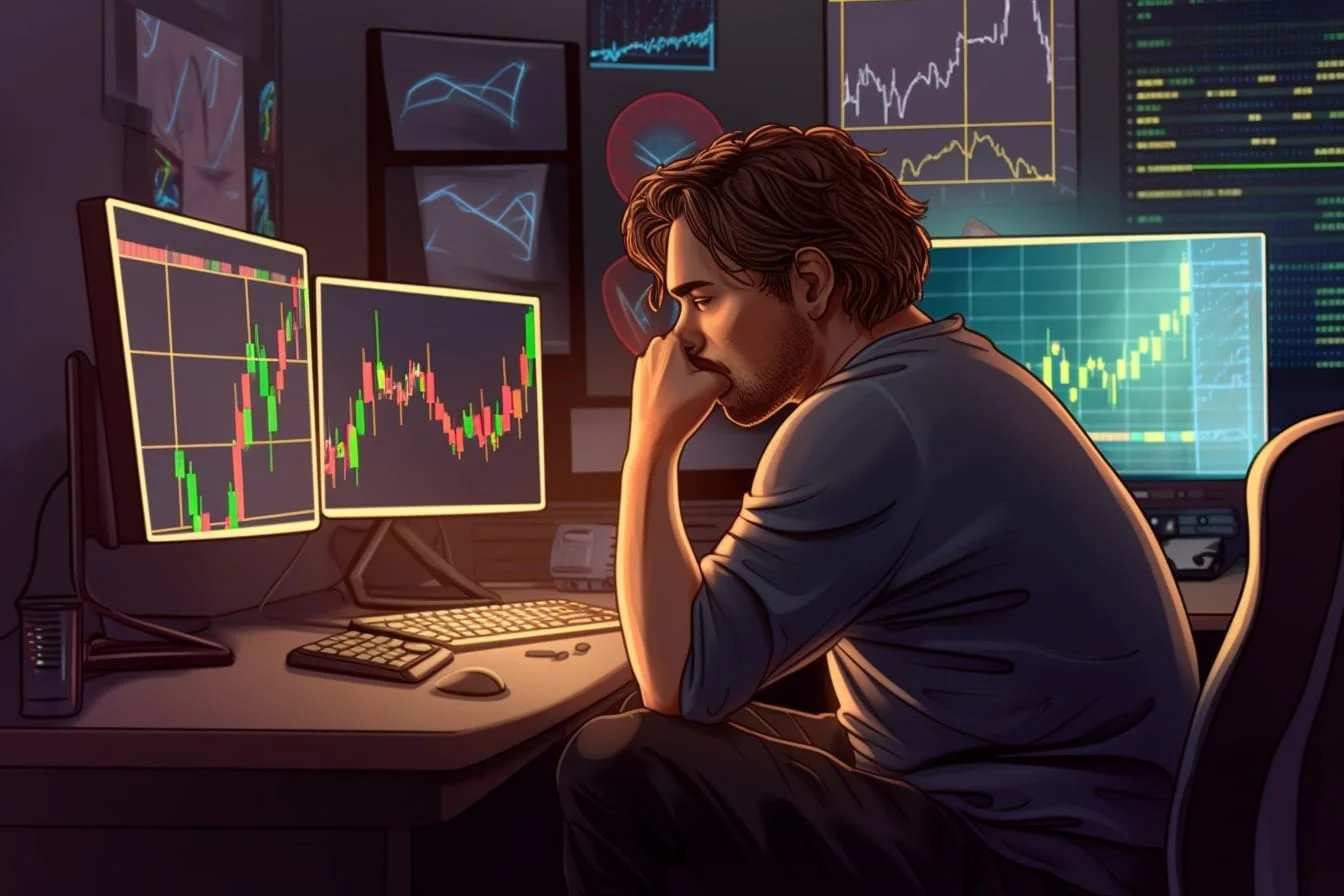
If you asked me to name the single most common reason profitable trading strategies turn into losing accounts, it wouldn’t be bad entries, poor risk management, or getting the direction wrong. It would be overtrading. Not because it’s the most dramatic way to lose money — revenge trading and leverage blow-ups get all the headlines — but because it’s the quietest. Overtrading doesn’t announce itself. It doesn’t feel like a mistake in the moment. It feels like being diligent, staying active, “putting in the work.” And that’s exactly why it’s so dangerous.
Here’s the uncomfortable truth: most traders would make more money if they made fewer trades. I’ve reviewed thousands of trading journals over the years, and the pattern is remarkably consistent. The top 20% of trades by quality produce all the profits. The bottom 50% collectively lose money and eat into those gains. Shrink the bottom 50% — or eliminate it entirely — and the same account with the same strategy suddenly looks very different on the bottom line.
Key Takeaways
- Overtrading turns winning strategies into losing accounts by generating excessive fees, spreading losses, and degrading decision quality through mental fatigue.
- The 24/7 nature of crypto markets removes natural circuit breakers — traders must build their own trading schedules and stick to them.
- Most overtrading comes from boredom, the dopamine hit of being “in a trade,” or the false belief that more screen time equals more profits.
- A simple pre-trade checklist and daily trade cap are the most effective defenses against the overtrading trap.
What Overtrading Actually Looks Like
Overtrading isn’t just “trading too much” — that definition is too vague to be useful. Let’s get specific. Overtrading typically falls into three patterns:
The first is frequency overtrading: you’re taking trades that don’t meet your criteria because you’re bored, anxious, or chasing a dopamine hit. The setup isn’t really there, but you find a reason to enter anyway. Maybe you drop down to a lower timeframe and suddenly “see” patterns that justify jumping in. Maybe you start trading pairs you don’t normally follow because your usual watchlist is quiet. These trades feel productive in the moment, but they’re statistically negative.
The second is position overtrading: you’re in too many positions simultaneously. Your attention is split across eight different coins, and when one of them starts moving against you, you miss it because you’re watching a different chart. Degraded monitoring leads to degraded exits, which leads to larger losses on trades that should have been small.
The third is size overtrading: similar to what happens with greed, you’re gradually increasing position sizes beyond what your system calls for. Maybe it started at 2% risk per trade, crept to 3%, then 5% after a winning streak. The system still “works” but the drawdowns are now mathematically unsustainable.
All three patterns share a common root: the trader has stopped following their own rules. The system they built — which presumably had a statistical edge — has been abandoned in favor of gut feel, and gut feel is terrible at probability math.

Free Crypto Signals Channel
 Free Telegram Channel
Why Crypto Makes Overtrading So Easy
Crypto markets are practically designed to encourage overtrading. Traditional markets have built-in circuit breakers: the stock market closes at 4 PM, futures have settlement periods, and forex at least slows down on weekends. Crypto never sleeps. At 3 AM on a Tuesday, there’s a meme coin somewhere pumping 400%, and FOMO doesn’t care that you should be unconscious.
Exchanges profit from your trading volume. Every UI decision — from the “Buy” button being more prominent than “Sell” to the default leverage settings to the push notifications about “BTC moving!” — is engineered to get you to place more orders. This isn’t a conspiracy theory; it’s basic business. Exchanges are brokers, and brokers make money on volume. Your long-term profitability is not their priority.
The social media layer adds another dimension. Crypto Twitter and Telegram are 24/7 hype machines. Every hour there’s a new narrative, a new “this is the one” coin, a new chart pattern that “can’t fail.” If you’re plugged into these feeds while trying to trade systematically, you’re bringing a rules-based approach to an information environment designed to override rules-based thinking.
Then there’s leverage. Crypto exchanges offer 50x, 100x, even 125x leverage on some platforms. At 100x, a 1% move against you wipes out your entire position. This creates a scenario where small, normal market noise generates outcomes that feel significant — forcing you to pay attention to movements that wouldn’t matter at all if you were trading spot with reasonable position sizes. High leverage doesn’t just amplify returns; it amplifies the perceived need to be constantly watching and reacting.
The Hidden Costs of Every Extra Trade
When traders think about the cost of a trade, they usually think about the spread and the exchange fee. On a major exchange, spot fees might be 0.1% per side. That’s $20 round-trip on a $10,000 position. Not nothing, but manageable, right?
The problem is that the visible cost is the smallest part. Let’s walk through what overtrading actually costs, trade by trade.
First, fees compound aggressively. If you’re making 10 trades per day instead of 2, that’s an extra 8 round-trips of fees. At 0.2% round-trip (0.1% each way), 8 extra trades per day on a $100,000 account base is $1,600 per day in additional fees. Over 250 trading days, that’s $400,000. You need to generate $400,000 in additional alpha just to break even on the extra activity. For context, beating the market by $400,000 annually on a $100,000 starting capital base requires a 400% return — before fees. Most professional fund managers celebrate 20%.
Second, every extra trade is a new opportunity to be wrong. If your strategy has a 55% win rate — which is excellent — there’s still a 45% chance any given trade loses. More trades mean more total losses, and those losses compound just like wins do. A strategy that makes 100 trades per month with a 55% win rate at 1.5:1 reward-to-risk will outperform the same strategy making 300 trades per month, because fees and slippage eat into the edge proportionally with volume.
Third, and this is the one nobody quantifies: mental fatigue. Decision-making is a finite resource — psychologists call this ego depletion. Every trade you evaluate, every entry you time, every position you monitor, every exit you execute — each one burns a little bit of your cognitive budget. By trade number eight of the day, you’re not making the same quality decisions you made on trade number one. The tenth setup might look identical to the first on the chart, but the person looking at it is cognitively diminished.
I’ve seen traders with profitable morning sessions give it all back — and then some — in the afternoon, purely because they kept trading past the point where their brain was still sharp. The solution isn’t to “try harder” to concentrate. The solution is to stop trading when the quality degrades.
How to Know If You’re Overtrading
Here’s a self-diagnostic. Answer honestly:
- Do you feel anxious or restless when you don’t have an open position?
- Do you find yourself scanning lower timeframes looking for “something happening” when your primary charts are quiet?
- Do you take trades that are “close enough” to your setup criteria but don’t actually meet them?
- Do you trade more actively after a loss, trying to “make it back”?
- Do you trade more actively after a win, riding the confidence high?
- Do your best P&L days correlate with fewer, higher-conviction trades?
If you answered yes to more than two of these, overtrading is almost certainly costing you money. The good news is that it’s one of the easiest problems to fix — not because the fix is easy psychologically, but because the fix is purely mechanical.
 Most Popular
- 2-5 Signals Daily
- 82% Success Rate
- Entry, Take Profit & Stop Loss
- Amount To Risk Per Trade
- Risk Reward Ratio


Building an Anti-Overtrading System
The solution starts with defining what a good trading day actually looks like. Most traders define it by P&L — “I made money, therefore it was a good day.” This is backwards. You can make money on a terrible process (getting lucky on a bad trade) and lose money on a great process (a well-executed trade that simply didn’t work out). P&L is the outcome; process quality is what you control.
Redefine a good trading day as one where you followed your rules. Period. Profit or loss is downstream of that. When process adherence becomes the goal, overtrading becomes obviously counterproductive — by definition, overtrading means violating your rule about how many trades to take. Here’s the practical system:
- Set a maximum number of trades per day. Start with three. Yes, three. Most traders react to this number with horror — “But what if a great setup appears after my third trade?” The answer: it goes in the journal as a missed opportunity for review. If your max-three-trades rule is consistently leaving money on the table because the fourth setup of the day is reliably profitable, you can bump the cap to four. But you must first prove that the cap is actually costing you money, which requires tracking for at least a month.
- Use a pre-trade checklist for every single entry. It doesn’t need to be complicated: (1) is the setup I see actually in my defined playbook? (2) is my stop placement valid based on market structure, not just my pain tolerance? (3) is my position size correct based on my risk model? (4) am I entering because of the chart, or because of an emotion? If you can’t answer all four clearly, you don’t take the trade.
- Schedule your trading sessions. Pick specific hours and stick to them. The market is open 24/7, but you shouldn’t be. I know traders who only trade the first two hours after the US market open and the London-New York overlap. That’s it. Outside those windows, charts are closed. Not “watching” — closed. They catch fewer trades but their win rate and risk-adjusted returns are higher than people who “monitor the markets” all day.
- Track your overtrading triggers. After a week of journaling, you’ll see patterns. Maybe you overtrade after checking Twitter. Maybe you overtrade when you’re tired. Maybe you overtrade specific pairs that you find “exciting” but actually have no edge in. Once you see the trigger, you can break the pattern.
The Boring Truth About Consistency
Here’s what nobody on Crypto Twitter will tell you: consistent trading is boring. The setups that work repeat in recognizable patterns. The process is mechanical. Good trading days feel almost routine. If you’re feeling adrenaline during your trading session, something is probably wrong.
The traders I know who have been profitable for years don’t have wild war stories. They don’t have “the trade that changed everything.” They have spreadsheets showing small, steady equity curves with controlled drawdowns. They treat trading more like operating a small business than like gambling — because that’s what it is.
Overtrading is a tax you pay to your own impatience. Every unnecessary trade makes your broker richer and your probability of long-term success lower. The fix isn’t complicated. Trade less, earn more. Your future self — the one looking at a retirement funded by compound returns rather than a blown account — will thank you.
Conclusion
Crypto overtrading is the silent killer of portfolios precisely because it doesn’t feel like a mistake in real time. It feels like working hard, staying engaged, maximizing opportunity. But the math doesn’t lie: more trades mean more fees, more losses, more mental fatigue, and a thinner edge. The 24/7 crypto market will always be there. Your capital won’t be, if you keep giving it away in small increments disguised as “activity.”
Cut your trade count in half for one month. Journal every trade — the ones you take and the ones you skip. At the end of the month, compare your P&L to the previous month. I’ve seen this single change turn unprofitable traders profitable and mediocre traders into consistently good ones. The edge you’re looking for might not be in a better entry strategy. It might be in doing less.
Educational content only. Not financial advice. Always do your own research.