


Polkadot’s Q1 Reality Check: Rising Tech, Falling Traction
Estimated Reading Time: 3 minutes
Don’t invest unless you’re prepared to lose all the money you invest. This is a high-risk investment and you are unlikely to be protected if something goes wrong. Take 2 minutes to learn more

In the first quarter of 2025, Polkadot showed a mix of progress and concern. A report by Messari revealed that the total transaction volume in the ecosystem dropped by nearly 37%, falling to 137.1 million. However, this decline wasn’t entirely negative; it was largely due to Neuroweb, a new upgrade that made processing more efficient.
To this end, despite the ecosystem-wide slowdown, certain projects such as Moonbeam, Mythos, and Peaq still showed strong growth. At the same time, the number of active users and developers dropped, and Polkadot’s native token, DOT, continued to lose value.
Network Activity Shows Growth in Pockets
Generally, the ecosystem had fewer transactions; some networks stood out. Moonbeam saw a 6.5% increase, handling 16.7 million transactions, which made up 12.2% of all activity. However, Mythos also grew by 12%, reaching 12.3 million transactions, while Peaq had the biggest jump, rising 84% to 10.1 million. These projects are helping keep momentum alive, even as the broader ecosystem sees a slowdown.
Polkadot also made efforts to improve the developer experience. The launch of the PAPI Console gave developers a simpler interface to work with, and a UX Audit Grants Program was introduced to fix user experience issues in various projects.
Even with these efforts, the number of active developers fell slightly, and weekly code contributions dropped by over 14%. This suggests that while tools are improving, developer engagement is still an issue.
Market Value and Confidence in Decline
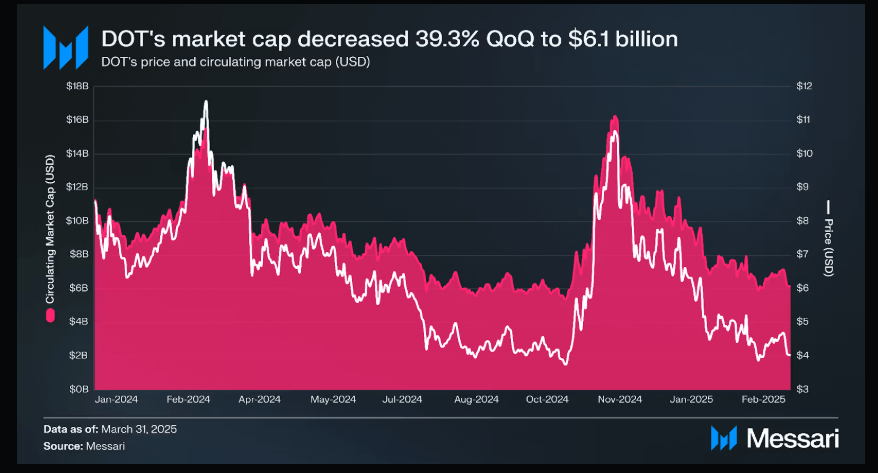
It is vital to note that during this period, DOT’s market value fell under $8 billion at the start of the quarter to $6.1 billion by March and further to $5.14 billion by late June. A known crypto trader, Nonzee, criticized Polkadot’s ecosystem for becoming what he called a “ghost chain.” He pointed to DOT’s price crash from $55 to about $3.30 and questioned how the treasury spent over $129 million without any clear return on investment.
Although he acknowledged that Polkadot’s technology had improved, Nonzee argued that tech alone isn’t enough without users or excitement in the market. He described Polkadot as having built a powerful Web3 engine with no real-world use yet. According to him, unless a breakthrough app emerges, Polkadot risks staying a strong but empty project, good in theory but missing real adoption.
In order to place winning trades with us via Bybit, you can open an account here.