


Is Sandwich Trading Smart Strategy or Market Exploitation?
Estimated Reading Time: 6 minutes
Don’t invest unless you’re prepared to lose all the money you invest. This is a high-risk investment and you are unlikely to be protected if something goes wrong. Take 2 minutes to learn more

-
blockchain trading tactic that exploits pending transactions to profit from short-term price movements on decentralized exchanges.
-
Traders place buy and sell orders around a victim’s trade, “sandwiching” it to capture value from the forced price shift.
-
While considered a trading strategy, it is widely viewed as MEV exploitation that results in worse trade execution for unsuspecting users.
Imagine placing a buy order on a decentralized exchange, only to discover you paid more than expected—not because the market suddenly moved, but because someone saw your transaction before it was confirmed and traded around it.
This practice, known as a sandwich attack, sits in one of crypto’s biggest gray areas. Some view it as a sophisticated trading strategy powered by blockchain transparency, while many others see it as an unfair tactic that quietly extracts value from unsuspecting traders.
Understanding how it works is the first step toward avoiding becoming its next victim.

How Does a Sandwich Attack Work?
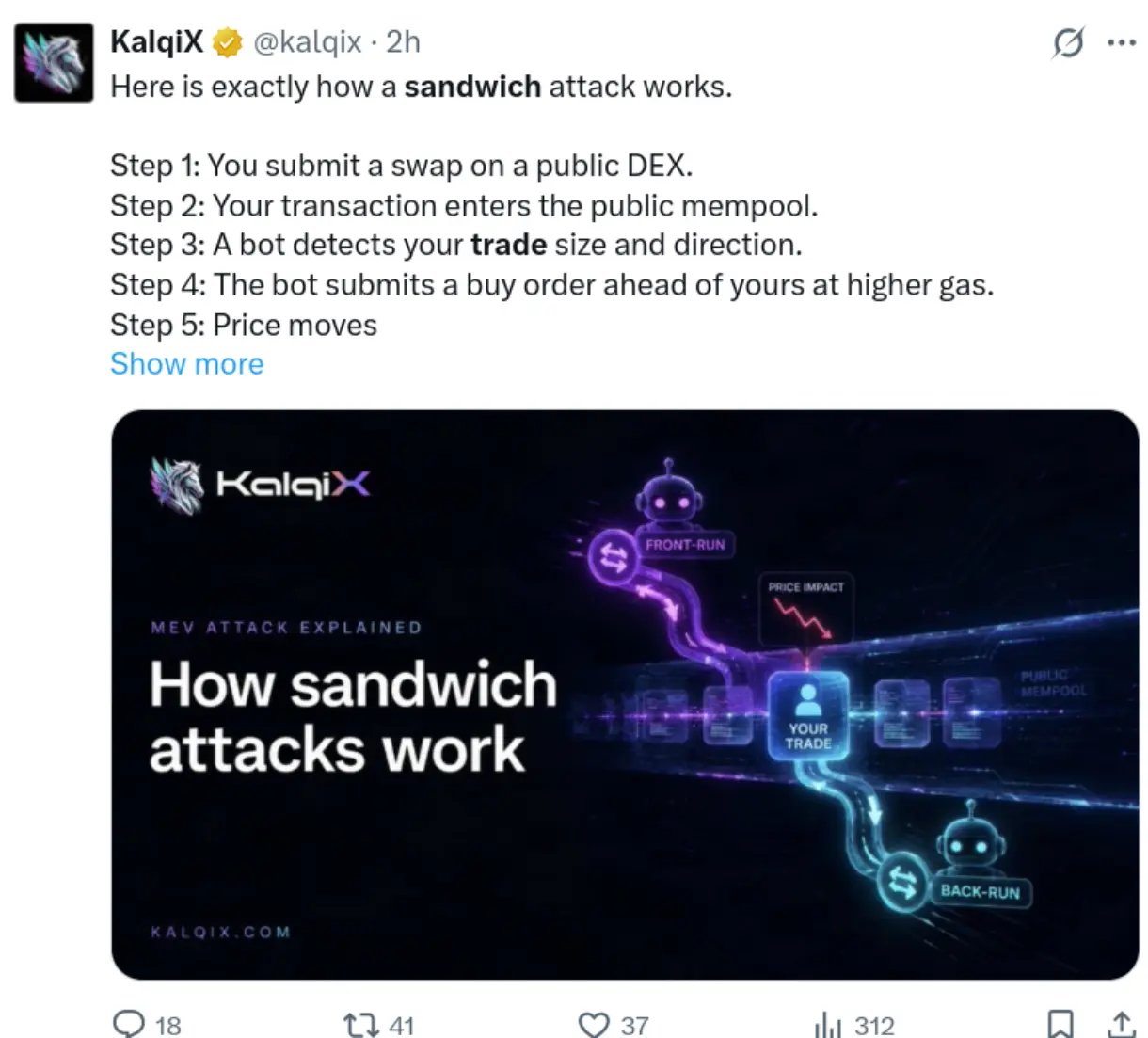
A sandwich attack begins when an automated bot scans the blockchain mempool for large pending transactions that are likely to move an asset’s price. Once it spots a suitable target, the bot quickly places a buy order ahead of the victim’s transaction, causing the token’s price to rise.
When the victim’s order is eventually processed, it executes at this inflated price, meaning they receive fewer tokens or pay more than expected. Immediately afterward, the bot sells the tokens it purchased earlier, locking in a profit from the temporary price increase it helped create.
In simple terms, the attacker profits by exploiting the price movement triggered by another trader’s transaction, while the unsuspecting trader bears the extra cost
Types of Sandwich Trades
-
Simple Sandwich Attack: The attacker targets a single pending transaction. They place a buy order just before it executes and a sell order immediately after, capturing a fast profit from the victim’s price impact.
-
Complex Sandwich Attack: High-speed trading bots target multiple pending transactions simultaneously. By stacking layered orders around a cluster of victims, attackers amplify price shifts to maximize profits across a broader range.

Risks Involved in Sandwich Trading
Although sandwich trading may look profitable on paper, it carries several serious risks that can quickly erase gains or lead to losses.
Execution Risk
Timing is everything. If the attacker’s transactions are not executed in the correct order, the strategy fails. A slight delay can cause the trade to become unprofitable or even result in losses.
High Competition
Sandwich opportunities are often detected by multiple bots at the same time. This creates intense competition, where only the fastest and most efficient systems succeed, leaving others with failed or front-run trades.
Gas Fee and Cost Pressure
On networks like Ethereum, high transaction fees can significantly reduce profit margins. In some cases, gas costs may exceed the profit gained from the sandwich trade.
Slippage and Price Reversal
Market conditions can shift unexpectedly. If the price moves against the attacker after entry, the expected profit disappears, or the position may close at a loss.
Transaction Failure Risk
Pending victim transactions may be canceled, replaced, or delayed. When this happens, the entire sandwich setup collapses mid-execution.
Regulatory and Ethical Risk
While not always clearly illegal, sandwich trading is widely considered a form of market exploitation (MEV activity). This exposes participants to future regulatory restrictions or platform-level bans as DEXs develop anti-MEV protections.
Protection Against Sandwich Attacks
Protecting against sandwich attacks mainly involves reducing how visible and predictable your transactions are before they are confirmed.
One effective method is using low slippage tolerance when placing trades. This limits how much price movement you accept, making it harder for bots to exploit your order.
Traders can also use MEV-protected or private transaction routes, which prevent pending transactions from being exposed in the public mempool where bots typically operate.
Avoiding large, sudden market orders and instead using smaller or split trades can also reduce the chance of being targeted.
In addition, some modern wallets and DEX aggregators now include built-in protections that detect and reduce exposure to sandwich attacks.
In essence, the goal is simple: reduce visibility, reduce predictability, and reduce exploitable trade size.
Key Takeaway
Sandwich trading exploits transaction transparency for profit at the expense of regular traders. While technically sophisticated, it is a form of value extraction that sits in a gray area between efficiency and exploitation.
As blockchain ecosystems evolve, new defenses are emerging to counter these practices. Ultimately, awareness is a trader’s best defense—understanding how sandwich attacks work is essential for avoiding them and making more informed trading decisions.