



Bitcoin Rallies Past $117K as Government Shutdown Sparks Safe-Haven Demand
Estimated Reading Time: 4 minutes
Don’t invest unless you’re prepared to lose all the money you invest. This is a high-risk investment and you are unlikely to be protected if something goes wrong. Take 2 minutes to learn more

Bitcoin pushed through the $117,000 barrier on October 1, 2025, hitting a two-week high as the US federal government shutdown triggered a flight to alternative assets.
The rally comes despite growing caution among traders who remember how the 2018 shutdown led to a significant sell-off.
The US Government Shutdown Angle
The 2018 government shutdown offers a cautionary tale. Bitcoin dropped 9% during that 35-day period, falling from $3,900 to $3,550.
Granted, the broader market context was different then. Stricter regulatory guidelines from the Financial Action Task Force had just been announced, creating additional headwinds.
Today’s environment differs in key ways. Bitcoin ETFs now manage nearly $147 billion in assets, providing institutional infrastructure that didn’t exist in 2018. Also, corporate treasuries continue accumulating Bitcoin as a reserve asset. This sustained demand could buffer against temporary economic weakness.
The Trump administration’s warning about potential mass layoffs adds uncertainty. Federal agencies activated contingency measures as hundreds of thousands of employees stayed home. Another Senate vote is scheduled, but resolution timing remains unclear.
Strong Bitcoin ETF Inflows Drive Momentum
US spot Bitcoin ETFs recorded $429.9 million in net inflows on September 30, marking the second straight day of gains.
BlackRock’s IBIT led the charge with $199.43 million, while Ark Invest’s ARKB added $105.74 million. Fidelity’s FBTC contributed another $54.7 million to the total.
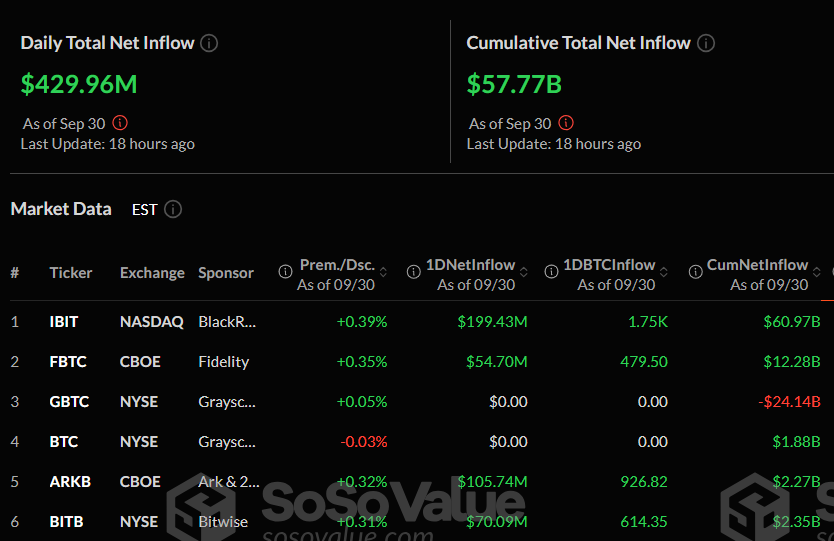
These inflows signal renewed institutional confidence in Bitcoin as a portfolio hedge.
The timing is notable too. Traditional safe-haven assets like gold also surged, reaching $3,895 per ounce. Meanwhile, yields on US 10-year Treasuries dropped, showing traders are accepting lower returns for perceived safety.
Historical Context and Price Targets for Bitcoin
CryptoQuant’s analysis suggests Bitcoin could reach $160,000 to $200,000 by year’s end if current demand trends continue. The firm points to several supporting factors.
First off, spot demand has climbed at a monthly pace exceeding 62,000 BTC since July. Next, whale holdings are expanding at an annual rate of 331,000 BTC, up from 255,000 in Q4 2024.
Importantly, October historically favors Bitcoin. The cryptocurrency has posted gains in 10 of the past 12 years during this month. Average returns for October sit at 29.9%, with November and December typically delivering even stronger performance.
Is it #Pumptober again?
Historically, $BTC prices have risen in October for 10 out of the past 12 years. pic.twitter.com/wTXKWKnENT
— Lookonchain (@lookonchain) October 1, 2025
However, near-term pullback risks remain. Several analysts expect Bitcoin to test the $111,000 to $112,000 range where unfilled CME futures gaps exist. These gaps have consistently been filled over the past five months, suggesting a brief correction could precede the next major move up.
What This Means for Traders
Bitcoin’s price action suggests it’s increasingly viewed as an independent hedge rather than simply following equity markets. The decoupling from traditional risk assets could strengthen Bitcoin’s appeal during periods of government uncertainty.
Standard Chartered Bank maintains its long-term forecast of $500,000 by 2028. That projection assumes expanding investor access and declining volatility. Bitwise and Fundstrat’s Tom Lee have also issued $200,000 year-end targets.
The current setup favors patience. Strong hands who weathered previous volatility typically came out ahead. With Q4 historically bullish and institutional money still flowing in, the risk-reward appears tilted toward higher prices over the next three months.
Interested in learning how to day-trade crypto? Get all the information you’ll need here.