


Cardano Gains Momentum as DeFi Growth Drive Expansion
Estimated Reading Time: 5 minutes
Don’t invest unless you’re prepared to lose all the money you invest. This is a high-risk investment and you are unlikely to be protected if something goes wrong. Take 2 minutes to learn more
Cardano has closed Q3 2025 with notable progress across multiple sectors, posting gains in DeFi activity, stablecoin adoption, and community-led governance.
The blockchain’s native token, ADA, climbed 41% during the quarter, reaching $1.02 and pushing the network’s market cap to $34.3 billion while maintaining its position as the 10th largest cryptocurrency by valuation.
DeFi Ecosystem Shows Strong Quarter-Over-Quarter Growth
According to a recent Messari report, Cardano’s decentralized finance sector expanded significantly, with total value locked (TVL) rising 28.7% to reach $423.5 million—the highest level recorded since early 2022.
This growth reflects increasing confidence in the network’s DeFi infrastructure and its ability to compete with established Layer-1 competitors.
Liqwid, the platform’s leading lending and borrowing protocol, emerged as Cardano’s largest DeFi application by TVL. The protocol’s total locked value jumped 50.8% to $101.6 million, capturing a 29.7% share of the network’s entire DeFi market.
The platform’s introduction of qTokens—interest-bearing assets that represent collateral in lending pools—helped drive this expansion.
Meanwhile, Minswap remained the dominant decentralized exchange, accounting for 74.7% of total DEX trading volume despite a 22.3% decrease in TVL to $53.4 million.
Other protocols showing growth included DJED, the algorithmic stablecoin, which expanded 38% to $25.5 million in TVL, and Splash Protocol, which saw its average daily volume surge 42.8% to roughly $424,833.
Stablecoin Market on Cardano Expands as Payment Options Multiply
The stablecoin sector on Cardano grew 21.5% during Q3, with total market capitalization reaching $38.1 million. USDM held the largest share at 33.9% with $12.9 million in circulation, followed by USDA at 27.2% with $10.4 million.
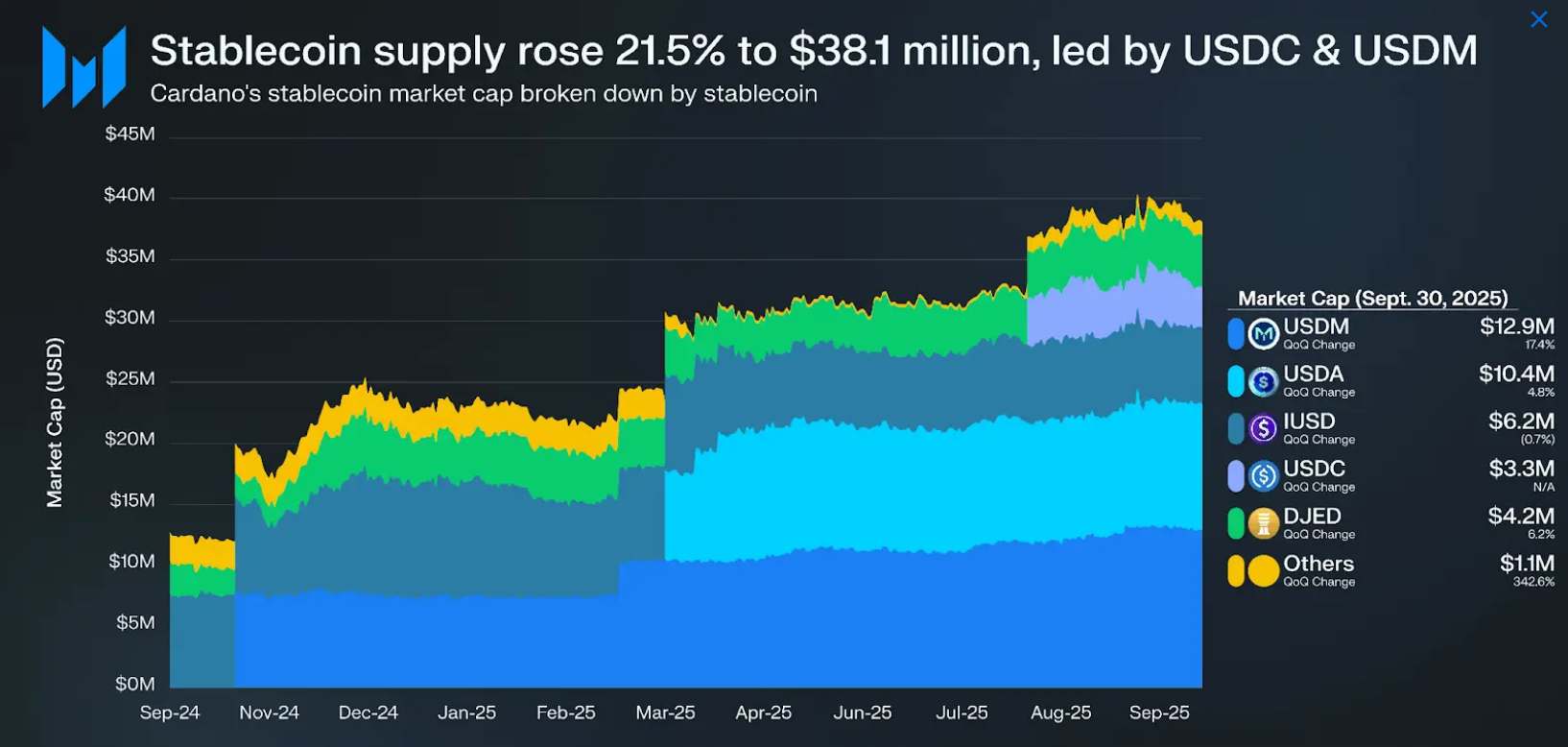
A significant development came with USDC’s arrival on Cardano through cross-chain bridges, ending its first quarter with $3.3 million in liquidity and capturing 8.6% market share.
This stablecoin growth sets the stage for Cardano’s upcoming payment infrastructure. In November 2025, EMURGO announced the Cardano Card—a crypto debit card developed in partnership with Wirex.
We’re excited to announce our strategic partnership with@emurgo_io to issue the first-ever @Cardano Card! 💳
The @cardano_card is designed to empower the Cardano community with real-world spending options, allowing $ADA to be used effortlessly for everyday purchases. pic.twitter.com/V5fRGi8tdo
— Wirex (@wirexapp) November 11, 2025
The card will support over 685 cryptocurrencies across multiple chains, offering up to 8% crypto cashback, low foreign exchange fees, and DeFi features, including yield generation and crypto-backed loans.
The product targets a Q4 2025 launch, with plans to direct a portion of profits to the Cardano Treasury for network development.
Cardano Governance Reaches Full Decentralization
Cardano achieved a major milestone in September 2025 by electing its first fully community-driven Constitutional Committee.
Seven members took office through on-chain voting, replacing the interim committee that included founding organizations like Input Output Global, EMURGO, and the Cardano Foundation.
This transition completed Cardano’s shift to community-led governance under the Voltaire phase of its roadmap.
The network also implemented a smart contract framework for treasury management, developed by Intersect in collaboration with Sundae Labs.
This system automates fund disbursements for community-approved projects, replacing manual processes with transparent, auditable code execution.
An independent Oversight Committee now monitors all transactions to verify accuracy and alignment with governance decisions.
In August, the community approved its first core protocol development funding. It allocated 96 million ADA (approximately $71 million) to support infrastructure upgrades, including Ouroboros Leios, Hydra scaling solutions, and Mithril enhancements.
Cardano’s Technical Advances Support Privacy and Scalability
Input Output Engineering released the Halo2-Plutus verifier in August, enabling Cardano smart contracts to verify zero-knowledge proofs directly on-chain.
This capability opens doors for privacy-preserving applications and strengthens integration with Midnight, Cardano’s privacy-focused partner chain.
Looking ahead, Cardano’s roadmap includes continued expansion of its DeFi liquidity, real-world asset tokenization initiatives, and the mainnet launch of Midnight—which distributed over 2.7 billion NIGHT tokens to more than 125,000 wallets during its initial claim phase.
Interested in learning how to day-trade crypto? Get all the information you’ll need here.