


Crypto Isn’t Late—It’s Following the Same Road E-Commerce Took
Estimated Reading Time: 4 minutes
Don’t invest unless you’re prepared to lose all the money you invest. This is a high-risk investment and you are unlikely to be protected if something goes wrong. Take 2 minutes to learn more

- Crypto payments mirror early e-commerce, says Ripple executive.
- Stablecoins and infrastructure are driving adoption.
- Crypto’s long-term potential may be underestimated.
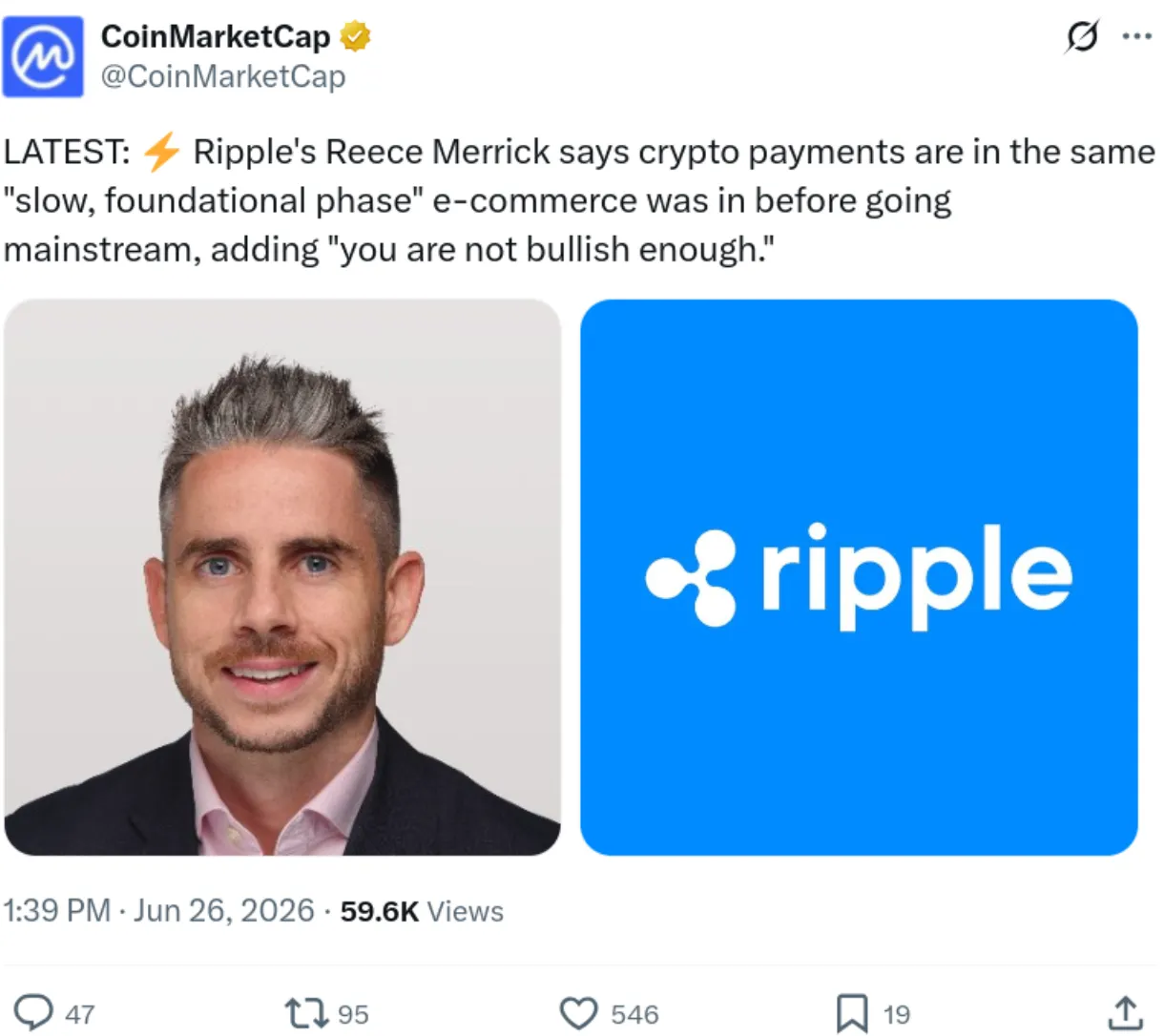
Twenty-five years ago, buying anything online sounded risky. Many people refused to enter their credit card details on websites, believing internet shopping was a fad. Today, more than one out of every five retail dollars is spent online. Ripple executive Reece Merrick believes crypto payments are standing at a similar turning point.
The Digital Evolution: Mirroring the Early Internet Stage
To understand where cryptocurrency is today, we only need to look back at the internet in 2000. At the turn of the millennium, e-commerce was met with deep skepticism. Internet speeds were painfully slow, payment gateways were in their infancy, and the concept of smartphones didn’t even exist. Because the infrastructure was clunky and unfamiliar, the average person simply didn’t trust online payments, and traditional merchants rarely bothered to sell online.

Today, cryptocurrency is navigating that exact same maturity curve. For many users, managing digital wallets still feels confusing and intimidating, while global regulatory frameworks are still evolving to catch up with the tech.
However, just like the early web, the foundational infrastructure is rapidly improving behind the scenes. Businesses are steadily integrating digital assets into their models, and the rise of stablecoins is finally providing a practical, stable bridge for everyday use. What feels complex today is simply the groundwork being laid for tomorrow’s mainstream adoption
The Hidden Lesson: Bet on the Builders
The most critical takeaway from the internet revolution is often the most overlooked: the ultimate winners weren’t the flashy, first-generation websites. Instead, the real fortunes were made by the companies that built the invisible infrastructure making the ecosystem viable.
E-commerce couldn’t truly thrive until broadband internet and smartphones made connectivity seamless, while payment processors, cloud computing, and advanced logistics networks made global commerce secure and reliable.
Today, crypto is quietly undergoing the exact same foundational shift. The future giants won’t just be the speculative tokens but the entities building the plumbing of the new financial system.
We are seeing this happen in real-time through the rapid rise of stablecoins and Layer-2 scaling networks that make transactions cheap and fast. Combined with user-friendly wallets, regulated exchanges, robust compliance tools, and seamless cross-border payment systems, the critical infrastructure is finally locking into place to support mass adoption.
What this means for investors
If Merrick’s comparison is correct, investors shouldn’t focus only on coin prices.
Investors should watch whether the infrastructure continues improving. Infrastructures such as
- merchant adoption
- stablecoin growth
- payment integrations
- easier user experiences
- clearer regulations
Those factors could determine whether crypto payments follow the same trajectory as online shopping. At the same time, it’s important to note that Merrick’s view is a forward-looking opinion rather than a certainty.
Key Takeaway
History shows that transformative technologies often spend years looking unimpressive before reaching mainstream adoption. Whether crypto payments repeat the e-commerce story remains uncertain, but the comparison reminds investors to pay attention not only to prices but also to the infrastructure quietly being built beneath the surface.