


Stablecoin Adoption Rises as Global Regulations Take Shape
Estimated Reading Time: 4 minutes
Don’t invest unless you’re prepared to lose all the money you invest. This is a high-risk investment and you are unlikely to be protected if something goes wrong. Take 2 minutes to learn more
The stablecoin market is experiencing significant changes as countries worldwide establish clearer rules, potentially setting the stage for wider use of these digital assets tied to traditional currencies.
In Europe, Markets in Crypto-Assets (MiCA) regulations that began in June 2024 are nearing completion this month, according to the latest Kaiko Research findings. These rules have already caused notable shifts in the European stablecoin market, particularly for euro-backed tokens.
Meanwhile, the United States Senate is set to vote on March 12 on the Genius Act, a bill that would impose regulations on stablecoins similar to those for traditional financial institutions. If passed, this legislation could encourage more institutional participation in the stablecoin market.
In Southeast Asia, Thailand’s Securities and Exchange Commission recently granted approval for USD₮ (Tether) as an officially recognized cryptocurrency. This decision, effective March 16, 2025, allows USD₮ to be traded on regulated exchanges and used for payments within the country.
“We highly value the Thai market and are continuously exploring ways to enhance our services and offerings,” said Paolo Ardoino, CEO of Tether, following the announcement.
Thailand has positioned itself among the top 20 countries globally for crypto adoption, with stablecoins accounting for around 40% of trading volumes.
Shifting Market Dynamics
Despite improving regulatory clarity, stablecoin dominance has weakened since November 2024, with overall market share relative to fiat declining from 84% to 77%.
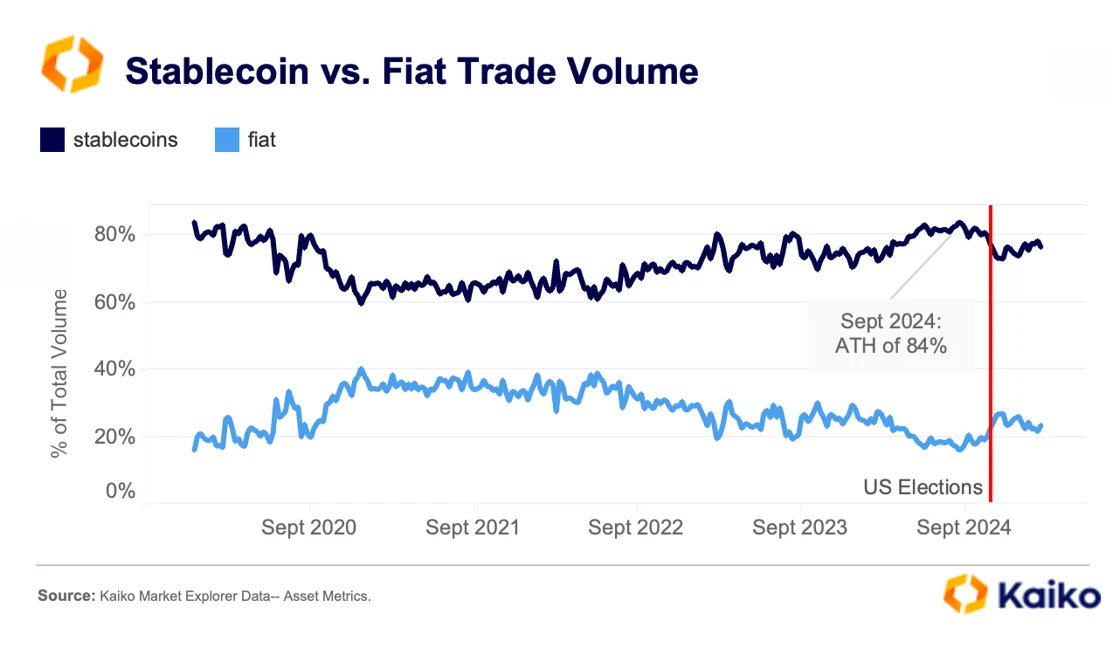
This decline is primarily attributed to USDT’s falling dominance, while other stablecoins are gradually gaining ground. The market capitalization of top stablecoins has increased by $45 billion since the November 2024 U.S. elections.
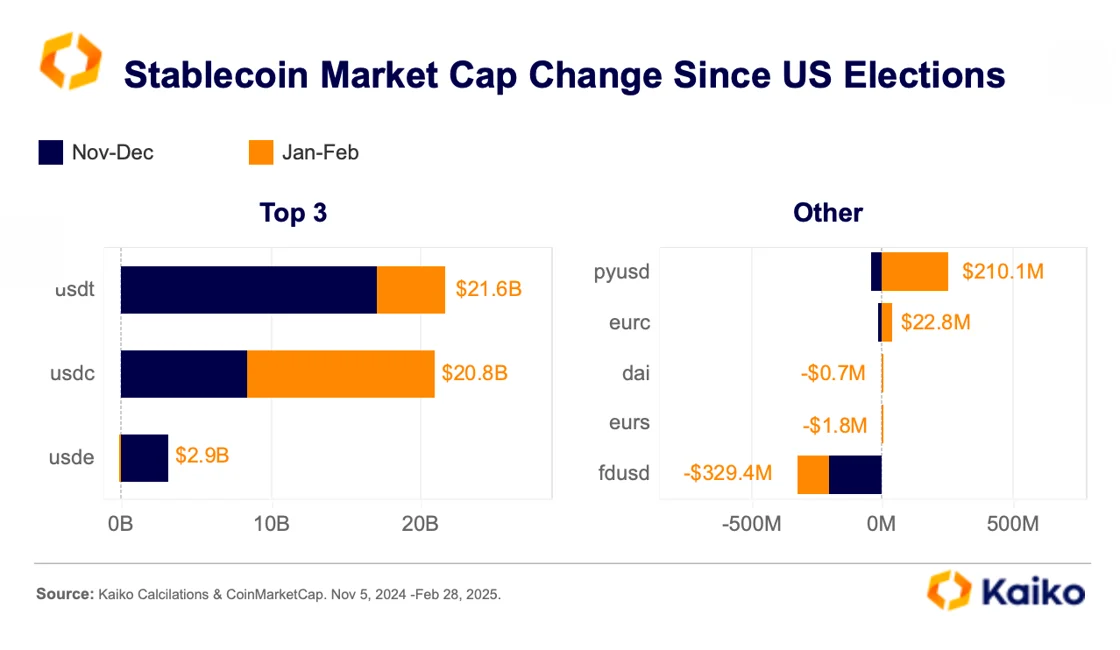
However, growth patterns vary significantly among different tokens:
- Regulated stablecoins like USDC, PYUSD, and EURC have shown steady growth throughout 2025
- USDT’s growth was concentrated between November and December 2024
- Some smaller stablecoins like DAI and EURS have experienced slight declines
Regional Trends and Use Cases for Stablecoins
Regional analysis reveals distinct patterns in stablecoin adoption:
- In South Korea, stablecoin-related trades have reached an all-time high, accounting for about 17% of all volume on major exchanges Bithumb and Upbit by February 2025
- Korean traders turned to stablecoins amid political instability following the December martial law crisis
- In Brazil, a proposed ban on self-custodial stablecoins has led to increased selling, with USDT-BRL showing negative volume despite the Brazilian Real weakening against the dollar
- Turkey continues to show strong USDT demand, likely due to its persistently high inflation rates compared to other countries
Trading Patterns and Market Structure
While Bitcoin and Ethereum trading pairs are almost evenly split between fiat currencies and stablecoins, altcoins are primarily traded against stablecoins. Recent volatility in altcoin markets has negatively impacted stablecoin demand, both as trading intermediaries and for leverage.
Altcoin volatility surged in March 2025, with Cardano (ADA) reaching an all-time high of 150% volatility, while Solana (SOL) and XRP exceeded 100%. Bitcoin’s volatility remains relatively lower at 50%, still below historical peaks.
Future Outlook of Stablecoins
As regulations become clearer, stablecoin adoption is expected to increase in the medium term. However, demand remains tied to cyclical patterns in crypto markets, especially in altcoin trading.
The growing recognition of stablecoins by regulators like Thailand’s SEC marks a significant step toward mainstream adoption. This trend, coupled with increasing market capitalization, suggests stablecoins will continue to play a crucial role in bridging traditional financial systems and digital economies despite recent market fluctuations.
Interested in learning how to day trade crypto? Get all the information you need here