


What You Need to Know about Polymarket as an Investor
Estimated Reading Time: 5 minutes
Don’t invest unless you’re prepared to lose all the money you invest. This is a high-risk investment and you are unlikely to be protected if something goes wrong. Take 2 minutes to learn more
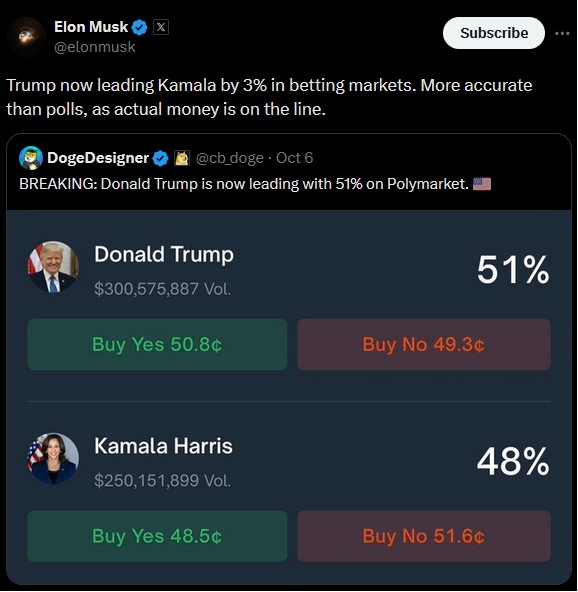
A polymarket is a type of “prediction market,” which essentially functions as a betting platform. It gained widespread attention during the U.S. presidential election, allowing users to wager real money (via the USDC stablecoin) on various outcomes. These bets aren’t limited to politics; participants can stake funds on topics as diverse as the next James Bond actor, whether the U.S. will confirm alien existence, or if Bitcoin will hit $250,000.
Polymarket has achieved cultural significance, frequently cited in mainstream media and praised by figures like Elon Musk, who argued it provides more accurate insights than traditional polling due to the financial stakes involved. Built on the Polygon blockchain, Polymarket is among the first mainstream cryptocurrency applications of its kind.
Understanding How Polymarket Operates
Polymarket’s betting mechanics are straightforward, resembling sports betting but simpler. Users buy “shares” of a particular outcome, priced between $0 and $1. This price represents the market’s estimated probability of that event occurring. If the outcome is realized, each share pays out $1; if not, shares pay $0.
For instance, imagine a Polymarket bet on whether it will rain tomorrow:
– “Yes” shares are priced at $0.70, indicating a 70% estimated chance of rain.
– “No” shares are priced at $0.30.
If you purchase 10 “Yes” shares:
– Cost: 10 x $0.70 = $7.00 (Your investment is $7.00)
– If it rains: Your payout is 10 x $1 = $10.00 (Profit: $3.00)
– If it doesn’t rain: The payout is $0 (Loss: $7.00).

Gambling vs. Investing
Gambling is often criticized for offering the illusion of easy gains. With the odds in favor of the “house,” gambling can be both highly addictive and financially devastating for some, ultimately generating no real value (unless one counts the fleeting entertainment of a win).
Investing, on the other hand, is valued because it supports essential companies that develop products and services society relies on. By investing, we pool resources to fuel growth and create meaningful value, benefiting both investors and the broader community.
Currently, everyone is discussing Polymarket, yet few are mentioning its blockchain foundation. Media giants like CNN and Fox News frequently cover it without focusing on its cryptocurrency roots. This marks a breakthrough moment; blockchain is finally mainstream.
This also suggests that Polymarket offers smart investment opportunities behind the scenes if one knows where to look.
Exploring Investment Opportunities in Polymarket
Polymarket operates on the Polygon (POL) network, one of Ethereum’s (ETH) most widely used layer-2 solutions. By leveraging Polygon, Polymarket’s smart contracts—facilitating thousands of rapid bets globally—can be executed with greater speed and reduced costs compared to the main Ethereum blockchain.
Currently, there’s no dedicated Polymarket token (a launch that would generate significant excitement), but investors can buy and hold POL, the core asset of Polygon’s platform. Alternatively, one could hold ETH, the foundational layer underpinning Polygon and Polymarket.

The technology behind Polymarket is impressive. By connecting a crypto wallet to Polymarket, users can deposit USDC into the platform. When shares are purchased, the platform generates ERC-20 tokens specific to each outcome, minting or burning these tokens as trades occur.
To put it another way, each bet is represented by outcome-specific tokens minted as NFTs, backed by USDC. If you place a bet on the year’s highest-grossing movie, for instance, your NFT could represent “Inside Out 2” or “Deadpool 3.” This NFT can either be redeemed for winnings or lose its value entirely, depending on the outcome.
How Polymarket Determines Outcomes
On Polymarket, outcomes are verified through a community-driven process. To propose a resolution, a user must stake a $750 bond. For the next two hours, others have the opportunity to challenge this proposal. If no challenges arise, the proposer is rewarded with $5, bets are settled, and the market is closed.
But what if you believe the outcome is incorrect? If an outcome is ambiguous, any user can dispute it by staking their own $750 bond. This then escalates the matter to a human vote via the Universal Market Access (UMA) protocol, where UMA token holders, acting like an impartial jury separate from Polymarket, vote to determine the final result.

If the proposer’s resolution stands, they reclaim their $750 bond plus an additional $250 from the challenger’s bond. This system discourages “sore loser” disputes by making them costly—if you dispute and lose, you forfeit even more funds.
Conclusion
Consider investing in assets connected to the broader gambling ecosystem. For example, you could invest in Allegiant Stadium or the Las Vegas Raiders, as they’re bound to attract large audiences of gamblers who follow football. Alternatively, Las Vegas real estate could be promising, given the influx of homebuyers and retail demand driven by the gambling industry.
With Polymarket, there’s no direct investment option—yet you can invest indirectly by holding Polygon (POL) or Ethereum (ETH). Since a portion of each Polymarket transaction flows through both POL and ETH, hearing Polymarket discussed in the media could feel even more rewarding, as you can say, “I own a piece of that.”