The Best Cryptocurrency Companies Generating the Highest Income
Estimated Reading Time: 5 minutes
Don’t invest unless you’re prepared to lose all the money you invest. This is a high-risk investment and you are unlikely to be protected if something goes wrong. Take 2 minutes to learn more

Savvy cryptocurrency investors often start by asking a fundamental question: Is this cryptocurrency company making a profit? To evaluate potential cryptocurrency investments, key metrics such as revenue, fees, market capitalization, and daily active users (DAUs).
This guide focuses on cryptocurrency companies that are currently leading the way in terms of revenue generation.
Definition of Income and How Cryptocurrency Companies Generate It
Given the rapidly evolving nature of the cryptocurrency industry, the term “revenue” can be interpreted in many different ways. Revenue refers to the total accumulated fees of the cryptocurrency business. This revenue usually comes from various transaction fees, such as:

Network Fees: Paid by users to miners or validators to facilitate transaction approval.
Trading Fees: Charged to users when trading tokens on decentralized exchanges (DEX) like Uniswap.
Lending fees: Collected from borrowers on decentralized finance (DeFi) lending platforms such as Aave and Compound.
Mintage Fees: Occurs when new NFTs are minted.
While some fees are redistributed to users or network participants, a portion is retained by cryptocurrency businesses to finance their operations, project growth, or future innovation. This retained portion is what we call “income.”
Top Three Cryptocurrency Companies With the Most Income
Ethereum
Source of Revenue: Ethereum’s revenue comes primarily from network fees, commonly known as gas fees. These fees are generated by layer 2 solutions built on the Ethereum blockchain, with these often substantial additional fees.
In 2021, Ethereum implemented the EIP 1559 update, which fundamentally changed the way gas fees are calculated and managed. This system now determines fees based on block capacity and user-defined maximum fees, replacing the previous sales model.

Ethereum’s daily revenue climbed to more than $35 million in March 2024, driven by an increase in DeFi and NFT activity in the first quarter. The growing popularity of memecoins has also contributed to this increase in revenue by increasing transaction volumes in the network.
Ethereum revenue trends are closely related to price movements and overall market capitalization.
Tron
Revenue Source: Tron generates revenue by charging fees for TRX transactions, which are then burned to create a deflationary effect on the token supply.
Launched in 2017 by Justin Sun, a fantastic crypto entrepreneur known for high-profile stunts like spending $4.05 million for a charity dinner with Warren Buffett, Tron mainly targets the Asian market as an alternative to Ethereum.
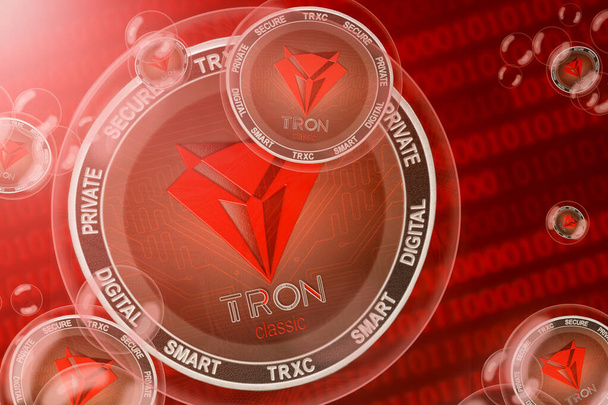
Tron runs on a proof-of-stake (DPoS) delegated consensus algorithm, known for its efficiency, but often criticized for its centralization. Currently, Tron is ranked as the 14th largest blockchain network in the world.
With more than $9 billion in total value locked (TVL), Tron is the second largest player in decentralized finance (DeFi), behind Ethereum. However, its ecosystem remains relatively isolated, with nearly $7 billion of its TVL concentrated in its lending platform, JustLend.
Sky (formerly MakerDAO)
Source of revenue: Sky generates revenue through several channels, including interest paid on loans, fees from liquidated collateral, and fees that help keep the exchange rate of its currency, the USDS (formerly DAI), stable.
As one of the leading decentralized finance (DeFi) platforms, Sky holds more than $9 billion in crypto assets in its smart contracts. It runs on Ethereum, and it works as a lending platform and a currency system, issuing its own stablecoin backed by the US dollar, USDS.
Sky’s daily earnings are usually below $1 million, although it occasionally sees increases exceeding $1 million and even surpassing $10 million. Interestingly, this revenue metric shows little correlation with the price of the governance token, SKY. However, Sky’s revenue is closely tied to Ethereum’s performance, as it is built on the Ethereum blockchain. Therefore, investors studying Sky should also consider Ethereum (ETH) as part of their analysis.
Conclusion
Projects with high revenue streams, such as Ethereum and Solana, show high demand and practical use, indicating their potential for long-term sustainability and growth.
However, a complete analysis of a cryptocurrency investment must also consider essential metrics such as daily active users (DAU), daily active developers, and total value (market cap).
For a deeper look at these factors, check out our detailed sections on DAU, Revenue, Daily Active Developers, and Market Cap. Gaining a solid understanding of these metrics is essential to making informed and strategic crypto investment decisions.