


Hyperliquid Faces Technical Challenges Amid Record Growth
Estimated Reading Time: 5 minutes
Don’t invest unless you’re prepared to lose all the money you invest. This is a high-risk investment and you are unlikely to be protected if something goes wrong. Take 2 minutes to learn more

Hyperliquid, the leading decentralized perpetual futures exchange, experienced significant technical difficulties this week that highlighted both its rapid growth and infrastructure limitations.
The platform, built on its own high-performance Layer 1 blockchain called HyperEVM, suffered a 37-minute outage on Tuesday (July 29) that exposed critical weaknesses in its API server architecture.
The Technical Breakdown
The outage began at 14:10 UTC when traders started reporting failed order executions across the platform.
Unlike typical blockchain issues, Hyperliquid’s core infrastructure continued operating normally—blocks were produced at regular intervals and the consensus mechanism remained stable.
The problem centered specifically on API servers that handle order routing between users and the blockchain.
During the downtime, price discrepancies emerged as traders couldn’t close positions. Ethereum prices diverged by approximately $9 on the platform compared to other exchanges.
This price deviation demonstrates how API failures can create isolated market conditions even when the underlying blockchain functions properly.
The technical root cause was straightforward: API servers couldn’t handle a sudden traffic surge.
However, the platform’s status page initially failed to reflect these issues, leaving users confused about whether their transactions were processing. Many orders were actually sent to the blockchain’s memory pool successfully but API servers returned error messages, creating false failure signals.
Bad news: the Hyperliquid API is down
Good news: Hyperliquid appears to still be producing blocks
Bad news: you cannot short HYPE because all frontends are down
Good news: you also cannot get liquidated because the API is down (i actually don’t know if this is true) pic.twitter.com/NmIeD2kx98
— Luke Cannon (@lukecannon727) July 29, 2025
Recovery and Compensation Plans for Hyperliquid
Hyperliquid’s response to the outage demonstrates mature crisis management. The team confirmed the issue stemmed from traffic spikes rather than security breaches or exploits, which helped maintain user confidence.
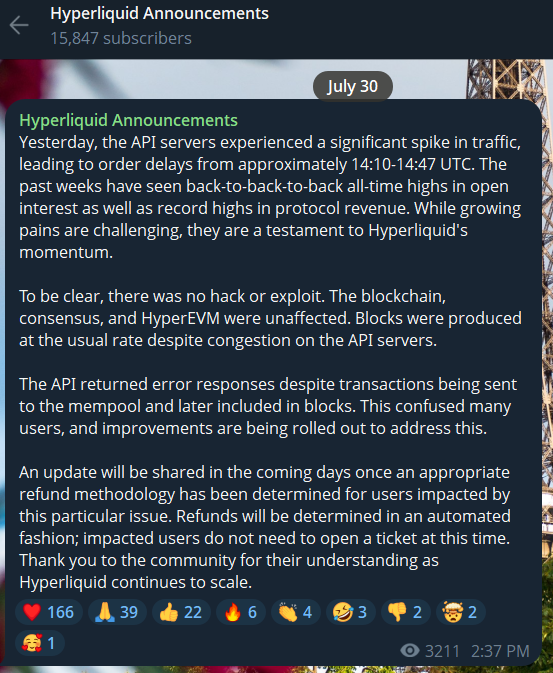
They’ve implemented additional monitoring systems to detect similar API bottlenecks before they impact trading.
More importantly, the platform announced automated refund plans for affected users. Rather than requiring manual claims, the system will identify impacted trades and issue compensation automatically.
This approach reduces friction for users while acknowledging the platform’s responsibility for service disruptions.
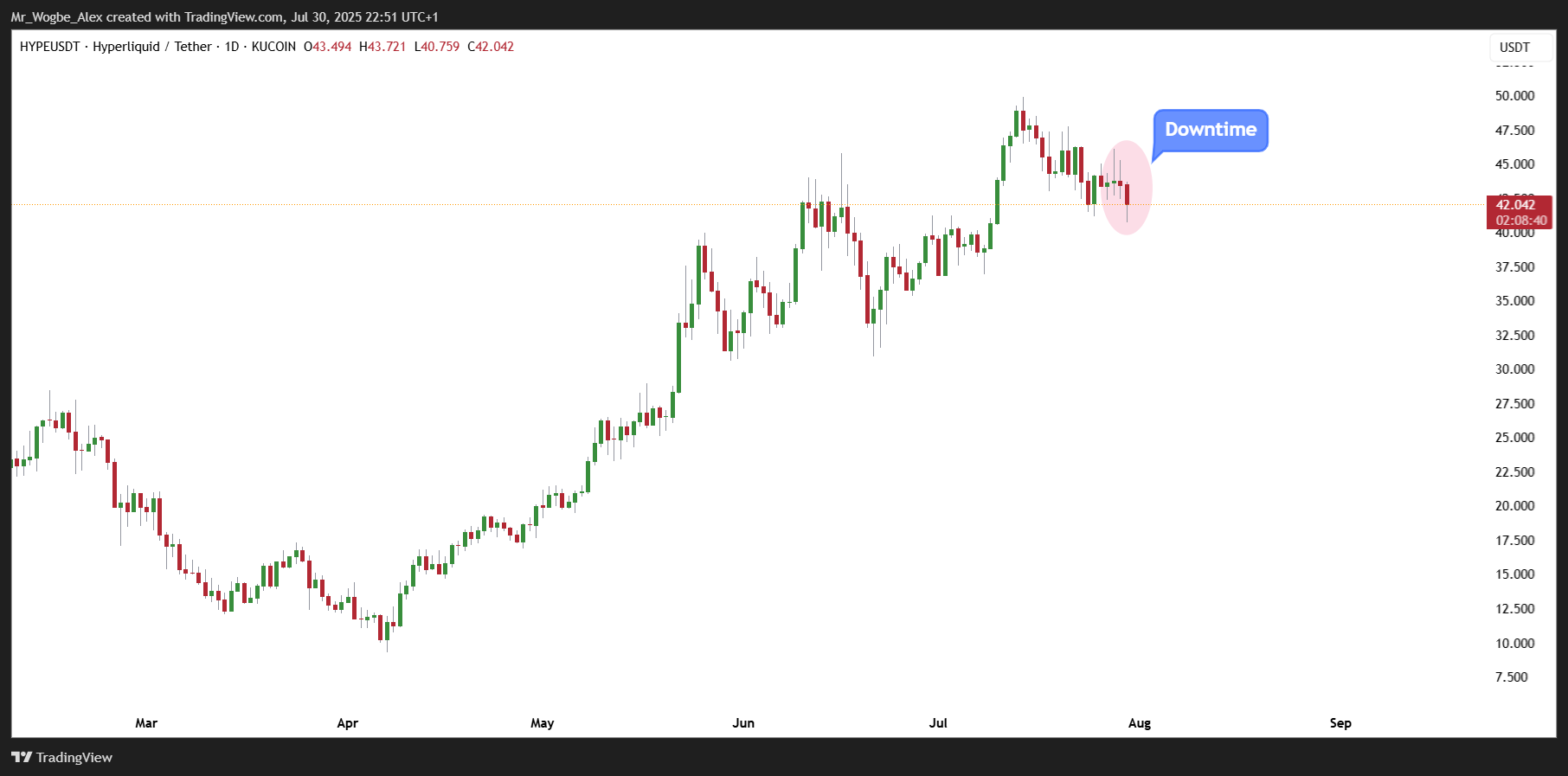
The native HYPE token dropped 3.75% to $43 during the outage but has since stabilized around $42.00, suggesting markets view this as a temporary technical issue rather than a fundamental problem.
Infrastructure Scaling Challenges
This incident illustrates broader challenges facing decentralized exchanges as they scale. While blockchain infrastructure can handle high throughput, auxiliary systems like APIs, user interfaces, and order management often become bottlenecks first.
Hyperliquid’s experience mirrors growth pains seen across DeFi protocols. The platform’s success in capturing market share has outpaced its infrastructure development, creating pressure points that only emerge under peak load conditions.
The quick resolution and transparent communication suggest Hyperliquid is prepared to address these scaling challenges as trading volumes continue expanding toward traditional exchange levels.
Hyperliquid’s USDC Dominance and Market Position
Despite the technical setback, Hyperliquid’s market fundamentals remain robust. USDC deposits on the platform have reached $4.9 billion, more than doubling since January.
This growth reflects increasing confidence in decentralized derivatives trading, where USDC serves as the primary settlement currency.
The platform now processes 11.5% of Binance’s trading volume, a remarkable achievement for a decentralized exchange. July alone saw over $150 billion in trading volume, indicating sustained institutional and retail interest despite centralized exchange competition.
Hyperliquid commands 83% market share within the on-chain perpetuals sector, establishing clear dominance in decentralized derivatives. This concentration suggests network effects are strengthening as liquidity gravitates toward the most active venue.
Interested in learning how to day-trade crypto? Get all the information you’ll need here.