



Stablecoin Growth Accelerates Across Africa as Remittances Overtake Aid
Estimated Reading Time: 3 minutes
Don’t invest unless you’re prepared to lose all the money you invest. This is a high-risk investment and you are unlikely to be protected if something goes wrong. Take 2 minutes to learn more

Stablecoin growth in Africa is expanding rapidly as individuals and businesses seek faster and more affordable ways to send money across borders. Speaking at the World Economic Forum in Davos, Switzerland, economist Vera Songwe stated that remittances and protection against inflation are now the main reasons Africans are turning to stablecoins.
In addition to this statement, she explained that stablecoins are becoming a practical alternative to traditional financial systems that remain costly and slow across continents.

Source: WEF
Remittances and Inflation Drive Stablecoin Growth
Songwe told participants at the Davos panel that money sent home by Africans living abroad has become more significant than foreign aid for many economies. To this, she said traditional remittance services in Africa often charge fees of around $6 for every one hundred dollars transferred, while also taking several days to complete transactions.
Meanwhile, the analyst has said that stablecoins are reducing both costs and waiting times. Additionally, she raised a point that small and medium-sized enterprises are the main users of these digital assets. This shows that stablecoins are supporting everyday business activity rather than speculative trading.
As it stands, Songwe has highlighted Egypt, Nigeria, Ethiopia, and South Africa as the highest users of Stablecoins.
To this end, she was able to justify her statement that these nations face challenges such as high inflation or strict capital controls, making stablecoins the only means of preserving value and accessing global markets.
African Governments Respond as Crypto Use Expands
According to a recent Chainalysis report on Sub-Saharan Africa, it was revealed that over two hundred and five billion dollars in on-chain transactions were made between July 2024 and June 2025. This represents a year-on-year increase of about fifty-two percent.
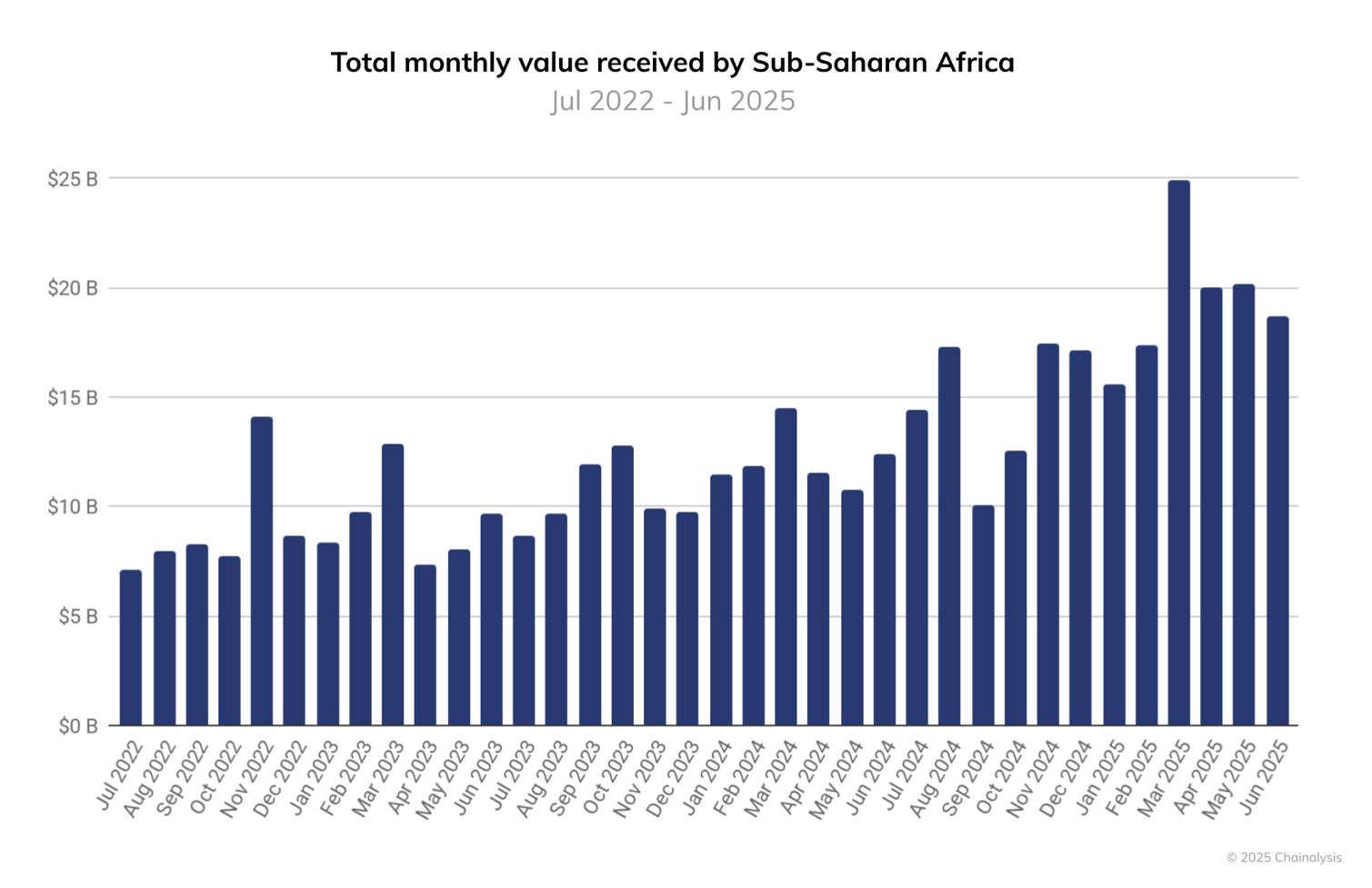
As it stands, stablecoin use in Africa has seen a significant increase. Meanwhile, African governments are beginning to introduce different regulatory approaches.
In December, Ghana passed legislation to formally legalize cryptocurrency trading. To this development, officials stated that the new framework allows innovation while giving regulators oversight tools to manage risks. In addition to that, Nigerian authorities recently introduced rules requiring crypto platforms to link transactions to users’ tax identification numbers to enhance openness.
However, to crown it all, South Africa’s central bank has warned that rising crypto and stablecoin adoption may be considered good, but may be a problem for the traditional financial sector.
In order to place winning trades with us via Bybit, you can open an account here.