


A $150 Bitcoin Miner Just Pulled Off the Impossible
Estimated Reading Time: 4 minutes
Don’t invest unless you’re prepared to lose all the money you invest. This is a high-risk investment and you are unlikely to be protected if something goes wrong. Take 2 minutes to learn more

Key Takeaways:
- A $150 Bitaxe miner solo-mined a Bitcoin block, defying incredible odds.
- The 3.125 BTC reward was worth about $200,000 at the time of the find.
- The event highlights Bitcoin’s open mining model, where anyone can still get lucky.
Most people who want to mine Bitcoin buy industrial hardware, join a mining pool, and split rewards with thousands of others. One person with a $150 device just skipped all of that — and found a block entirely on their own.
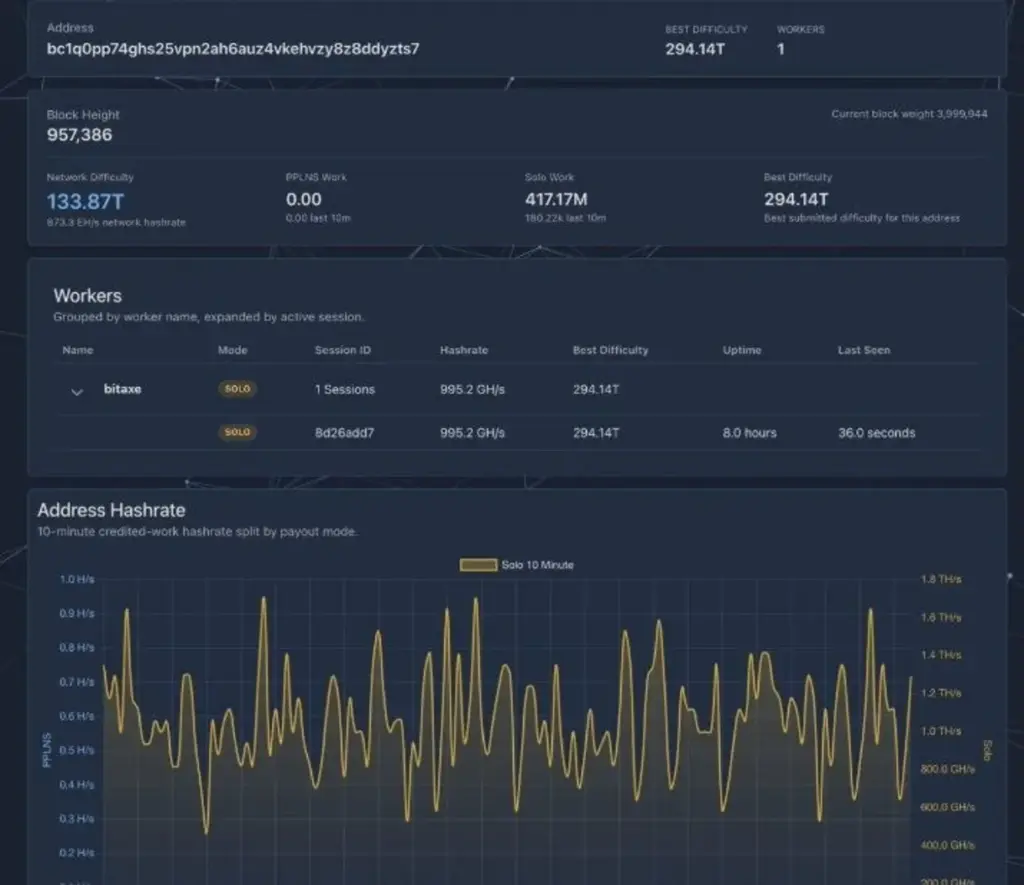
A Bitaxe solo miner running at just 995.2 GH/s has achieved a best difficulty of 294.14T — a figure that confirms a solo block find against a network difficulty of 133.87T. The dashboard, captured on July 14, 2026 at block height 957,386, shows a single worker named “bitaxe” that has been running for 8 hours with 36 seconds of uptime logged at the moment of capture.
The solo work column reads 417.17M in the last 10 minutes. This is not a pool payout. This is a solo miner — one device, one person — finding a Bitcoin block on the world’s most competitive computational network.
What Makes This So Remarkable
To understand the significance, consider the odds. The Bitcoin network currently operates at approximately 873.3 EH/s of total hashrate. A Bitaxe running at 995.2 GH/s contributes roughly 0.000000114% of that total. Statistically, a miner at this hashrate might expect to find a block once every several thousand years of continuous operation.
Solo block finds at this scale are not supposed to happen — which is precisely why the crypto community treats them as events worth celebrating when they do. They are the proof-of-work equivalent of winning a lottery no one expected to be winnable.
The Bitaxe is an open-source, community-designed Bitcoin miner built around the BM1366 ASIC chip. It draws minimal power, fits in the palm of a hand, and costs roughly $150. It was never designed to compete with industrial mining farms. It was designed to let individuals participate in Bitcoin’s proof-of-work consensus in a meaningful — if statistically unlikely — way.
Bitcoin’s Price on the Day of the Find
Data pulled from CoinGecko on July 14, 2026 at approximately 8:53 UTC shows Bitcoin trading at $64,549.00, up 1.3% over seven days. The weekly chart shows a market that ground between $62K and $64K from July 8 through July 13, then broke sharply higher on July 14 — pushing above $64.5K in a clean, late-week move.
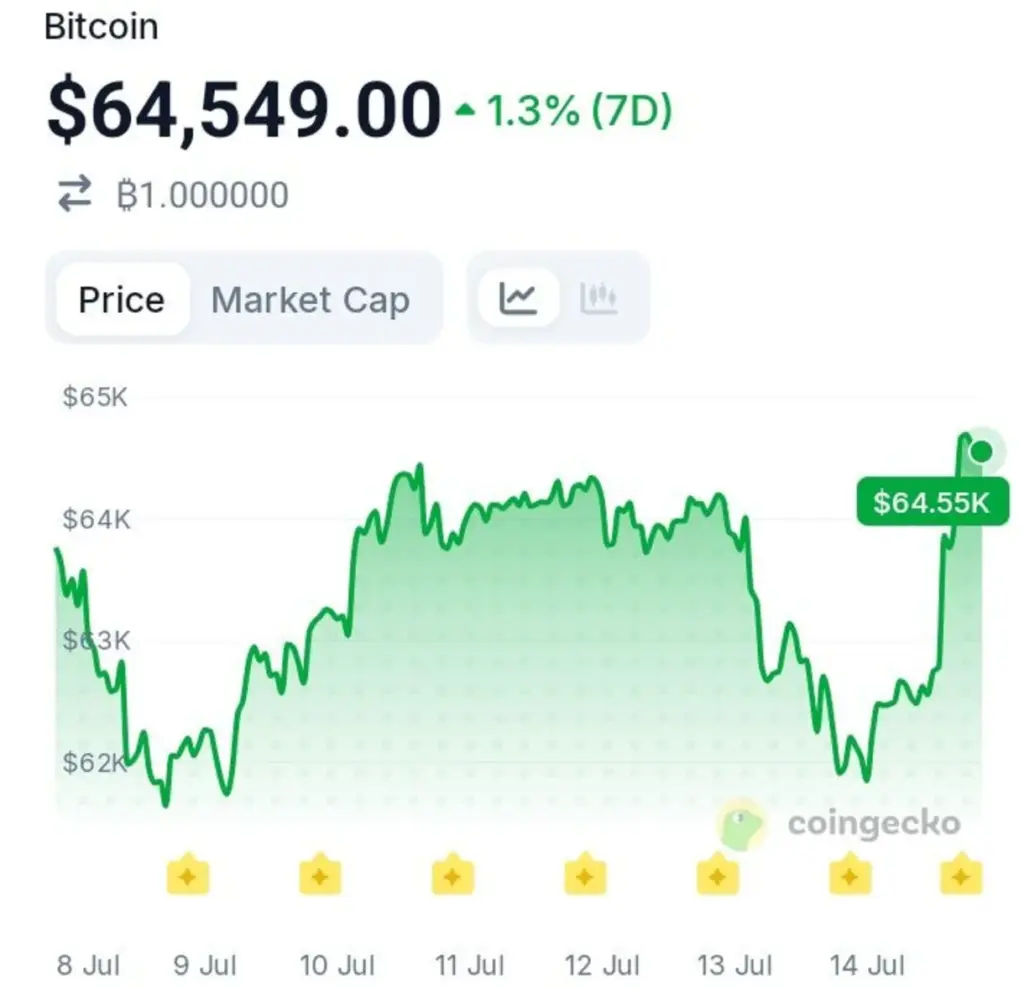
The timing means this solo miner found their block on the same day Bitcoin broke to its highest level in over two weeks. At current prices, a solo block reward of 3.125 BTC is worth approximately $201,700 — earned by a device that cost less than a monthly gym membership.
What This Moment Represents
Beyond the extraordinary mathematics, this find carries a message about what Bitcoin was designed to be. The network’s proof-of-work system was never meant to be the exclusive domain of warehouse-scale mining operations. It was meant to be open — participatory in a way that anyone with hardware and electricity could access.
Industrial mining dominates in practice. But the protocol itself has no minimum entry requirement, and moments like this are the living proof of that design philosophy. Someone spent $150, plugged in a device the size of a small book, and earned $200,000 in Bitcoin. The odds said it was impossible. The blockchain said otherwise.