


China Threatens Artificial Intelligence (AI) Investment Growth Via Aggressive Pricing
Estimated Reading Time: 5 minutes
Don’t invest unless you’re prepared to lose all the money you invest. This is a high-risk investment and you are unlikely to be protected if something goes wrong. Take 2 minutes to learn more
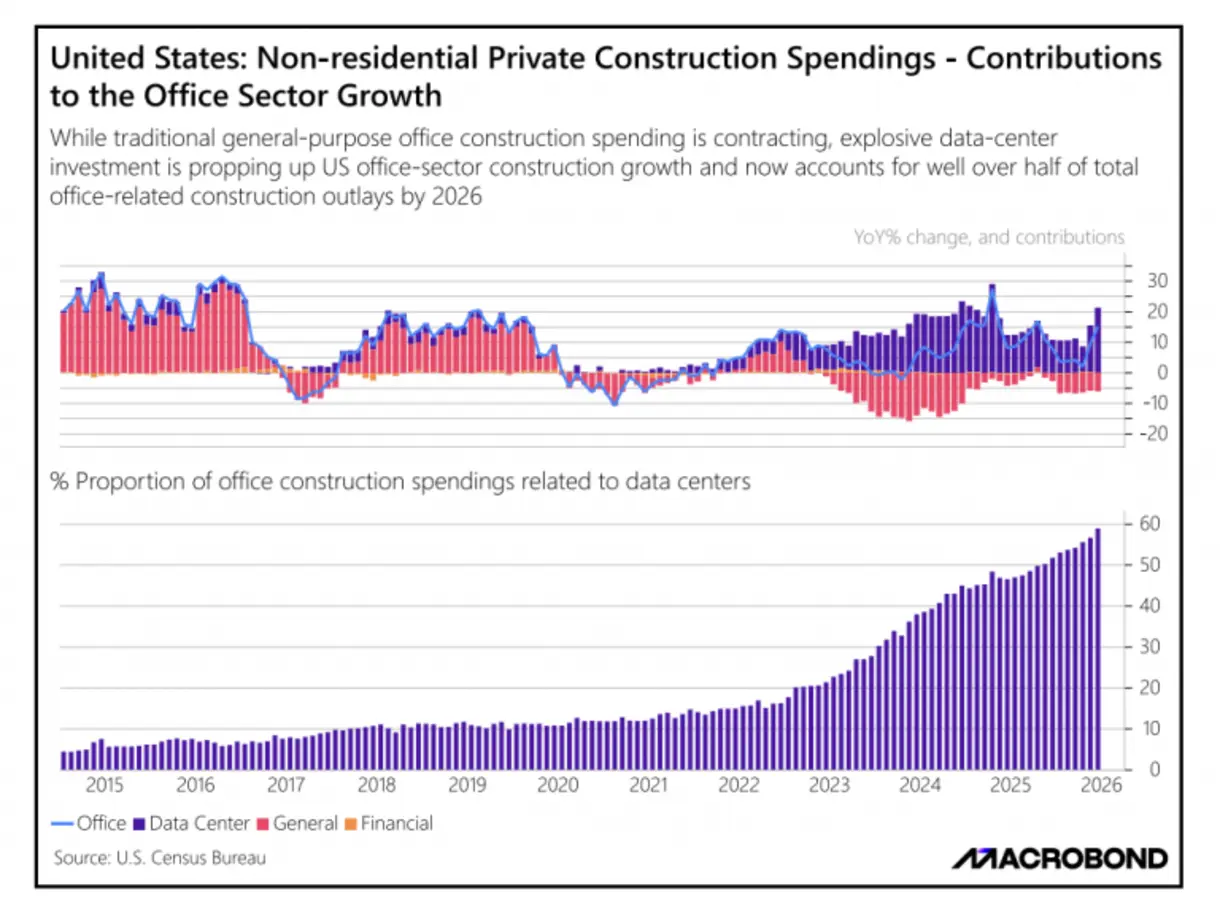
The Artficial intelligence (AI) growth has undoubtedly become a major driver of economic activity and investment in the United States. Major technology organizations, from well-established giants such as Meta to AI companies like OpenAI, are investing billions of dollars in developing increasingly powerful large language models. To support these models, many organizations are also spending heavily on large, energy-intensive data centers. Based on the chart below, these investments are sufficient to offset some of the weakness from reduced spending on traditional office construction.
Investment in artificial intelligence and the infrastructure supporting it is rapidly increasing demand for a wide range of products, including steel, concrete, cooling systems, servers, cables, processors, and memory chips. Some analysts estimate that AI-related investment could account for roughly one-third of current U.S. economic growth. This surge has pushed up the share prices of companies across the technology and industrial sectors, from chipmakers to heavy-equipment manufacturers.
However, concerns about high valuations, rising debt, and interconnected investment deals are also growing. These developments have made the AI sector increasingly vulnerable. The growing competitiveness of Chinese AI companies could ultimately become the catalyst that reverses the current U.S. AI investment boom.
A major challenge for leading U.S. AI companies is the rapid technological progress made by their Chinese counterparts. Chinese firms now appear to be closing the performance gap with some of the industry’s most advanced U.S. models. For example, Chinese AI lab DeepSeek recently introduced its V4 Flash coding model, with early tests suggesting performance close to Anthropic’s Opus 4.8, considered one of the industry’s leading systems. This followed the release of Kimi K3 by Moonshot AI, another Chinese model that reportedly performs competitively against both Opus 4.8 and OpenAI’s GPT-5.6 Sol.
Beyond raw performance, the openness and flexibility of many Chinese AI models could give them an additional advantage. From a broader user-experience perspective, some businesses may ultimately find these open-source Chinese alternatives more practical and attractive than comparable U.S. offerings.
Aggressive Chinese AI Pricing
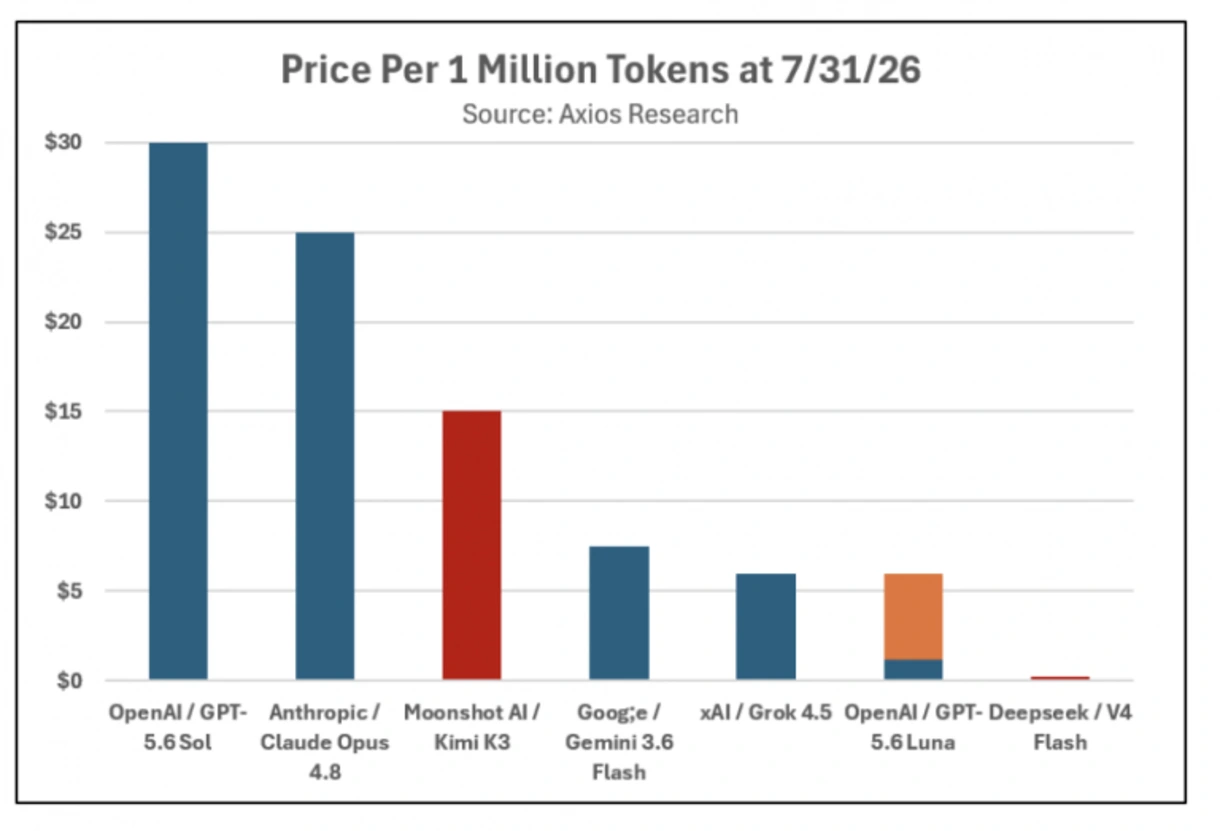
Another major development that could undermine the position of leading U.S. AI companies is the extremely low pricing offered by Chinese competitors. For example, DeepSeek reportedly charges just $0.28 for its V4 Flash model, which is said to deliver output comparable to Anthropic’s Opus 4.8, priced at around $25. This aggressive pricing came shortly after OpenAI reportedly reduced the price of its GPT-5.6 Luna model by 80%, bringing its cost to approximately $1.20 for comparable output.
The significant price difference highlights the competitive advantage Chinese AI companies could have if they continue offering highly capable models at substantially lower costs.
Considering this, China’s aggressive pricing strategy should not come as a complete surprise. Consistent with the long-standing objectives of the Chinese Communist Party to strengthen China’s manufacturing base and compete with leading global industries, Beijing has historically supported domestic producers through subsidies and other measures.
China has used this strategy in sectors such as steel, rare-earth processing, automobiles, and electronics, often enabling domestic companies to compete aggressively on price. AI could become another strategically important industry where China applies a similar approach.

Some analysts believe U.S. companies could remain dominant in high-end AI services even if Chinese firms take the lead in lower-cost applications. Anthropic, for example, appears to be positioning its most advanced models as premium products. However, DeepSeek’s aggressive pricing strategy highlights the growing competitive pressure from Chinese AI firms.
Chinese companies are demonstrating that they can produce highly capable AI models at dramatically lower prices, potentially making them up to 99% cheaper than comparable U.S. offerings. As U.S. companies continue spending heavily on AI development and infrastructure, their costs could rise while Chinese competitors continue to undercut them.
If investors increasingly recognize the scale of this competitive threat, the current U.S. AI investment boom could become considerably more fragile.