Centralized vs Decentralized Exchanges: Which Crypto Platform Fits You?
Estimated Reading Time: 15 minutes
Don’t invest unless you’re prepared to lose all the money you invest. This is a high-risk investment and you are unlikely to be protected if something goes wrong. Take 2 minutes to learn more
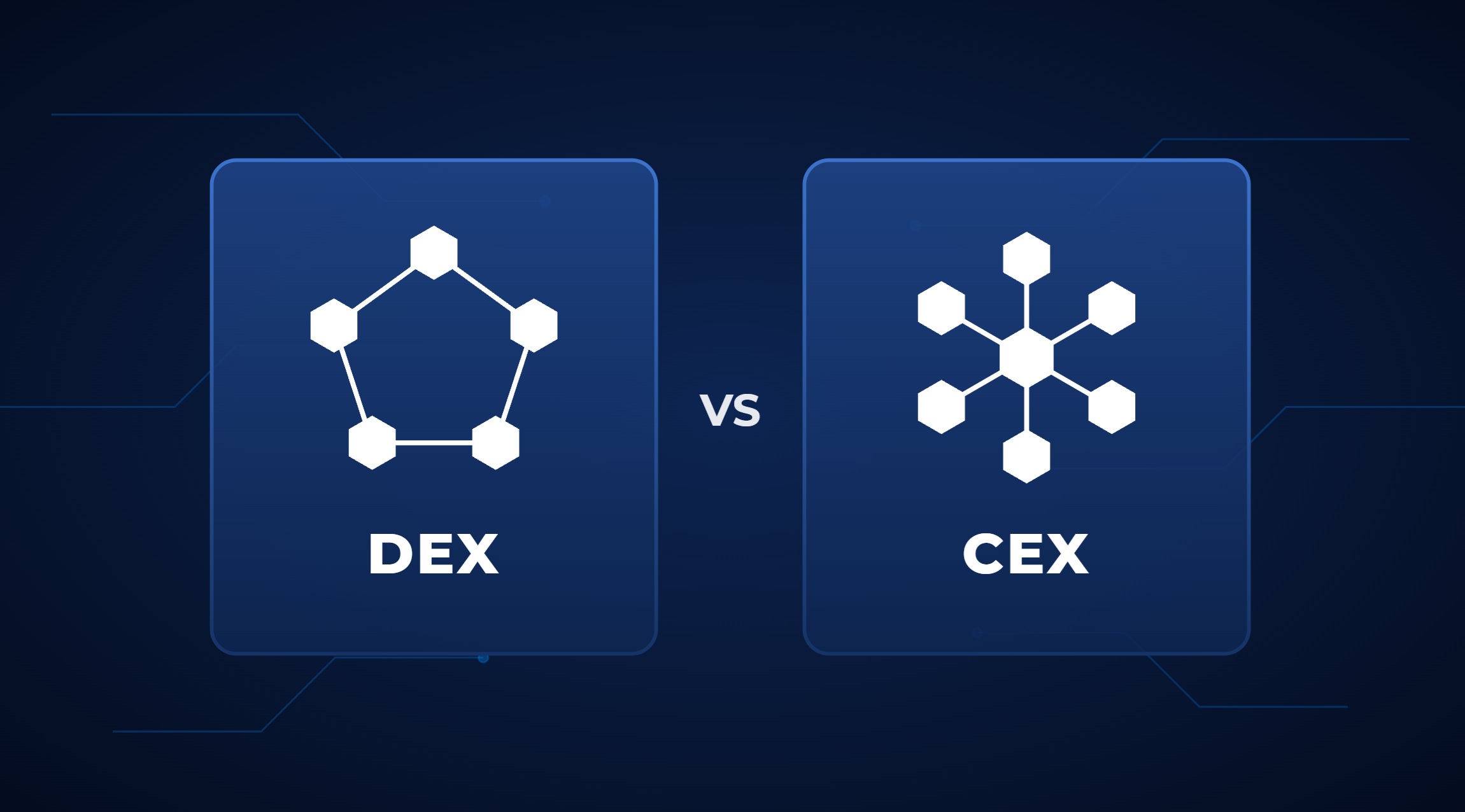
The first real decision every crypto trader makes isn’t what to buy — it’s where to buy it. Do you create an account on Binance, Coinbase, or Bybit (a centralized exchange, or CEX)? Or do you connect a wallet to Uniswap, Jupiter, or Hyperliquid (a decentralized exchange, or DEX)?
Both paths work. Both have produced millionaires. Both have also produced horror stories — CEX users who got their funds frozen without explanation, and DEX users who signed a malicious contract and watched their wallet drain to zero. The difference isn’t which is “better” in the abstract. It’s which fits your trading style, your technical comfort level, and your risk tolerance.
This guide compares centralized and decentralized exchanges across the dimensions that actually matter: security, custody, fees, liquidity, user experience, and asset selection. No ideology. No “not your keys, not your coins” purity tests. Just the trade-offs, so you can make the call that works for you.
Key Takeaways
- Centralized exchanges hold your funds. You’re trusting a company with your money. The trade-off is deep liquidity, fast execution, and customer support when things go wrong.
- Decentralized exchanges never hold your funds — you trade directly from your wallet. The trade-off is you’re fully responsible for your own security, and mistakes (wrong network, malicious contract) are irreversible.
- For most beginners, starting on a CEX is the safer, simpler path. Learn the basics there, then explore DEXs once you understand wallet management, gas fees, and how to verify contract addresses.
- The best traders don’t choose one or the other. They use CEXs for deep liquidity on major pairs and DEXs for early access to new tokens, yield opportunities, and permissionless trading.
- Regulation is the wildcard. CEXs can freeze accounts, delist tokens, and restrict access based on your jurisdiction. DEXs are permissionless by design — but that also means no recourse if something goes wrong.

Free Crypto Signals Channel
 Free Telegram Channel
What Is a Centralized Exchange (CEX)?
A centralized exchange is a company that matches buyers and sellers, holds customer funds in custodial wallets, and manages the order book. You deposit dollars or crypto, the exchange credits your account, and you trade against other users on the platform’s matching engine. The exchange takes a fee on each trade.
The dominant CEXs as of 2026 are Binance (roughly 40-50% of global spot volume), followed by Bybit, OKX, Coinbase, Kraken, and KuCoin. Between them, they handle the vast majority of crypto trading volume worldwide.
How a CEX Works, Step by Step
- You create an account, complete KYC (Know Your Customer) verification — identity document, selfie, proof of address.
- You deposit fiat (bank transfer, card, etc.) or transfer crypto from an external wallet.
- Your funds appear as a balance in your exchange account. Crucially, you don’t control the private keys to the wallet holding your funds. The exchange does.
- You place orders on the exchange’s order book. The matching engine fills your order against other users or the exchange’s own liquidity.
- When you want to withdraw, you submit a request. The exchange sends the funds to your external wallet address.
The CEX model is essentially a broker + custodian bundled together. The convenience is high — deposit, trade, withdraw, all in one interface. The trust requirement is also high — you’re relying on the exchange to remain solvent, honest, and operational.
What CEXs Do Well
Deep liquidity. A BTC/USDT market buy for $100K on Binance slips maybe 0.01%. The same trade on a DEX might slip 0.5-2% depending on the chain and pool. For large trades, CEX liquidity is significantly better.
Speed. CEX matching engines operate in microseconds. Your market order fills instantly, even during volatility. DEX trades take seconds to minutes depending on block times — and during network congestion, they can take much longer, or fail entirely.
User experience. CEX interfaces are designed for mass adoption. Deposit with a credit card. Trade with a clean chart. Set stop-losses and take-profits with a few clicks. The learning curve is measured in minutes, not days.
Customer support (in theory). If something goes wrong on a CEX, there’s a support ticket system, a compliance department, and — in regulated jurisdictions — a financial ombudsman or regulator you can escalate to. On a DEX, if something goes wrong, there’s nobody to call.
Fiat on/off ramps. CEXs are the bridge between bank accounts and crypto. You can deposit USD, EUR, GBP directly and withdraw back to your bank account. DEXs are crypto-native — you need crypto to get started.
What CEXs Do Poorly
Custodial risk. “Not your keys, not your coins” isn’t just a slogan. When you hold funds on a CEX, you’re an unsecured creditor. If the exchange goes bankrupt (FTX, November 2022), gets hacked (Mt. Gox, 2014), or freezes withdrawals (numerous examples), your funds are at the mercy of the exchange’s balance sheet and legal proceedings. FTX customers are still waiting for recoveries years later.
KYC and privacy. Every CEX requires identity verification. Your trading history, balances, and PII are stored on centralized servers. If the exchange is hacked, that data is exposed. Governments can subpoena it. For traders who value financial privacy, CEXs are inherently leaky.
Account freezes and restrictions. CEXs can and do freeze accounts — sometimes legitimately (suspected fraud), sometimes arbitrarily (compliance overreaction, regulatory pressure). If your account gets flagged, you might spend weeks or months fighting to regain access while the market moves without you.
Geographic restrictions. Binance is restricted or limited in multiple countries. Bybit has pulled out of several jurisdictions. Your access can change overnight based on regulatory developments. DEXs don’t care where you live — they’re accessible to anyone with an internet connection and a wallet.
What Is a Decentralized Exchange (DEX)?
A decentralized exchange is a set of smart contracts running on a blockchain that enables peer-to-peer trading without an intermediary. You connect your wallet (MetaMask, Phantom, Rabby, etc.), approve the trade, and the smart contract executes the swap. At no point does the DEX take custody of your funds — the trade happens atomically: either the entire swap completes in a single transaction, or nothing happens and your funds stay in your wallet.
There are two main DEX architectures:
Automated Market Makers (AMMs). Instead of an order book, AMMs use liquidity pools — pairs of tokens deposited by users (liquidity providers). The price is determined by a mathematical formula: typically x * y = k, where x and y are the quantities of the two tokens in the pool. When you swap, you add to one side and remove from the other, shifting the ratio and updating the price. Uniswap (Ethereum), PancakeSwap (BNB Chain), Jupiter aggregating across Solana pools, and Raydium (Solana) are the most prominent AMM-based DEXs.
Order Book DEXs. These work like a CEX — buy and sell orders sit on a book, matched by the protocol. The difference is the order book lives on-chain (or on a layer-2 with on-chain settlement), not on a company’s server. Hyperliquid (its own L1 for perpetuals), dYdX (Cosmos-based), and Serum/OpenBook (Solana) are the leading order book DEXs.
How a DEX Trade Works, Step by Step
- You connect your wallet to the DEX’s front-end (e.g., app.uniswap.org).
- You select the token pair, enter the amount, and review the quoted price and estimated gas fee.
- You approve the token spend (a one-time transaction per token) if you haven’t already.
- You confirm the swap. Your wallet prompts you to sign the transaction.
- The transaction is broadcast to the network. Once included in a block, the swap executes: tokens leave your wallet, new tokens arrive.
The entire process happens without an intermediary. The DEX front-end is just a user interface — the actual trade executes on-chain via smart contracts that anyone can inspect. If the DEX website goes down, you can still interact with the contracts directly or through an alternative front-end.
What DEXs Do Well
Self-custody. Your funds never leave your wallet until the moment of trade, and the new tokens arrive in the same transaction. You’re not trusting a third party to hold your assets or remain solvent. The risk of exchange bankruptcy is zero.
Permissionless access. No KYC. No account application. No geographic restrictions. If you have a wallet and crypto to trade, you can use a DEX. This is the core value proposition for traders in restricted jurisdictions or anyone who values financial privacy.
Token availability. CEXs list maybe 300-500 tokens across all trading pairs. DEXs list tens of thousands — any token deployed on the chain can have a liquidity pool. If you want to trade the latest memecoin, AI agent token, or DeFi protocol before it hits a CEX, you need a DEX.
Composability. DEX trades are just smart contract interactions. They can be embedded in larger transactions — swap Token A for Token B, deposit Token B into a lending protocol, and borrow Token C against it, all in one atomic transaction. This “money Lego” composability powers DeFi strategies that don’t exist on CEXs.
No withdrawal fees or limits. You’re not “withdrawing” from a DEX — the tokens are already in your wallet. There are no withdrawal minimums, maximums, or processing delays.
What DEXs Do Poorly
User experience. Wallet setup, gas fee estimation, transaction signing, network switching — the DEX onboarding flow takes 20-30 minutes for a first-timer, compared to 5 minutes on a CEX. The friction is real, and it’s the main barrier to mass adoption.
Irreversible mistakes. Send tokens to the wrong network, sign a malicious contract approval, get front-run by a MEV bot — there’s no undo button and no support ticket. The irreversible nature of on-chain transactions means errors are permanent.
Gas costs (chain-dependent). Trading $50 on Ethereum mainnet with a $25 gas fee is a 50% cost before any price movement. On Solana or L2s, gas is negligible, but the user still needs to understand which chain they’re on and hold the native token for gas.
MEV and front-running. On public blockchains, bots can see your pending transaction and insert their own transaction ahead of yours to profit from your trade. Sandwich attacks — where a bot buys before your trade and sells after, capturing the price impact — are common on Ethereum and BNB Chain. DEX aggregators and private mempools mitigate this, but it’s a risk that doesn’t exist on CEXs in the same way.
Regulatory uncertainty. DEX front-ends can be geo-blocked or taken down by regulatory action. The smart contracts remain accessible, but the easy-to-use website might disappear. Uniswap has delisted certain tokens from its front-end under regulatory pressure, even though the underlying contracts can still trade them.
CEX vs DEX: The Comparison Table
| Dimension | Centralized Exchange (CEX) | Decentralized Exchange (DEX) |
|---|---|---|
| Custody | Exchange holds your funds | You hold your funds |
| Liquidity | Deep, especially for majors | Improving, but thinner for large trades |
| Fees | 0.02%-0.60% per trade | 0.05%-1% pool fee + gas |
| Speed | Milliseconds | Seconds to minutes (block time) |
| KYC required | Yes | No |
| Fiat support | Yes | No (crypto-only) |
| Token selection | 300-500 tokens | 10,000+ tokens |
| Customer support | Yes (variable quality) | None |
| Downtime risk | Exchange dependent | Blockchain dependent |
| Regulation risk | Account freezes, restrictions | Front-end takedowns possible |
| Hacking risk | Exchange is target | Individual wallet is target |
| Recovery if hacked | Possible (depends on exchange) | Impossible (blockchain is final) |
Neither column is universally “better.” The right choice depends on what you’re trading, how much, and what risks you’re willing to manage yourself.
When to Use a CEX vs When to Use a DEX
Use a CEX When:
- You’re new to crypto. Learn on a CEX. Understand order books, order types, and basic risk management before adding wallet security and gas management to your plate.
- You’re trading large size in major pairs. A $50K BTC buy on Binance has near-zero slippage. The same trade on Uniswap on Ethereum might cost several hundred dollars in price impact plus a $5-15 gas fee.
- You need fiat on/off ramps. Depositing and withdrawing cash requires a CEX (or a fiat on-ramp service, which is essentially a lightweight CEX).
- You need advanced order types. OCO, trailing stops, TWAP — these are standard on CEXs and rare or nonexistent on DEXs. If your strategy depends on automated order management, CEXs are the practical choice.
- You want someone to call when things break. For all the complaints about CEX support, having a support team — even a slow one — is better than having nobody.
Use a DEX When:
- You’re trading tokens not listed on CEXs. Early-stage projects, memecoins, niche DeFi tokens — they launch on DEXs first and may never reach a CEX.
- You value self-custody above all else. If the thought of an exchange holding your funds keeps you up at night, trade on DEXs. Accept the higher friction as the price of sovereignty.
- You’re in a jurisdiction with restricted CEX access. DEXs don’t check your passport. As long as you have internet and a wallet, you can trade.
- You’re doing DeFi composability. Lending, borrowing, yield farming, liquidity provision — these strategies require DEXs and the broader DeFi ecosystem they plug into.
- You’re trading small to medium size on L2s or Solana. $500-$5,000 trades on Arbitrum, Base, or Solana have negligible fees and slippage comparable to CEXs for major pairs. For this use case, DEXs are genuinely competitive.
The Hybrid Approach
Most experienced traders use both. They hold the bulk of their portfolio in self-custody (hardware wallet), keep a trading balance on one or two CEXs for active trading in liquid pairs, and use DEXs for speculative plays, airdrop farming, and DeFi strategies. The CEX is the workhorse for day-to-day trading; the DEX is the playground for higher-risk, higher-reward opportunities.
This hybrid model captures the strengths of both: deep liquidity and fast execution from the CEX, permissionless access and self-custody from the DEX. It also diversifies risk — an exchange hack or freeze doesn’t wipe out your entire portfolio, and a wallet compromise doesn’t drain your actively traded balance.
 Most Popular
- 2-5 Signals Daily
- 82% Success Rate
- Entry, Take Profit & Stop Loss
- Amount To Risk Per Trade
- Risk Reward Ratio


Conclusion
The CEX vs DEX debate is less about choosing sides and more about understanding trade-offs. Centralized exchanges offer convenience, liquidity, and support — at the cost of custody risk and regulatory exposure. Decentralized exchanges offer sovereignty, permissionless access, and broader token selection — at the cost of user experience, irreversibility, and gas complexity.
If you’re starting out, pick a reputable CEX with strong security practices (Binance, Coinbase, Kraken, or Bybit), enable 2FA — ideally with a hardware security key — and never keep more on the exchange than you’re actively trading. Once you’re comfortable with the basics, set up a self-custody wallet, experiment with small DEX trades on a low-cost chain like Solana or Arbitrum, and build the skills to operate in both worlds.
The traders who thrive in crypto don’t pick one platform and ignore the rest. They understand when to use each tool and they don’t let ideology get in the way of practicality. CEX or DEX isn’t a religion. It’s a decision you make fresh every time you trade.
Educational content only. Not financial advice. Always do your own research.