Crypto Order Types Explained: Market, Limit and Stop-Limit in Practice
Estimated Reading Time: 13 minutes
Don’t invest unless you’re prepared to lose all the money you invest. This is a high-risk investment and you are unlikely to be protected if something goes wrong. Take 2 minutes to learn more
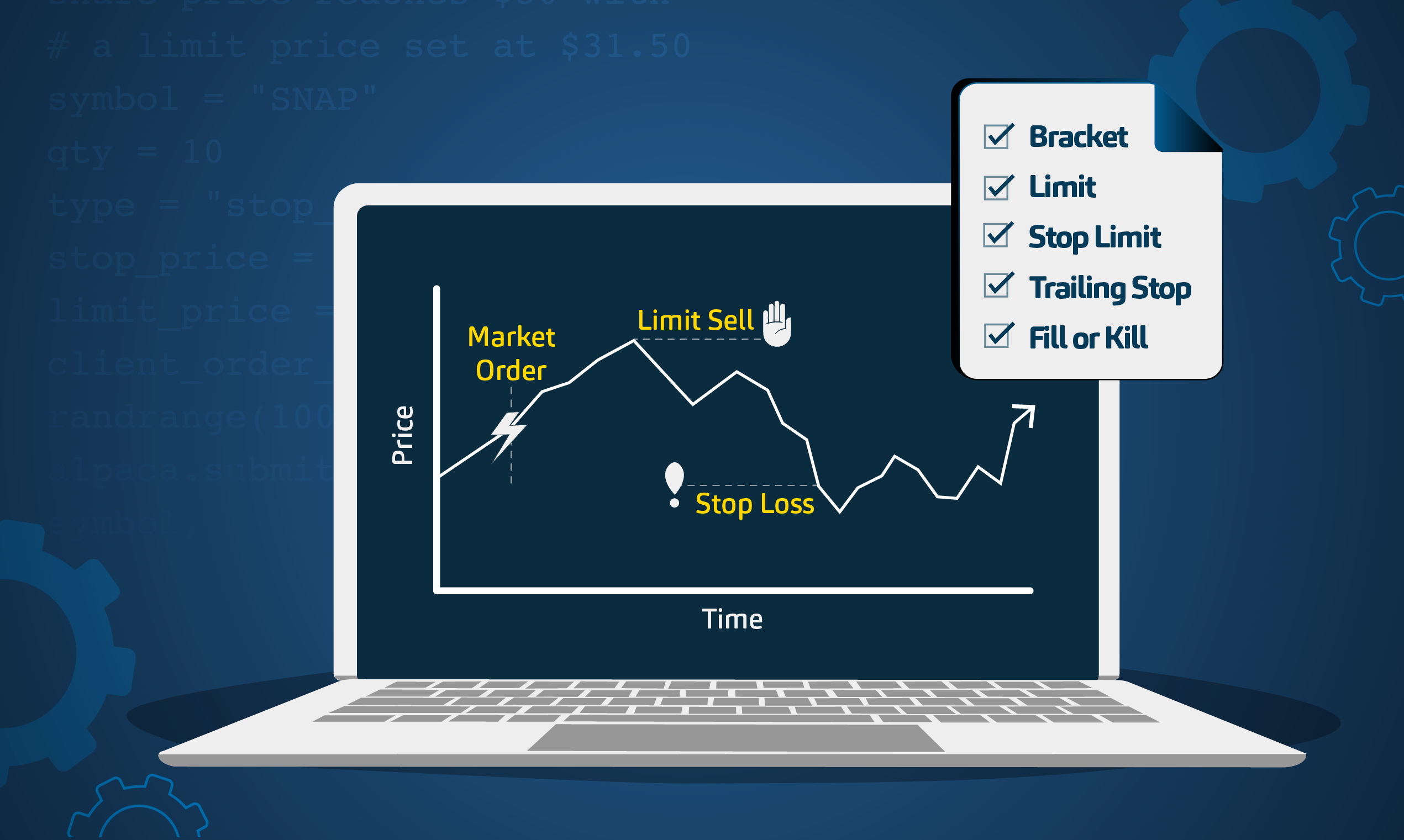
Every trade you place is an instruction to the exchange: buy this, sell that, at this price, under these conditions. The specific instruction you choose — the order type — determines what price you get, how fast you get filled, and whether you pay maker or taker fees. For a beginner, the market order is the default because it’s the simple button. You click buy, you get filled. Done.
The problem: market orders are almost always the most expensive way to trade. You pay taker fees, you eat the spread, and in fast-moving markets you get slipped. A trader who only uses market orders on a $10,000 account making 20 trades per week is burning through hundreds of dollars in unnecessary costs every month — costs that switching to limit orders eliminates entirely.
This guide covers the three essential order types — market, limit, and stop-limit — with real examples of when to use each. By the end, you’ll know exactly which button to press for every trade scenario, and why the simple market-buy button is costing you more than you think.
Key Takeaways
- Market orders guarantee execution but at the worst available price — you’re paying for speed with spread, slippage, and taker fees.
- Limit orders guarantee price but not execution — you might miss the trade entirely if the market blows past your level without filling you.
- Stop-limit orders automate risk management: a stop price triggers the order and a limit price caps how badly you get filled. They’re the backbone of any systematic trading approach.
- For 80% of trading scenarios, limit orders are the correct choice. Use market orders only when speed matters more than price (breakouts, news events, emergency exits).
- Every order type corresponds to a different fee — understanding the maker/taker distinction will save you more money than any indicator.

Free Crypto Signals Channel
 Free Telegram Channel
Market Orders: Speed at a Price
A market order is the simplest instruction: “Buy (or sell) this asset at the best available price right now.” The exchange matches your order against the existing orders on the book and fills you instantly — or as close to instantly as the matching engine allows.
When Market Orders Make Sense
The benefit of a market order is certainty of execution. If you want to enter a position right now, a market order guarantees you get in. This matters in a few specific scenarios:
Breakout trades. You’ve identified a resistance level on SOL at $180. It breaks through on volume. You want to be in the trade before it runs to $185. A limit order at $180.50 might not fill if the breakout is fast — by the time your order hits the book, the price is already at $182 and climbing. A market order gets you in, and the spread cost is the price of capturing the move.
News-driven moves. A Fed announcement drops, BTC rips 3% in two minutes, and you have a directional bias. Waiting for a limit fill means missing the move. The market order cost is high — you’re paying wide spreads during volatility — but missing a 5% move to save 0.1% in fees is a false economy.
Emergency exits. You’re in a leveraged position, your stop-loss didn’t trigger (or you didn’t set one), and the price is moving against you fast. This is not the time to place a limit order at the price you wish you could get. Market-sell, take the loss, and live to trade another day.
The Real Cost of Market Orders
Let’s use ETH as an example. ETH/USDT is trading at $3,200 bid / $3,202 ask. The spread is $2, or about 0.06%.
With a market buy, you pay the ask: $3,202. You also pay the taker fee — typically 0.10% on major exchanges. Your effective cost is $3,202 + $3.20 (fee) = $3,205.20 per ETH. The displayed “price” was $3,200. The real cost of entry is $5.20 higher — 0.16% above the mid-price.
With a limit order at $3,200 (the bid), you’d pay $3,200 + $0.64 (maker fee at 0.02%) = $3,200.64. That’s $4.56 cheaper per ETH. On a 10 ETH trade, the difference is $45.60 — real money, same trade, different button.
Now scale this. A trader making 200 trades per month where the spread + fee difference between market and limit orders averages 0.15%: on a $2,000 position size, that’s $3 per trade, or $600/month. Annualized: $7,200. On a $10,000 account, that’s 72% of capital gone to order-type choice alone.
Market orders are not the enemy. They’re the right tool when speed dominates every other consideration. But most trades don’t need speed. Most trades need price. And for price, limits win every time.
Limit Orders: Precision Over Speed
A limit order says: “Buy (or sell) this asset at this specific price or better.” Your buy limit at $3,200 on ETH will only execute if someone is willing to sell at $3,200 or lower. If the market stays above $3,200, your order sits on the book unfilled.
The Maker Advantage
When your limit order sits on the book, you’re a maker — you’re providing liquidity. Most exchanges reward makers with lower fees, typically 0.02% to 0.10% compared to taker fees of 0.04% to 0.15%. On some exchanges like OKX futures, the maker fee is 0.02% with taker at 0.05% — a 60% discount for being patient.
Over hundreds of trades, the maker/taker fee spread compounds into thousands of dollars. A trader doing $500,000 in monthly volume saves $400/month by using limit orders at a 0.08% fee spread. That’s $4,800/year in pure cost reduction — no strategy changes, no better entries, just a different order type.
When Limit Orders Fail
Limit orders have one critical weakness: they might not fill. If you place a buy limit at $3,200 on ETH and the market drops to $3,201 before bouncing to $3,250, your order was within $1 of the low — but it never executed. The market didn’t reach your exact level. You missed a 1.5% bounce because you were squeezing for an extra dollar of entry.
This is the frustration every limit-order trader knows. You watch the chart, see the reversal at your level, refresh your open orders, and the fill isn’t there. The market came within a whisker of your price and turned without you.
Two rules help:
Round your entries to psychologically cleaner numbers? Don’t. If your analysis says support is at $3,198, place the order there — not at the “cleaner” $3,200. Everyone and their algorithm clusters orders at round numbers, which means more competition for fills. A limit at $3,198.50 often fills before the round-number orders because there’s less queue ahead of you.
Give yourself a tick of breathing room. If you’re aggressively trying to enter at the absolute low tick, you’ll miss more trades than you catch. If support is at $3,200 and you expect a bounce, placing a buy limit at $3,202 — just inside the support zone — gets you filled on the way down while still giving you a good price. The $2 you “lose” on entry is insurance against missing the move entirely.
The Partial Fill Problem
On DEXs and thin order books, limit orders sometimes fill partially. You place a limit order to buy 5 ETH at $3,200, but only 3 ETH trades at that level before the market moves up. You now have 3 ETH filled at your price and 2 ETH unfilled — congrats, you’re in the trade, but with less size than you planned.
If the partial fill is enough to matter to your position sizing, you have two choices: cancel the remaining 2 ETH and market-buy to complete the position (paying taker fees on the remainder), or adjust your plan to trade with the 3 ETH you’ve got. Neither is ideal, but both are better than watching the market run without you while 60% of your order sits unfilled.
On liquid CEX pairs (BTC/USDT, ETH/USDT, SOL/USDT), partial fills are rare for retail-size orders. On altcoins and DEX pools, they’re common. Size your orders accordingly.
 Most Popular
- 2-5 Signals Daily
- 82% Success Rate
- Entry, Take Profit & Stop Loss
- Amount To Risk Per Trade
- Risk Reward Ratio


Stop-Limit Orders: Automating Risk Management
A stop-limit order is two orders wrapped into one: a stop price that acts as the trigger, and a limit price that caps your fill. When the market reaches your stop price, the exchange places a limit order at your specified limit price.
The most common use is a stop-loss. You buy SOL at $150 and want to limit your downside to 5%. You set a stop-limit with a stop price of $142.50 and a limit price of $142.00. If SOL drops to $142.50, the exchange activates your sell order at $142.00 — you’re out with a controlled loss, automatically, without staring at the screen.
Stop vs Stop-Limit: The Critical Difference
A plain stop order (sometimes called a stop-market) triggers a market order when the stop price is hit. A stop-limit triggers a limit order instead.
The difference matters most during volatility. Imagine you have a stop-market at $142.50 on SOL. A sudden liquidation cascade drops SOL from $145 to $138 in one candle. Your stop triggers at $142.50, becomes a market sell, and you get filled at $138 — a 8% loss instead of your planned 5%. The stop worked, but you got slaughtered on the fill.
With a stop-limit, the stop triggers at $142.50, and the exchange places a limit sell at $142.00. If the market crashes through to $138 before anyone buys at $142.00, your order doesn’t fill. You’re still holding SOL at $138 — not ideal, but you haven’t sold into a liquidity vacuum either. In practice, you’d then manually decide whether to hold or cut.
The trade-off: stop-market guarantees you get out but at an unknown price. Stop-limit guarantees the minimum price you’ll accept but might leave you in the trade if the market gaps past your limit.
When to Use Each
- Stop-market: Use when getting out is more important than the exact exit price. Suited for leveraged positions where a missed exit means liquidation. If you’re 10x long and need to be out before a 9% drop, a stop-market is the right call — better to take 6% slippage on exit than a 100% liquidation.
- Stop-limit: Use when your exit price matters and you’re willing to risk not getting filled. Suited for spot positions and lower-leverage trades where a gap through your stop is survivable. Set the limit 0.5-2% beyond the stop to give the order room to fill without excessive slippage.
Other Order Types Worth Knowing (Briefly)
Once you’re comfortable with the core three, these order types add precision to your execution:
OCO (One-Cancels-the-Other)
An OCO order pairs a take-profit limit with a stop-loss limit. When one triggers, the other is automatically cancelled. You buy BTC at $65,000 and set an OCO with a take-profit limit at $68,000 and a stop-limit at $63,000. Whichever triggers first cancels the other — you’re managing both exit scenarios with a single order placement. Every major exchange supports OCO on both spot and futures.
Trailing Stop
A trailing stop moves with the price. You set a 5% trailing stop on a BTC long at $65,000. The stop starts at $61,750. If BTC rises to $70,000, the stop trails up to $66,500. If BTC then drops 5% from its peak, the stop triggers. Trailing stops let winners run while protecting profits — they’re the closest thing to a mechanical “let your winners run, cut your losers” rule.
TWAP / Iceberg Orders (Advanced)
For large positions, a single market order causes heavy slippage. A TWAP (Time-Weighted Average Price) order breaks your trade into small chunks executed at regular intervals, minimizing market impact. Iceberg orders show only a fraction of your total size on the order book, with the rest hidden until the visible portion fills. These matter at institutional size — 50+ BTC or 500+ ETH — and most retail traders will never need them.
How to Choose: A Decision Framework
Instead of memorizing rules, ask three questions before every trade:
1. How much does price matter vs speed?
If you’re entering a slow-moving market on a timeframe of hours or days, use a limit order. The entry price matters more than getting filled in the next 30 seconds. If you’re scalping a breakout where 0.5% slippage is the cost of being in the trade, use a market order.
2. What’s the spread and fee difference on this pair?
On BTC/USDT with a 0.01% spread and 0.08% maker/taker fee gap, the total cost of using a market order vs limit order is roughly 0.09%. On a $1,000 trade, that’s $0.90 — probably not worth missing a fill over. On a $100,000 trade, it’s $90 — absolutely worth posting a limit. On a small-cap altcoin with a 2% spread, the market-order cost is too high for any trade size. Always use limits.
3. Is this a planned trade or a reaction?
Planned trades — support bounces, resistance rejections, range entries — are perfect for limit orders. You know your level ahead of time. Reaction trades — news breaks, sudden volume spikes, liquidation cascades — typically need market orders because the window is measured in seconds.
For most retail traders, the default should be limit orders for entries and stop-limit OCOs for exits. Market orders are the exception, not the rule.
Conclusion
Order types aren’t complicated. The confusion comes from overthinking which button to press, when the answer is usually straightforward: limit orders for everything except breakouts and emergencies.
The cost difference between market and limit orders is real and measurable. It’s not theoretical — pull your trade history, calculate what you paid in taker fees and spread vs what you would have paid using limit orders, and the number will probably be larger than you expect. Every dollar saved on execution is a dollar that compounds into your P&L.
Learn the three core types — market, limit, stop-limit — and you can execute any strategy on any exchange. Learn OCOs and trailing stops, and you can automate most of your trade management. Everything beyond that is optimization for size and speed that most traders never need.
Educational content only. Not financial advice. Always do your own research.