Crypto Perpetual Swaps vs Quarterly Futures: What Traders Should Know
Estimated Reading Time: 13 minutes
Don’t invest unless you’re prepared to lose all the money you invest. This is a high-risk investment and you are unlikely to be protected if something goes wrong. Take 2 minutes to learn more
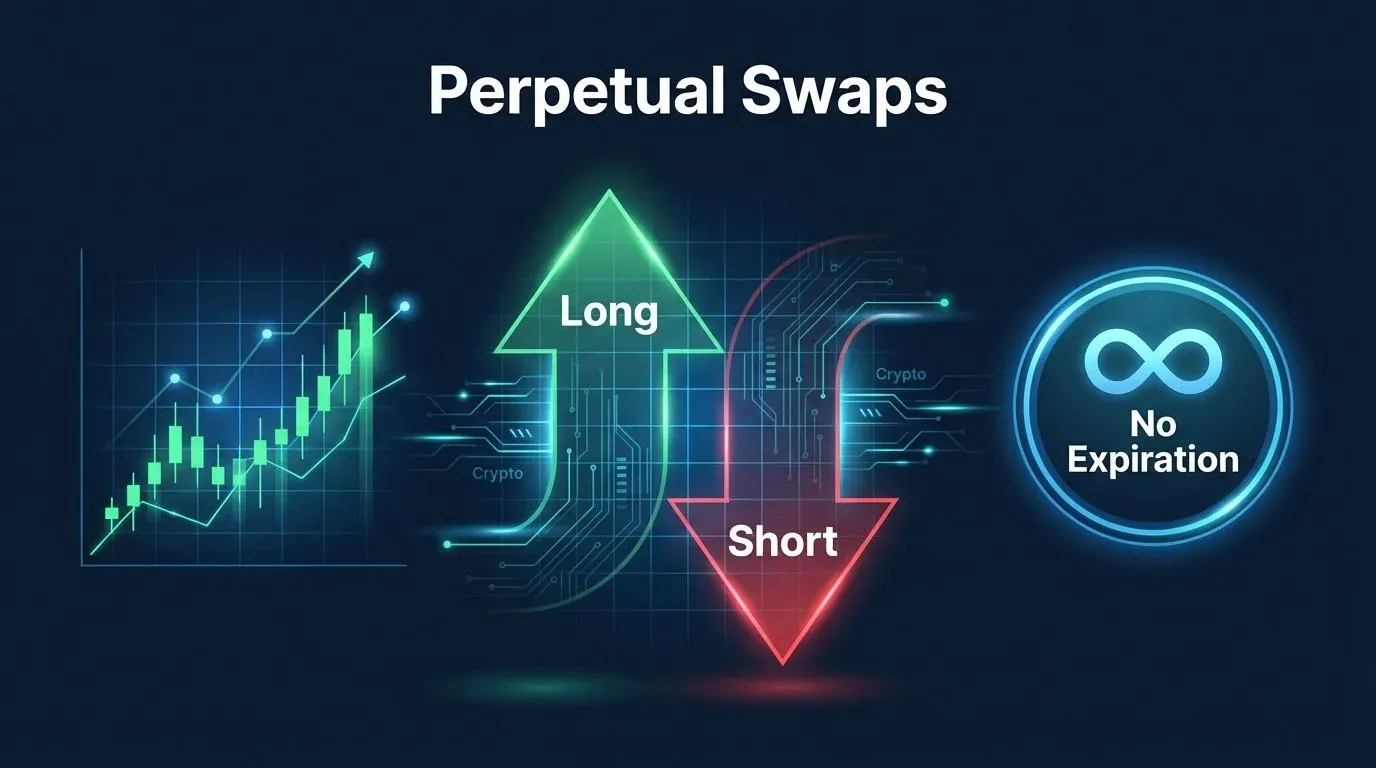
If you open a crypto derivatives exchange, the first thing you’ll see is two columns: perpetuals and futures. They look similar — both let you long or short with leverage, both settle in stablecoins or crypto, and both show a price that tracks the spot market. But under the surface, they work differently enough that picking the wrong instrument for your trade can cost you real money. If you’re holding a position for weeks and you’re in perpetual swaps, you’re paying funding that quarterly futures traders avoid. If you’re scalping intraday moves on quarterly contracts with wide spreads, you’re giving away edge to execution costs.
The choice between perpetual swaps and quarterly futures isn’t academic. It affects your carry cost, your fill quality, and whether your position behaves the way you expect during volatility. Here’s what you need to know to make the right call.
Key Takeaways
- Perpetual swaps use a funding rate mechanism to keep the contract price anchored to spot — you either pay or receive funding every 8 hours depending on market skew
- Quarterly futures have an expiry date and no funding rate; instead the contract price converges to spot at expiry, which means the price you trade today bakes in market expectations about where spot will be at settlement
- Perpetuals dominate volume and offer tighter spreads, but funding costs can eat a leveraged position alive if you hold through sustained bullish sentiment
- Quarterly futures let you express longer-term views without bleeding to funding, but they carry basis risk and typically have wider spreads and less liquidity
How Perpetual Swaps Actually Work
A perpetual swap is a derivative contract with no expiry date. You can hold a position indefinitely — the exchange won’t force you to close or roll it. That’s the “perpetual” part. The problem it solves is obvious: without an expiry, why should the perpetual contract trade at the same price as spot Bitcoin? Nothing forces convergence.
The answer is the funding rate. Every 8 hours — at 00:00, 08:00, and 16:00 UTC on most exchanges — longs and shorts settle a payment between each other. If the perpetual price is above spot (trading at a premium), longs pay shorts. If the perpetual is below spot (trading at a discount), shorts pay longs. The payment is proportional to the size of your position and the size of the deviation.
The maths: funding rate = premium index + clamp(interest rate – premium index, -0.05%, 0.05%). In plain English, the funding rate is based on how far the perpetual price has diverged from spot over the funding interval. The clamp prevents extreme rates, capping the impact at 0.05% per 8-hour period each way. In practice, funding rates on BTC might range from 0.01% (neutral, roughly $2.40 per $10,000 position per 8 hours) to 0.10%+ during euphoric rallies, which works out to 0.3%+ per day — or over 100% annualised.
For a trader holding $50,000 of BTC perpetual long at 10x leverage during a period where funding averages 0.05% every 8 hours, you’re paying $75 every 8 hours, or $225 per day, or $6,750 per month. That’s on top of your P&L from price movement. If the market chops sideways for a month, you lose over 13% of your position to funding alone.
When Funding Works in Your Favor
It cuts both ways. During sustained bearish sentiment, perpetuals often trade at a discount to spot — funding goes negative, and shorts pay longs. If you’re long during a period where funding averages -0.03%, you’re collecting about 0.09% per day just for holding the position. That’s free carry that quarterly futures don’t offer.
This is the strategic insight: perpetuals aren’t just an instrument, they’re a sentiment gauge. When funding is high and positive, the market is overwhelmingly long — that’s usually when corrections hit hardest because overleveraged longs get liquidated. When funding is deeply negative, the market is overwhelmingly short — squeeze setups. Many systematic strategies use funding rate extremes as a contrarian signal: go long when funding is extremely negative (shorts are paying you to be long, and the positioning is one-sided), go short when funding is extremely positive.

Free Crypto Signals Channel
 Free Telegram Channel
How Quarterly Futures Are Different
Quarterly futures — also called dated futures or delivery futures — expire on a specific date, typically the last Friday of March, June, September, or December. At expiry, the contract settles at the spot price of the underlying asset (or an index price, depending on the exchange). Between now and expiry, the futures price can trade at a premium or discount to spot based on market expectations, interest rate differentials, and supply/demand for leverage.
The key difference from perpetuals: there is no funding rate. If you buy a BTC futures contract expiring in December, you pay the premium (or receive the discount) upfront as part of the entry price, and you hold it until expiry with no ongoing payments. Your cost of carry is baked in at trade entry, not dribbled out every 8 hours.
This makes quarterly futures attractive for longer-duration trades. If you think ETH will be higher in three months and you want leverage without the daily bleed of funding payments, a quarterly future is cleaner. The basis — the difference between the futures price and spot — represents the market’s implied cost of carry. When BTC spot is $67,000 and the December futures contract is trading at $68,500, that $1,500 premium (about 2.2%) is the market’s estimate of the cost of holding a leveraged long position for roughly three months. You pay it once, not every 8 hours.
The Convergence Catch
At expiry, the futures price converges to spot. This means the $1,500 premium in our example will decay to zero over the life of the contract. If spot BTC doesn’t move at all, you lose $1,500 per contract just from convergence — that’s your implicit carry cost.
This convergence behaviour creates opportunities that don’t exist in perpetuals. If the basis (futures premium over spot) is unusually high — say 5% for a contract expiring in three weeks — you can enter a cash-and-carry trade: buy spot BTC, short the futures contract, and capture the 5% premium as it decays to zero by expiry. This is a market-neutral trade. You don’t care where BTC goes because your spot long and futures short offset each other. You pocket the basis. In 2024–2026, basis trades on BTC futures routinely offered 8–15% annualised returns with effectively zero directional risk, which made them a favourite of institutional desks and hedge funds.
For retail traders, the practical point is simpler: if the basis on a quarterly contract is high and you’re going long, you’re paying a fat premium that will decay against you. If the basis is low or negative (backwardation), long positions get a tailwind from convergence.
Spreads and Liquidity: The Practical Difference
Perpetual swaps dominate crypto derivatives volume. On Binance, BTC/USDT perpetuals routinely see $20–40 billion in daily volume, while the quarterly futures contract might see $1–3 billion. This volume gap translates directly to execution quality.
The bid-ask spread on BTC perpetuals during normal market conditions sits around $1–$3 on a $67,000 price — roughly 0.0015% to 0.0045%. The quarterly futures spread on the front-month contract might be $5–$15. On back-month contracts (two or three expiries out), spreads widen further — $20–$50 isn’t unusual even for BTC.
For a scalper or day trader taking dozens of positions per session, that spread difference matters enormously. Paying an extra 0.02% in spread per round trip, 20 times a day, is 0.4% per day just in spread costs — before fees, before slippage. Perpetuals are the clear winner for short-duration trading.
For a swing trader holding positions for days or weeks, the calculus flips. Saving 0.02% on entry spread doesn’t matter if you’re paying 0.15% per day in funding for a week. The quarterly futures spread gets amortised over a longer holding period, and the absence of funding payments becomes the dominant factor.
 Most Popular
- 2-5 Signals Daily
- 82% Success Rate
- Entry, Take Profit & Stop Loss
- Amount To Risk Per Trade
- Risk Reward Ratio


Altcoin Futures: A Different Game Entirely
On altcoin perpetuals — SOL, AVAX, LINK, and the long tail of mid-cap tokens — spreads are wider than BTC and ETH, but they’re still usually tighter than the equivalent quarterly contracts, when those even exist. Most exchanges only offer quarterly futures on BTC, ETH, and maybe the top 5–10 coins. For anything smaller, perpetuals are the only game in town for leveraged trading.
But the funding rate math bites harder on altcoins. Because altcoin perpetuals have thinner liquidity and more directional speculation, funding rates can spike to extremes faster. A SOL perpetual might sit at 0.01% funding for weeks, then spike to 0.1%+ during a rally as traders pile into leveraged longs. If you’re holding a leveraged position through one of these funding spasms, the cost adds up fast.
Basis Trading and Market Sentiment Signals
The basis — the gap between futures and spot — is a window into what the market expects. When quarterly futures trade at a significant premium to spot (contango), the market is pricing in upward drift over the contract’s life. This is the normal state of crypto futures. When futures trade below spot (backwardation), it signals that leveraged participants expect near-term downside and are willing to sell futures at a discount to spot to express that view.
Contango in BTC quarterly futures averaged around 5–15% annualised through the 2024–2026 cycle. During the peaks of bullish sentiment — around Bitcoin’s all-time highs in late 2024 and again in early 2026 — the basis compressed as spot rallied faster than futures could reprice, and then expanded again as futures caught up. Watching the basis trend over time gives you a read on whether speculative leverage is building or unwinding.
A practical screen: compare the perpetual funding rate with the quarterly basis. If both are elevated — funding at 0.05%+ and three-month basis at 8%+ — the market is carrying heavy long-side leverage. Pullbacks in these conditions tend to be sharp because liquidations cascade through overleveraged positions. If funding is neutral or negative and the basis is near zero or backwardated, the positioning is cleaner and upside surprises can trigger squeezes as shorts get run over.
Rolling Futures: What Happens at Expiry
Quarterly futures expire. If you want to maintain your position past expiry, you need to “roll” — close the expiring contract and open the next expiry. This is not free. You pay the spread on both legs of the roll, and depending on market conditions, the new contract might trade at a different basis. If the front-month contract is at a $1,000 premium and the next-month contract is at a $1,500 premium, rolling costs you an extra $500 in basis you weren’t paying before.
Traders who hold quarterly futures positions across expiries need to account for this. Rolling a BTC position quarterly at an average spread cost of 0.01% and a basis step-up of 0.2% adds roughly 0.8% per year in hidden costs — not enormous, but real. The alternative is to let the contract expire and re-enter the new contract after settlement, but this leaves you unhedged during the gap, which might be exactly when the market makes its largest moves.
Perpetual swaps avoid this entirely — there’s no expiry, no roll, no gap risk. But you pay for that convenience through funding, and over long holding periods, funding usually costs more than roll friction.
Which Instrument for Which Trade?
There’s no universal “better” instrument. The right choice depends on what you’re trying to do:
For intraday scalping and day trading: perpetuals. The tighter spreads and deeper liquidity mean lower transaction costs on high-frequency entry and exit. Funding is irrelevant if you’re in and out within hours — you’ll pay at most one or two funding intervals, and the spread savings dominate.
For swing trades held 2–7 days: it depends on the funding environment. If funding is neutral (below 0.01% per 8h), perpetuals are fine — the spread advantage outweighs the small funding cost. If funding is elevated (0.05%+), consider quarterly futures if the basis isn’t excessive. At 0.05% funding every 8 hours, a 5-day hold costs 0.75% in funding. A quarterly future with a 1% basis held for 5 days costs roughly 0.06% in basis decay — a tenfold difference.
For position trades held weeks to months: quarterly futures win almost every time, provided liquidity is adequate for your size. The absence of funding payments, the predictability of basis decay, and the ability to let convergence work in your favour (by shorting when the basis is high) make quarterly futures the cleaner instrument for expressing longer-term views.
For hedging: quarterly futures. If you hold spot BTC and want to hedge downside risk, shorting a quarterly future locks in the basis as additional yield and eliminates funding uncertainty. You know exactly what your hedge will cost upfront.
Conclusion
Perpetual swaps and quarterly futures solve different problems. Perpetuals give you liquid, tight-spread markets that work for active trading — but you pay for that convenience through funding. Quarterly futures give you clean carry economics for longer holding periods — but you trade in thinner markets with wider spreads and must manage rolls.
The traders who understand this distinction don’t just pick one instrument and stick with it. They use perpetuals for short-duration trades where spread matters most, and quarterly futures when they’re holding directional views over timeframes where funding costs would compound into a real drag. Check the funding rate and the basis before you open the position. The wrong choice in the wrong environment can turn a 10% winning trade into a 3% winner after carry costs — and that’s the kind of invisible bleed that separates profitable traders from the rest.
Educational content only. Not financial advice. Always do your own research.