



Bitcoin Sentiment Flashes a Rare Signal — What Happens Next?
Estimated Reading Time: 4 minutes
Don’t invest unless you’re prepared to lose all the money you invest. This is a high-risk investment and you are unlikely to be protected if something goes wrong. Take 2 minutes to learn more

The crowd is the most bullish it has been all year — and Bitcoin just had its worst week in months. That contradiction is not an error. It is, historically, one of the most reliable setups in crypto.
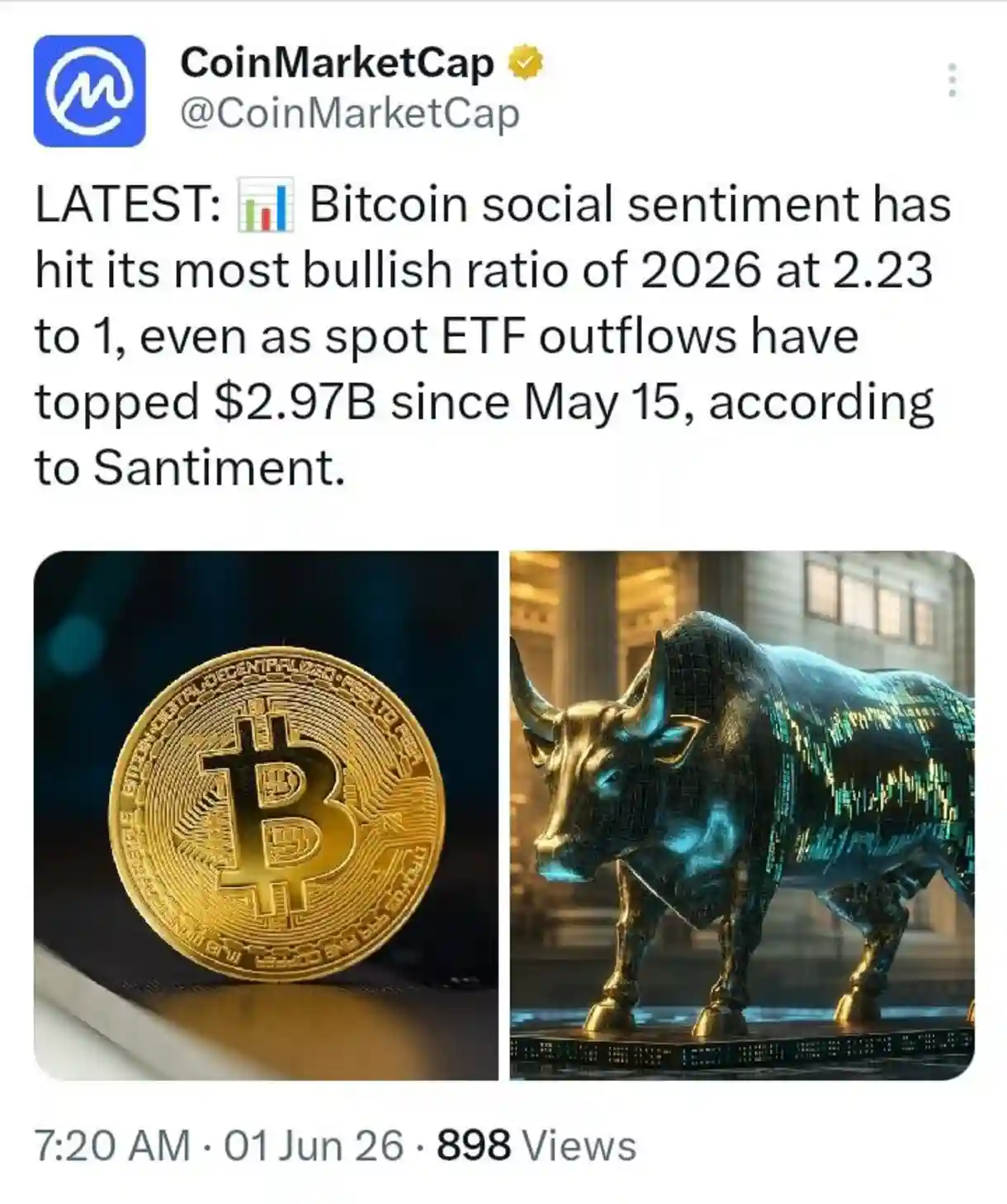
Santiment data reported by CoinMarketCap on June 1, 2026 shows Bitcoin social sentiment has hit its most bullish ratio of 2026 at 2.23 to 1 — even as spot ETF outflows have topped $2.97 billion since May 15.
Price down. Sentiment up. Institutions selling. Retail convinced. The last time this configuration appeared at scale, the recovery that followed was not subtle.
The Divergence That Contrarians Live For
The CoinGecko 7-day chart captured at approximately 14:15 UTC on June 2, 2026 is one of the cleaner illustrations of sustained institutional distribution the market has seen this cycle.
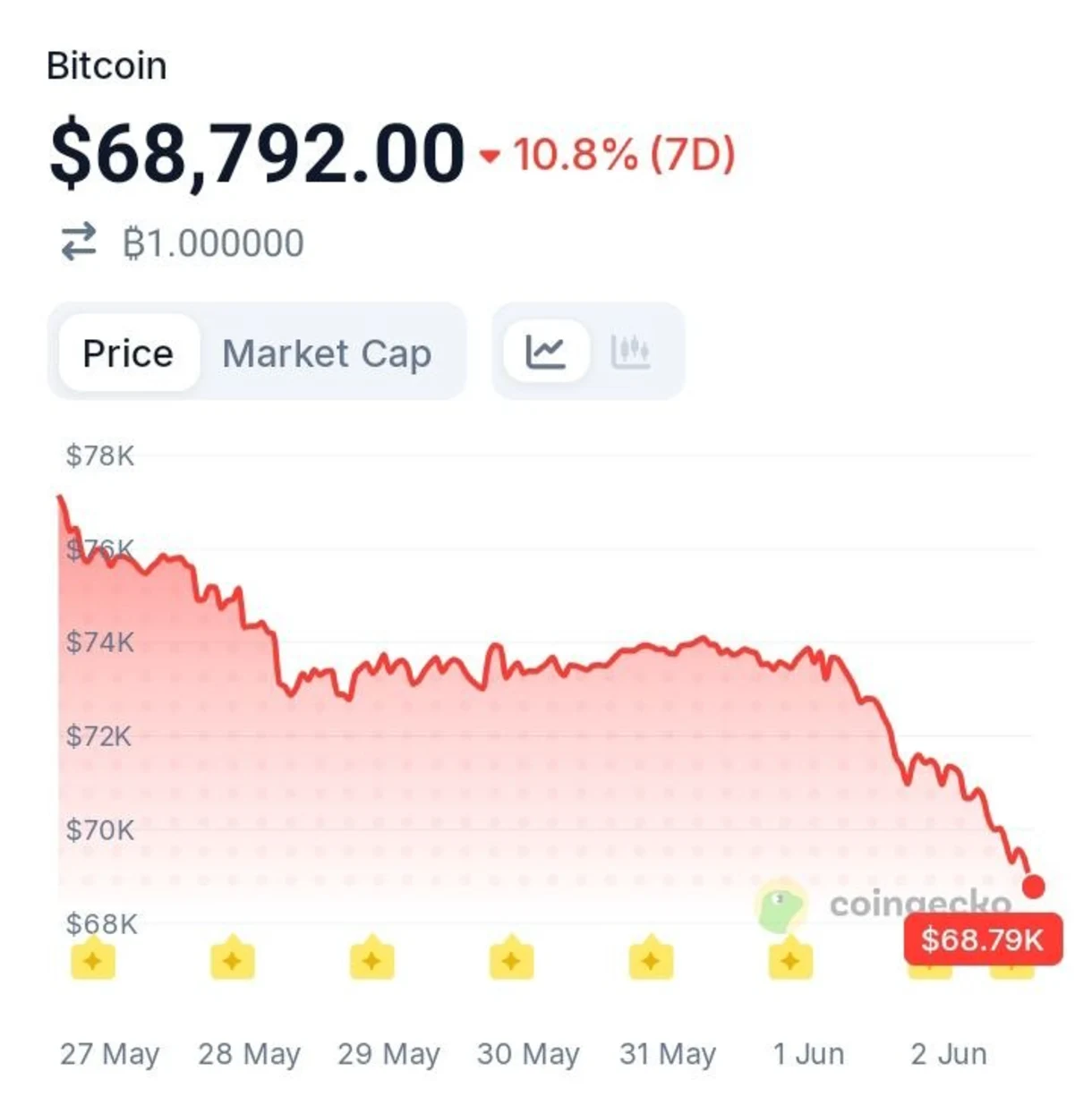
Bitcoin opened the period near $77,000 on May 27 and has not looked back once — a grinding, uninterrupted decline through $76,000, $74,000, $72,000, and now $70,000, closing at $68,792 and down 10.8% on the week.
There were no sharp flush-and-recover sequences, no dramatic wicks suggesting panic buying at support. Just a steady, directional step-down that has the structure of deliberate de-risking rather than retail fear.
The $2.97 billion in spot ETF outflows since May 15 confirms who has been doing the selling — and it is not the crowd that is currently 2.23 to 1 bullish on social media.
That gap between what retail sentiment is saying and what institutional flow data is doing is the tension the entire setup hinges on.
When the crowd is most convinced the bottom is in, and institutions are still walking out the door — one of them is about to be proven spectacularly wrong.
Why the Sentiment Signal Has Teeth
Extreme bullish sentiment during a price decline is not always a contrarian buy signal — context determines everything. But the specific configuration here carries historical weight.
A 2.23 to 1 bullish-to-bearish ratio on Santiment’s social data, reached while price is making new short-term lows rather than new highs, suggests the crowd is buying the narrative of a recovery rather than chasing momentum.
That is the psychologically cleaner version of the setup — believers accumulating conviction at lower prices, not tourists arriving late to a party.
When sentiment of this kind precedes an actual demand catalyst, the resulting move tends to be both sharp and sustained because the positioning is already in place before the trigger fires.
The risk is equally clear. $2.97 billion in ETF outflows since May 15 represents real Bitcoin hitting the market from the largest and most institutionally connected vehicles in the asset class.
Until those outflows reverse — or at minimum stabilise — the structural supply overhang remains. Retail sentiment cannot absorb institutional distribution indefinitely.
What Resolves the Contradiction
Three variables will determine which side of this trade ages better. First, the US-Iran MoU outcome — a signed agreement removes the macro risk-off pressure that has been the most credible explanation for the ETF outflow pattern.
Second, the CLARITY Act legislative trajectory — any progress toward regulatory certainty historically triggers institutional re-engagement with crypto allocations.
Third, and most immediately, whether this week’s ETF flow data shows a deceleration in outflows — a single week of neutral or positive flows into IBIT and its peers would signal that the institutional selling pressure is exhausting itself.
Bitcoin at $68,792, with social sentiment at its most bullish level of the year and over $2.97 billion in institutional outflows since mid-May, is a market at maximum internal contradiction.
Contradictions in markets do not persist indefinitely. They resolve — usually faster and more violently than anyone expects, and almost always in the direction that the majority is least prepared for.