Cronos’ $74M Tectonic Exploit Exposes a Risk Investors Can’t Ignore
Estimated Reading Time: 5 minutes
Don’t invest unless you’re prepared to lose all the money you invest. This is a high-risk investment and you are unlikely to be protected if something goes wrong. Take 2 minutes to learn more
A $74 million DeFi exploit has turned the spotlight on an uncomfortable question for Cronos investors: how much risk is hiding beneath the surface of a blockchain ecosystem that can be brought to a halt by an attack on a single lending protocol?
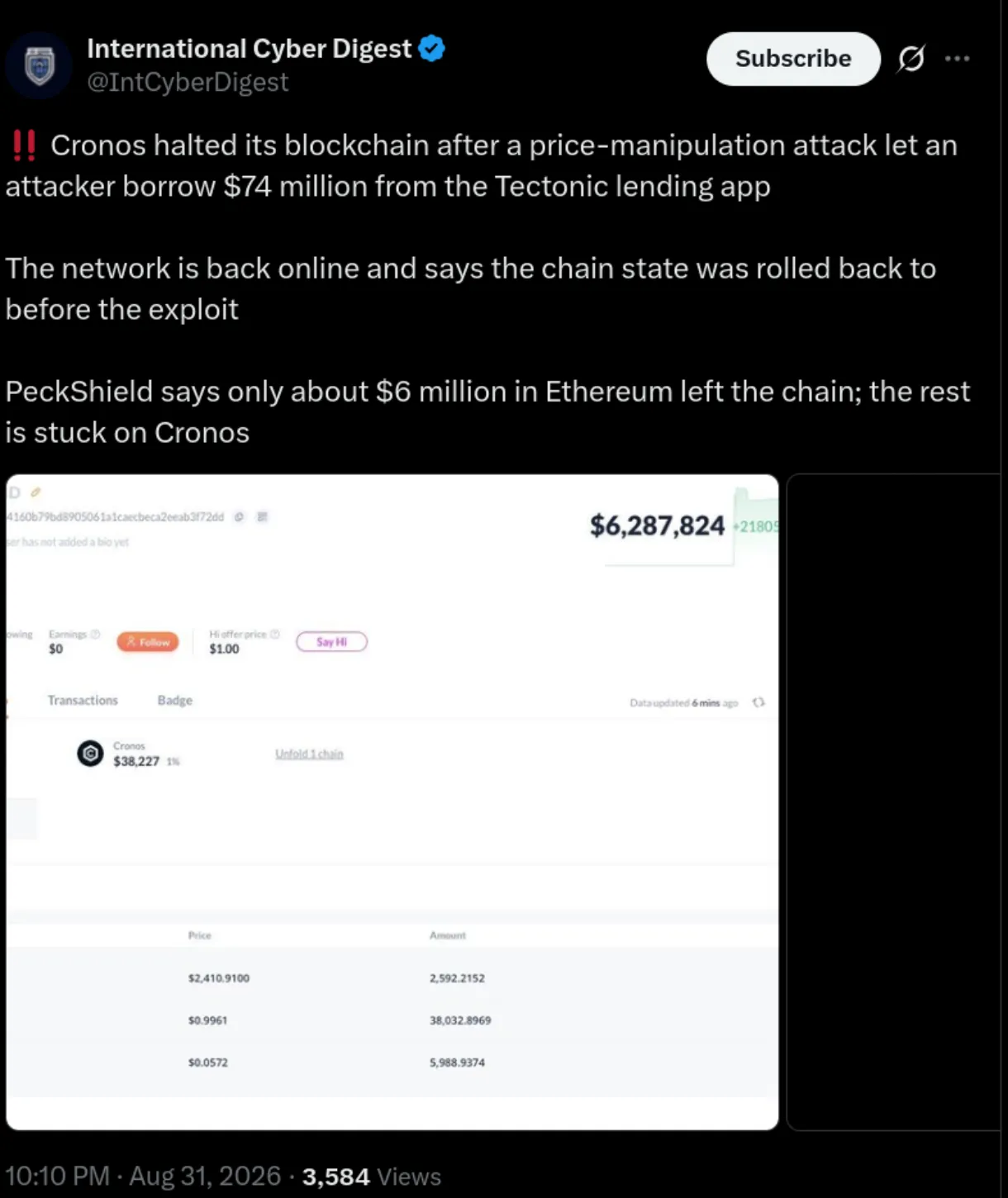
On August 30, Tectonic, the largest lending platform on Cronos, was exploited after an attacker manipulated the price of its native TONIC token and used the inflated value as collateral to borrow other crypto assets. PeckShield estimated that about $74 million was borrowed, although only around $6 million was moved to Ethereum before Cronos validators halted the network.
The incident is significant because it was not simply a case of an attacker finding a traditional smart-contract bug.
It appears to have exploited a weakness in how an illiquid token was valued as collateral.
The Attack Started With TONIC
According to blockchain analysis, TONIC had only around $1.34 million in liquidity before the attack, making it extremely vulnerable to price manipulation.
The attacker reportedly pushed TONIC’s price roughly 100 times higher within about 20 minutes. That artificial valuation was then used to deposit TONIC into Tectonic and borrow considerably more valuable assets against it.
The problem was the gap between market price and actual liquidity.
A token can appear to be worth millions or even billions based on its quoted price, but that does not mean millions of dollars can actually be sold at that price.
For investors, that distinction is crucial.
Why Did Cronos Halt the Entire Blockchain?
Once the exploit was detected, Cronos validators stopped producing blocks.
That decision effectively froze activity across the network, not just on Tectonic. The move prevented the attacker from transferring more funds away from Cronos and left roughly $60 million of suspected proceeds stranded on the chain.
Cronos has since restarted the network and restored the chain state to a point before the exploit.
From an investor’s perspective, this creates both a positive and negative takeaway.
The positive is that the emergency response appears to have limited the amount of money that actually escaped.
The negative is that a blockchain-wide shutdown demonstrates how an incident involving one major application can affect unrelated users and applications throughout the ecosystem.
The Bigger Risk Is Concentration
Tectonic was not a minor application.
Before the exploit, it held approximately $121.7 million in deposits and more than $82 million in active loans, making it the dominant lending protocol on Cronos. Its collapse therefore created a major shock for the chain’s DeFi economy.
This is where investors should look beyond the headline loss.
A healthy blockchain ecosystem needs more than a functioning base layer. It needs secure applications, sufficient liquidity, reliable price oracles and diversified economic activity.
If too much of that activity is concentrated in one lending protocol, a problem there can quickly become a problem for the wider ecosystem.
What Does this Mean for CRO?
The immediate temptation may be to treat the incident as simply another short-term crypto hack.
That could be a mistake.
For CRO investors, the more important question is whether the exploit changes confidence in the Cronos ecosystem.
The chain’s association with Crypto.com gives it significant visibility, but investors ultimately need to determine whether Cronos can maintain secure and sustainable on-chain activity.
The incident does not mean the CRO token itself was compromised. Crypto.com’s centralized exchange and app were also reported to be operating normally.
However, confidence is an important part of crypto valuations.
If developers, traders and capital providers become more cautious about deploying money on Cronos, lower DeFi activity could eventually affect the ecosystem’s growth.

Investors Should Watch What Happens Next
The exploit may therefore become less important than Cronos’ response.
Investors should watch whether Tectonic can recover, whether affected users are compensated, whether Cronos changes its approach to emergency interventions and whether lending protocols introduce stricter collateral and oracle controls.
Most importantly, investors should watch liquidity.
The attack demonstrated that a thinly traded token can become a dangerous form of collateral when a lending protocol treats its quoted market price as though it represents immediately available liquidity.
That is a lesson that extends far beyond Cronos.
For now, the $74 million figure makes the Tectonic exploit headline-worthy.
But the real investment story is deeper.
It is a reminder that in DeFi, the weakest risk control can sometimes matter more than the strength of the blockchain underneath it.