



The Proposal That Could Change Bitcoin Forever: 1 Million BTC for America
Estimated Reading Time: 5 minutes
Don’t invest unless you’re prepared to lose all the money you invest. This is a high-risk investment and you are unlikely to be protected if something goes wrong. Take 2 minutes to learn more

KEY TAKEAWAYS:
- A proposal to acquire 1 million BTC is gaining attention as a potential U.S. strategic reserve plan.
- At current prices, the cost would be far lower than buying near Bitcoin’s all-time highs.
- If adopted, the plan could significantly reduce available BTC supply and reshape the global market.
At the precise moment Bitcoin is printing its worst monthly performance since the 2022 bear market, a proposal circulating in Washington policy circles is asking a question that would have been dismissed as fantasy two years ago: should the United States government acquire 1 million Bitcoin as a strategic national reserve? The timing is either deeply ironic or perfectly deliberate — and for anyone who understands how transformative government accumulation at scale would be, the distinction matters enormously.
What the Proposal Actually Entails
The framework gaining traction among a bipartisan group of digital asset advocates and Senate allies draws directly from the logic of the Strategic Petroleum Reserve — a precedent that establishes the US government’s willingness to hold a finite, strategically important resource as a national hedge against supply disruption and geopolitical pressure.
Applied to Bitcoin, the proposal envisions the Treasury accumulating 1 million BTC over a multi-year window, representing approximately 4.76% of total supply, funded through a combination of existing seized asset holdings — the government already holds over 200,000 BTC from law enforcement actions — and new appropriations. Senator Cynthia Lummis’s BITCOIN Act has laid the formal legislative groundwork. The 1 million BTC target gives that groundwork a number that is specific enough to model and large enough to matter.
“One million Bitcoin in a US strategic reserve would not just change America’s balance sheet. It would change the global supply equation for every other buyer permanently.”
What the Charts Show Right Now
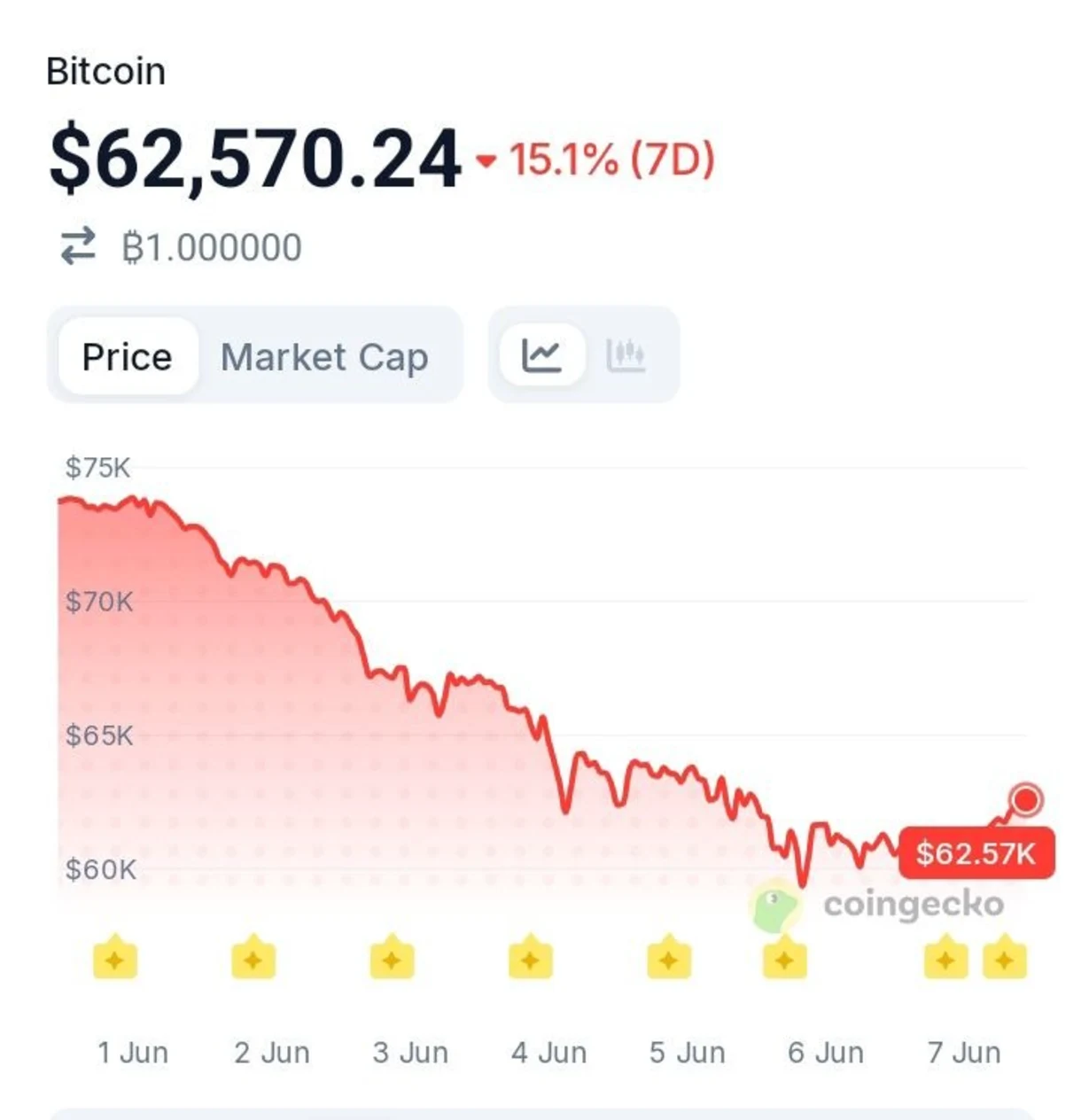
The CoinGecko data captured at approximately 12:00 UTC on June 7, 2026 presents the most uncomfortable and most compelling backdrop this proposal could have. On the 7-day chart, Bitcoin opened the week near $74,000 on June 1 and has declined without interruption through $70,000, $65,000, and into the $60,000 handle — closing at $62,570, down 15.1% on the week.
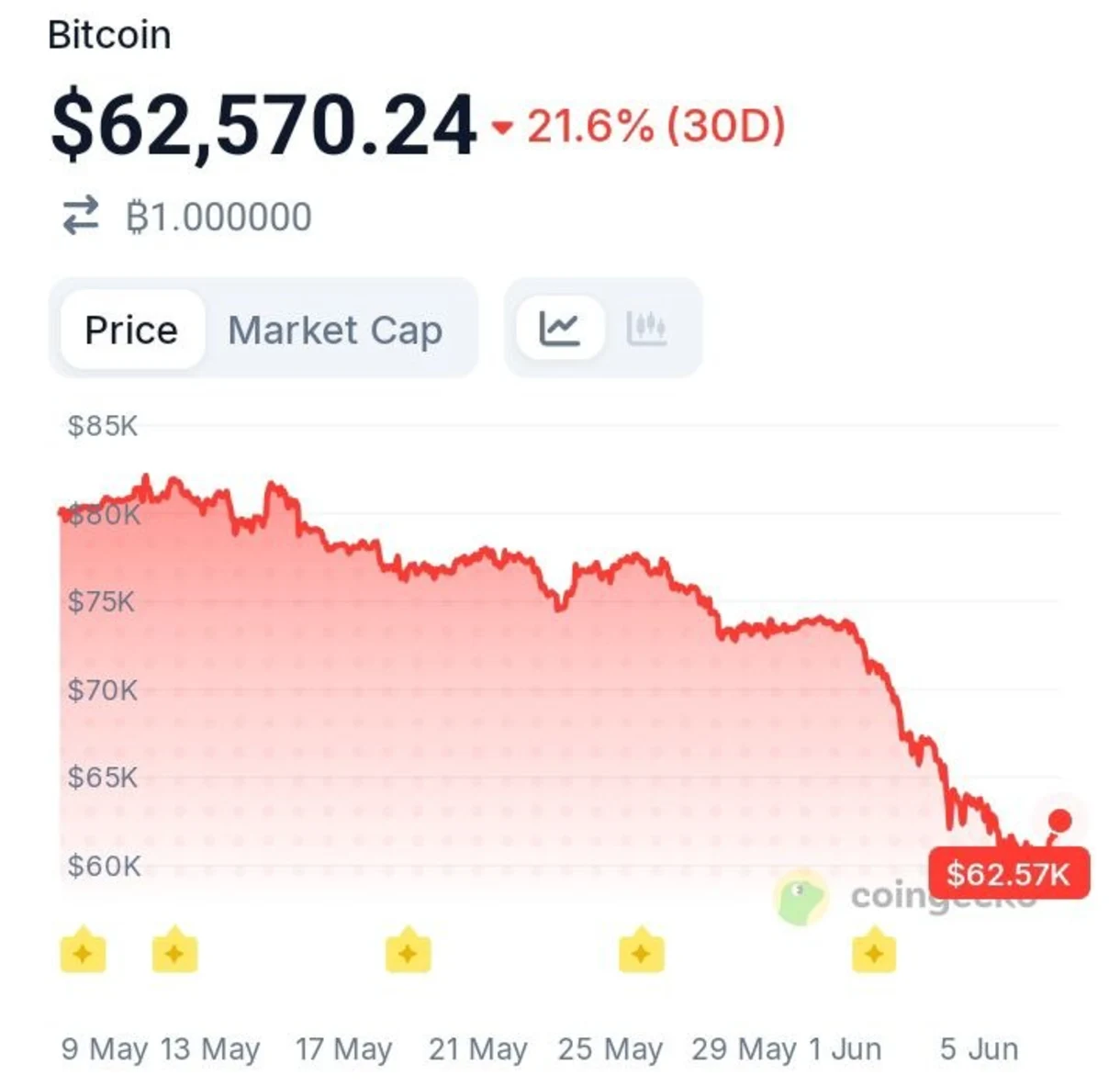
The 30-day chart extends that picture further: from a $80,000 opening in early May, Bitcoin has surrendered 21.6% to reach the same $62,570 print, with the final leg of the decline — from $70,000 to $62,000 — arriving in under five days. The absence of any meaningful bounce attempt, the clean breakdown through every prior support level, and the acceleration of selling into the $60,000 zone all point toward a market that has not yet found its clearing price.
That context reframes the 1 million BTC proposal in a specific way. If the US government were to begin accumulating at current prices, $62,570 per coin would imply a total acquisition cost of approximately $62.5 billion for the full million — less than 10% of the annual defence budget, and a fraction of the Federal Reserve’s balance sheet.
At $126,000 — Bitcoin’s all-time high reached earlier this cycle — the same acquisition would cost over $126 billion. The market is, right now, offering the United States a significant discount on the most consequential financial asset accumulation in modern government history.
Why the Supply Math Changes Everything
Bitcoin’s fixed supply of 21 million coins is the detail that makes government accumulation categorically different from any other asset purchase. When a government buys gold, it absorbs production that can be increased. When it buys Treasuries, it absorbs instruments that can be issued in unlimited quantities. When it buys 1 million Bitcoin, it permanently removes 4.76% of a supply that will never increase — and does so in direct competition with Strategy’s 843,738 BTC, BlackRock’s IBIT holdings, and every sovereign wealth fund quietly building a position.
El Salvador, Bhutan, and several Gulf states have already moved. A US acquisition at this scale would not just validate the thesis — it would structurally alter the available float for every other buyer in the market.
The proposal has not passed. The political obstacles are real. But the conversation has moved from whether governments should hold Bitcoin to how many, at what price, and who moves first. At $62,570, the answer to the third question has never been more consequential.

