


Leading Crypto Companies by Revenue
Estimated Reading Time: 5 minutes
Don’t invest unless you’re prepared to lose all the money you invest. This is a high-risk investment and you are unlikely to be protected if something goes wrong. Take 2 minutes to learn more

Savvy crypto investors often start with a fundamental question: Is this crypto company generating profit? Key metrics such as revenue, fees, market capitalization, and daily active users (DAUs) are crucial for assessing the financial health of a crypto enterprise.
In the cryptocurrency sector, “revenue” refers to the total fees a company earns, which are reinvested into the protocol. This revenue typically comes from various transaction fees, including:
Network Fees: These are paid by users to block miners or validators from processing transactions.
Trading Fees: Users incur these fees when they swap tokens on decentralized exchanges (DEX) like Uniswap.
Lending Fees: Borrowers pay these fees on decentralized finance (DeFi) lending platforms such as Aave and Compound.
While some fees are distributed to users or network participants, a portion is retained by the crypto company to support organizational operations, development projects, or innovations. This retained portion is what constitutes the company’s “revenue.”
Leading Blockchains by Revenue
Ethereum
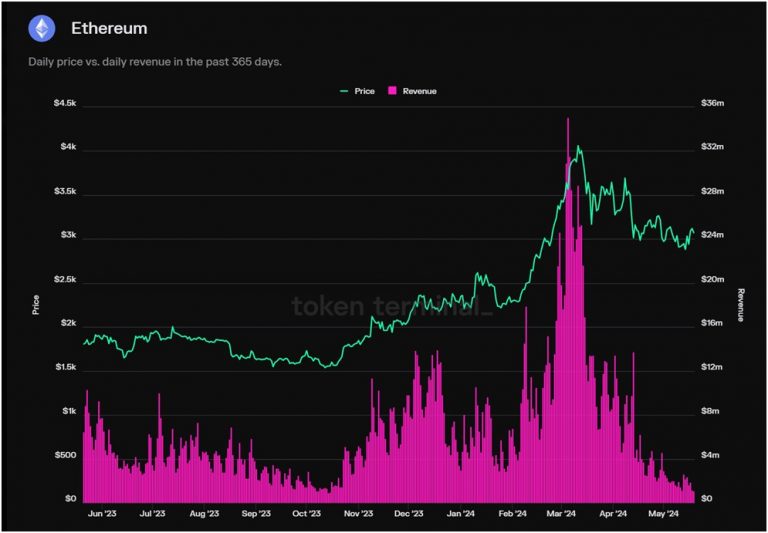
Ethereum’s revenue is primarily derived from network fees, commonly known as gas fees. These fees are particularly influenced by Layer-2 solutions built on the Ethereum network, which can add significant additional fees.
In 2021, Ethereum implemented the EIP 1559 upgrade, which restructured the fee system. The upgrade replaced the traditional auction model for gas prices with a new system based on block-based and sender-specified maximum fees.
Daily revenue on the Ethereum blockchain reached over $35 million in March 2024. This surge was driven by increased activity in decentralized finance (DeFi) and non-fungible tokens (NFTs) during the first quarter of the year. Additionally, the hype around meme coins contributed to the rise in transaction counts, further boosting revenue.
There is a direct correlation between Ethereum’s revenue, its price, and its market capitalization. As transaction activity increases, so do the associated fees, which in turn impact the overall revenue and market valuation of Ethereum.
Tron
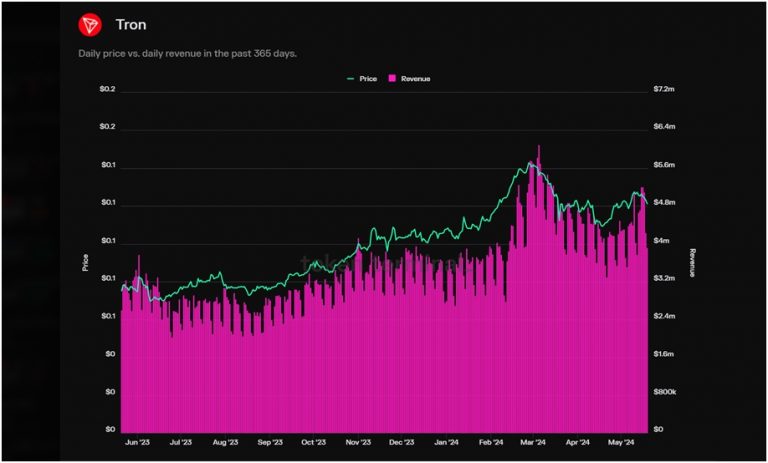
Tron generates revenue by imposing fees on TRX transactions, which are subsequently burned to promote the token’s deflationary model.
Positioned as an Ethereum alternative with a strong emphasis on the Asian markets, Tron was launched in 2017 by the notable crypto entrepreneur Justin Sun, who gained attention for paying $4.5 million for a charity dinner with Warren Buffett.
Tron utilizes a Delegated Proof of Stake (DPoS) consensus algorithm, which is more efficient yet centralized compared to other models. This algorithm allows Tron to operate as the 14th largest blockchain network globally.
With a Total Value Locked (TVL) exceeding $9 billion, Tron ranks as the second-largest player in the DeFi sector, following Ethereum. However, its ecosystem is somewhat isolated, with nearly $7 billion of its TVL concentrated in its lending protocol, JustLend.
Maker DAO
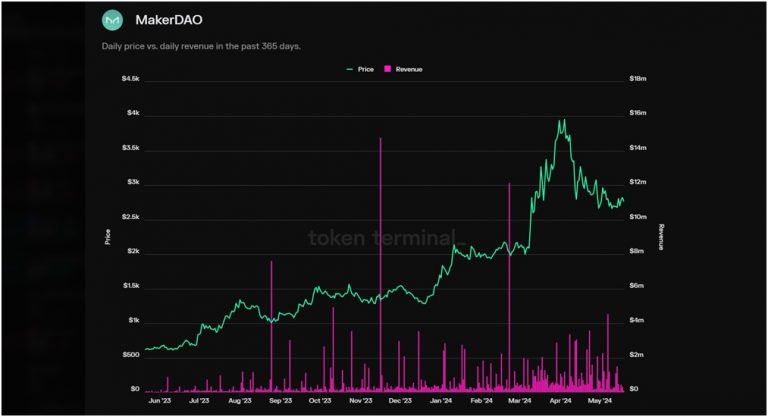
MakerDAO’s revenue comes from several sources, including interest paid by borrowers, liquidated collateral, and fees associated with maintaining the DAI stablecoin peg.
The company is one of the largest DeFi applications by Total Value Locked (TVL), with over $9 billion worth of cryptocurrency locked in its smart contracts.
As an Ethereum-based protocol, MakerDAO serves both as a lending platform and a monetary system, issuing the USD-backed stablecoin DAI.
MakerDAO’s daily revenue typically stays below $1 million but can occasionally spike to over $1 million, with rare surges surpassing $10 million. Although there’s a lower direct correlation between The company’s revenue and the price of its token, there is a clear link between Ethereum’s performance and Maker’s revenue streams, given that it is built on Ethereum. Thus, due diligence for MakerDAO often involves an analysis of Ethereum (ETH) as well.
Conclusion
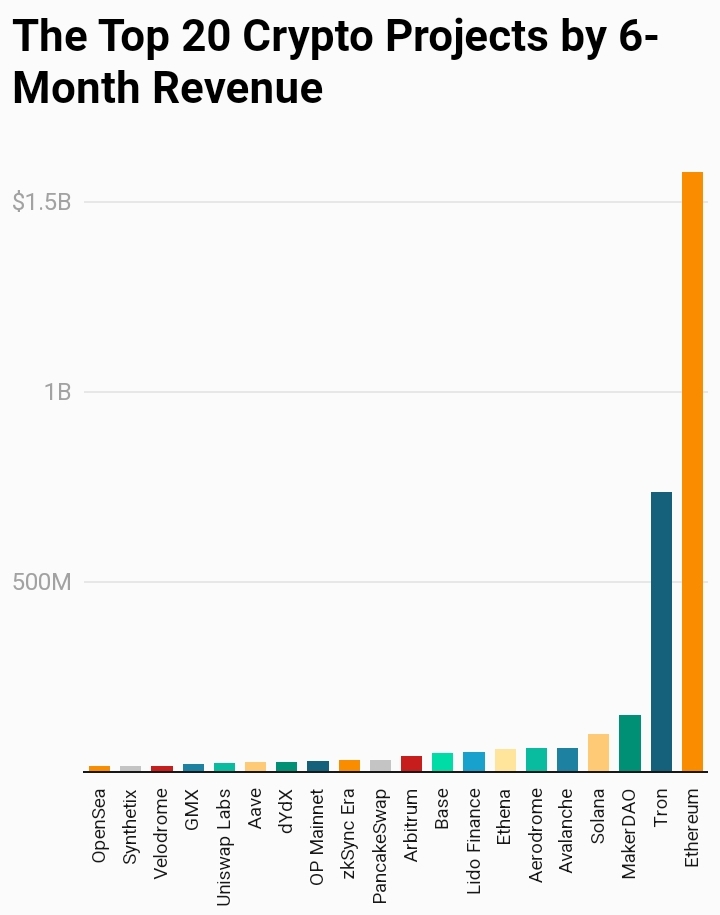
Evaluating cryptocurrency projects using key metrics such as daily active users (DAUs), revenue/fees, and market capitalization offers valuable insights into their overall health and long-term viability. Projects that generate substantial revenue, like Ethereum and Solana, indicate strong demand and practical utility, suggesting a robust potential for growth and resilience over time.
To gain a comprehensive understanding of these metrics, check out our detailed pages on DAUs, revenue, daily active developers, and market cap. Familiarizing yourself with these aspects is essential for making informed investment choices in the volatile crypto market.