


Stablecoins Face First Market Decline in Over Two Years: CoinDesk Data
Estimated Reading Time: 4 minutes
Don’t invest unless you’re prepared to lose all the money you invest. This is a high-risk investment and you are unlikely to be protected if something goes wrong. Take 2 minutes to learn more

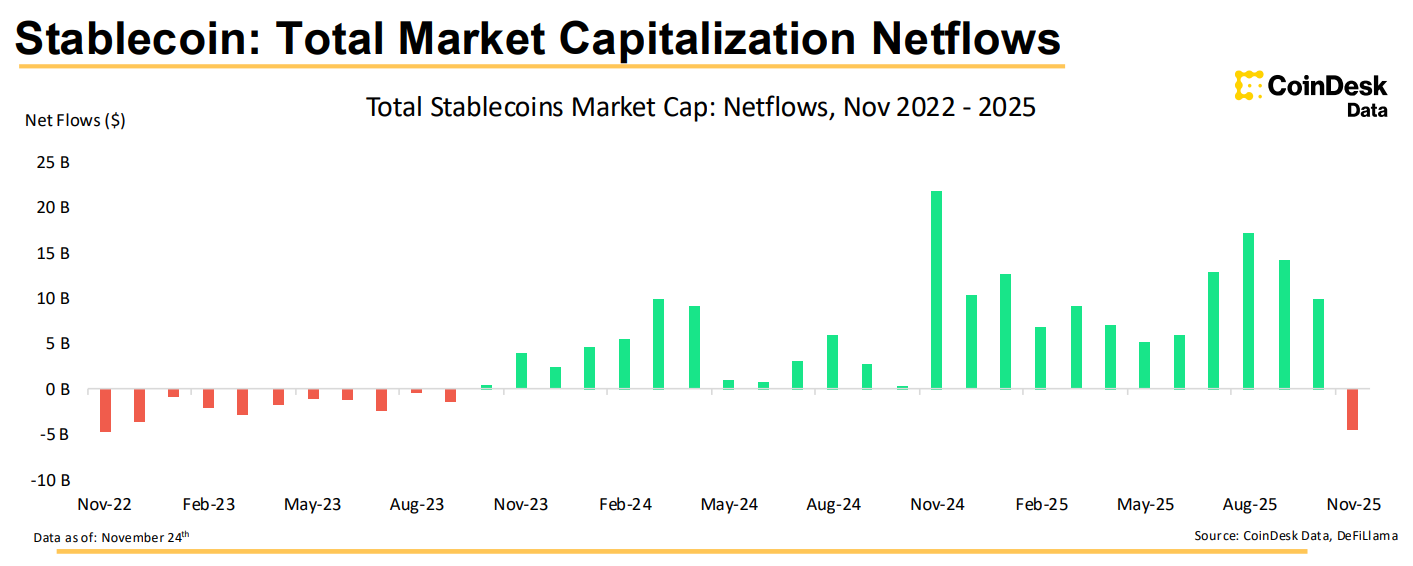
Stablecoins hit a rough patch in November 2025, with the market shrinking by 1.48% to $303 billion. This marks the first monthly drop in 26 months, signaling a shift in crypto market dynamics that traders should pay attention to.
Why the Stablecoins Are Contracting
The decline isn’t happening in isolation. Bitcoin and other major cryptocurrencies have been sliding to new multi-month lows, and money is flowing out of digital assets across the board.
When stablecoins decrease in circulation, it typically means investors are pulling capital out of crypto markets entirely, converting back to traditional currencies. Despite the overall market contraction, not all stablecoins are suffering equally.
According to the latest CoinDesk Data report, Tether (USDT) continues its remarkable run, growing for the 27th consecutive month. Its market cap rose 0.56% to $184 billion, and its dominance increased from 59.6% to 60.9%, the highest level since July.
On the flip side, USD Coin (USDC) saw its market cap fall 2.71% to $73.5 billion, while Ethena USDe dropped significantly by 22.5% to $7.39 billion. These outflows totaled over $4 billion combined, more than offsetting Tether’s gains.
Trading Activity Tells a Similar Story for Stablecoins
Trading volumes for stablecoin pairs reached $1.48 trillion on centralized exchanges as of November 24.
However, overall activity is trending downward compared to October. Tether maintained its grip on trading volume, accounting for 75.8% of all stablecoin trades. USDC captured 15.2% of the market, with First Digital USD (FDUSD) taking 7.88%.
The combination of reduced market cap and declining trading volumes suggests investors are becoming more cautious, waiting for clearer market signals before committing capital.
Winners in a Down Market
Some stablecoins managed impressive growth despite the challenging environment. PayPal USD (PYUSD) jumped 28.8% to reach $3.63 billion, while Sky Protocol’s Sky Dollar (USDS) increased 9.01% to $5.74 billion.
Ripple’s RLUSD hit a major milestone, crossing $1 billion in market cap for the first time with a 27.3% surge to $1.16 billion. This makes it the 22nd stablecoin to reach this threshold.
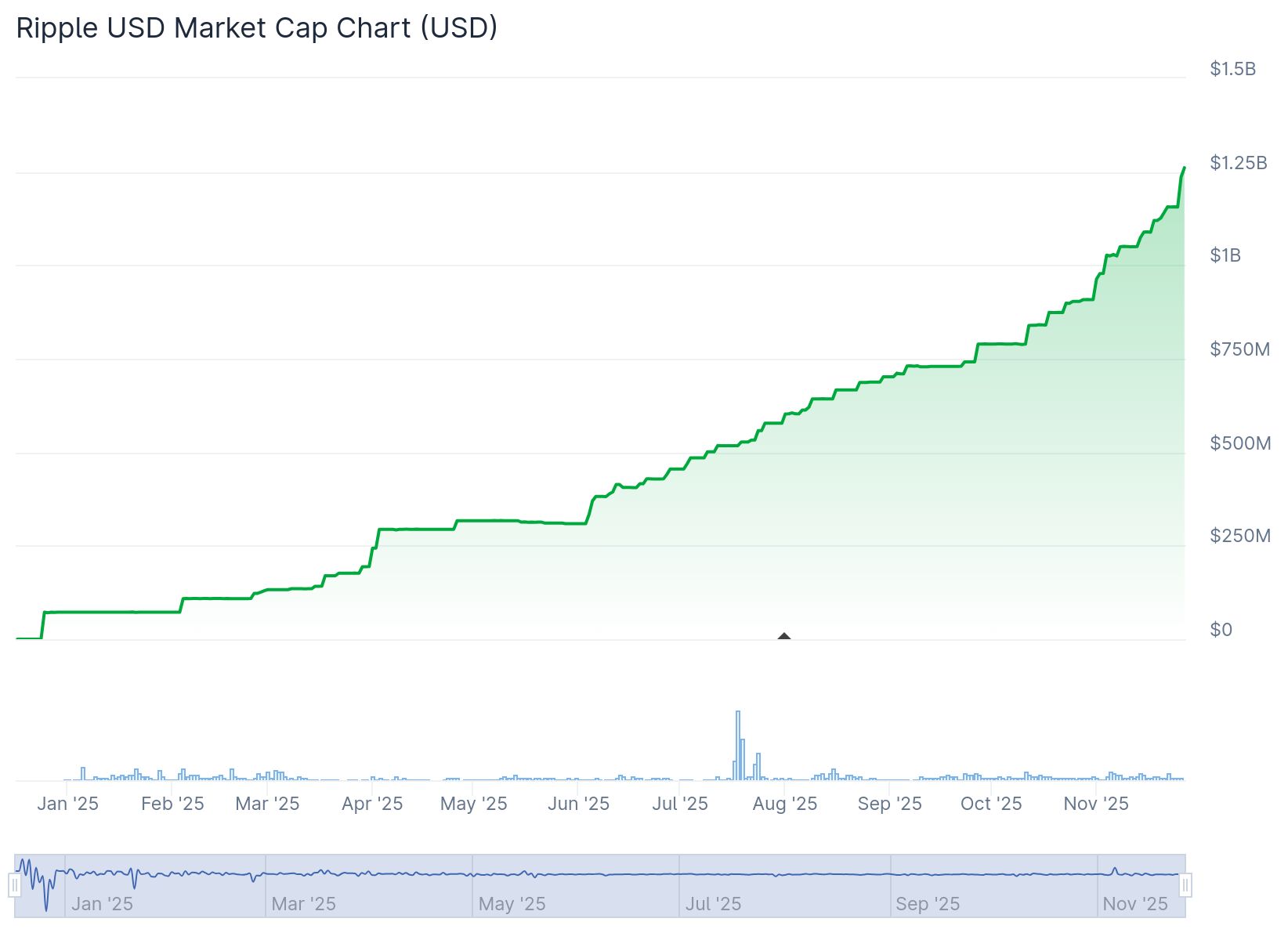
The growth came partly from Ripple’s partnership with Mastercard, WebBank, and Gemini to explore fiat settlement options using their network.
Circle’s euro-pegged EURC also reached record highs, hitting $312 million in market cap and breaking monthly trading volume records on centralized exchanges. The broader euro-pegged stablecoin market climbed to $638 million, its highest point since March 2022.
The Synthetic Stablecoin Crisis
November wasn’t just about market-wide trends. A major crisis hit synthetic stablecoins when Stream Finance disclosed a $93 million loss on November 4 and froze withdrawals. Their stablecoin xUSD lost its peg, dropping below $0.30.
The damage spread quickly. Elixir’s deUSD collapsed to nearly zero (under $0.02) because 65% of its backing was debt owed by Stream Finance. Stable Labs’ USDX also suffered, falling below $0.60.
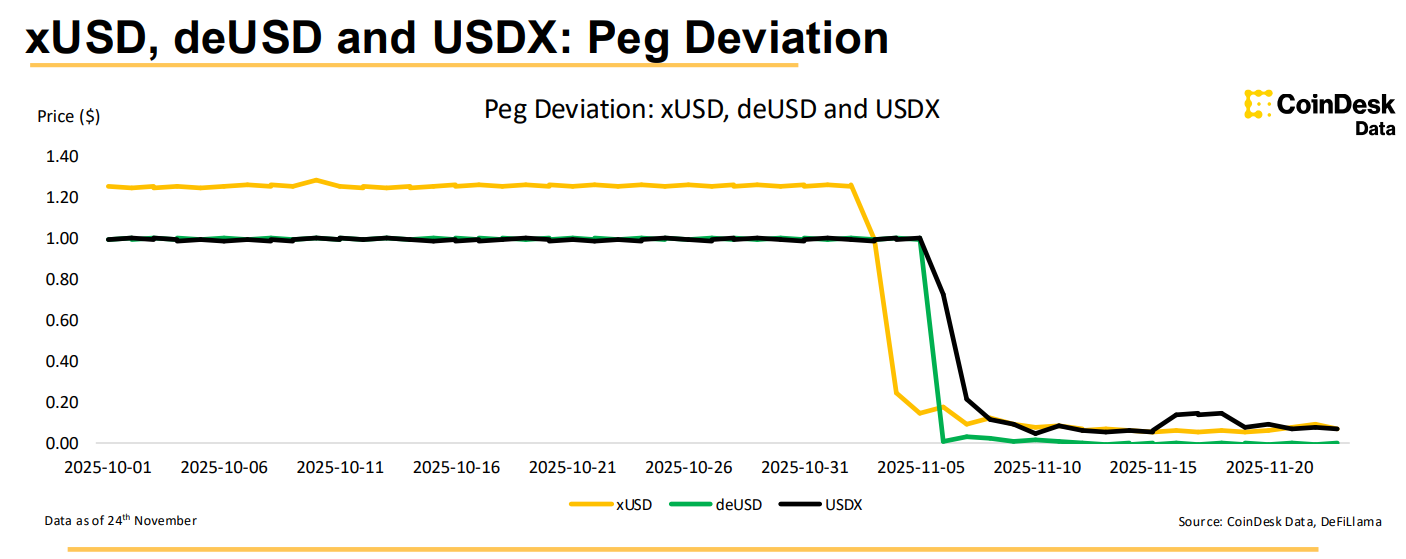
This incident showed the risks of complex leverage strategies and interconnected collateral systems in the stablecoin space.
What This Means for You
For crypto traders and investors, November’s data carries important implications. The stablecoin market often serves as a liquidity indicator for the broader crypto ecosystem. When stablecoins contract, it suggests people are moving money out rather than preparing to buy the dip.
However, the market isn’t uniform. Some projects are clearly gaining traction despite headwinds, suggesting opportunities still exist for those who choose carefully. The synthetic stablecoin failures also reinforce the importance of understanding how different stablecoins maintain their pegs and what risks they carry.
As we head into the final weeks of 2025, watching stablecoin flows can provide early signals about where the crypto market might be heading next.
Interested in learning how to day-trade crypto? Get all the information you’ll need here.