


Grayscale Sees Solana as Crypto’s Trading Hub
Estimated Reading Time: 5 minutes
Don’t invest unless you’re prepared to lose all the money you invest. This is a high-risk investment and you are unlikely to be protected if something goes wrong. Take 2 minutes to learn more
Grayscale Research recently labeled Solana “crypto’s financial bazaar,” and the data backs up this characterization. The network currently generates approximately $5 billion in annualized fees while hosting over 500 active applications that process thousands of transactions per second.
The comparison makes sense when you examine the underlying metrics. Solana processes new blocks every 400 milliseconds with transaction fees averaging just two cents, making it one of the fastest and cheapest networks available.
Over 1,000 developers now build on Solana full-time, creating the second-largest developer community after Ethereum.
DeFi platforms on Solana have facilitated over $1.2 trillion in trading volume year-to-date, with Raydium and Jupiter leading the ecosystem. Social and meme coin platforms like Pump.fun generate more than $1.2 million in daily revenue from roughly 2 million monthly users.
In the DePIN sector, Helium continues expanding its decentralized wireless network with over 112,000 hotspots and major partnerships with AT&T and Telefonica.
Price Action Shows Mixed Signals
SOL currently trades around $193 after pulling back from its recent high above $230, creating divergent views among market analysts. Some interpret this as healthy consolidation before the next move higher, while others express concern about recent whale activity patterns.
Technical trader Lark Davis notes that SOL sits between key resistance at $220 and support at $169. He believes a breakout above resistance could propel SOL prices past the $300 psychological level, with Fibonacci extension targets pointing to $346, $453, and potentially $540.
$SOL is tightening up between key levels.
If it breaks upwards, the Fib 1.618 points toward $300+
If it breaks down, the next possible support levels are at $169 → $125 → $95
One clean move from here decides the next major trend. pic.twitter.com/z7bDZYxirF
— Lark Davis (@TheCryptoLark) October 14, 2025
However, there are legitimate reasons for caution in the current market environment. Major holders reduced their perpetual futures positions by 70% over the past week, while whales cut their net positions by 103%.
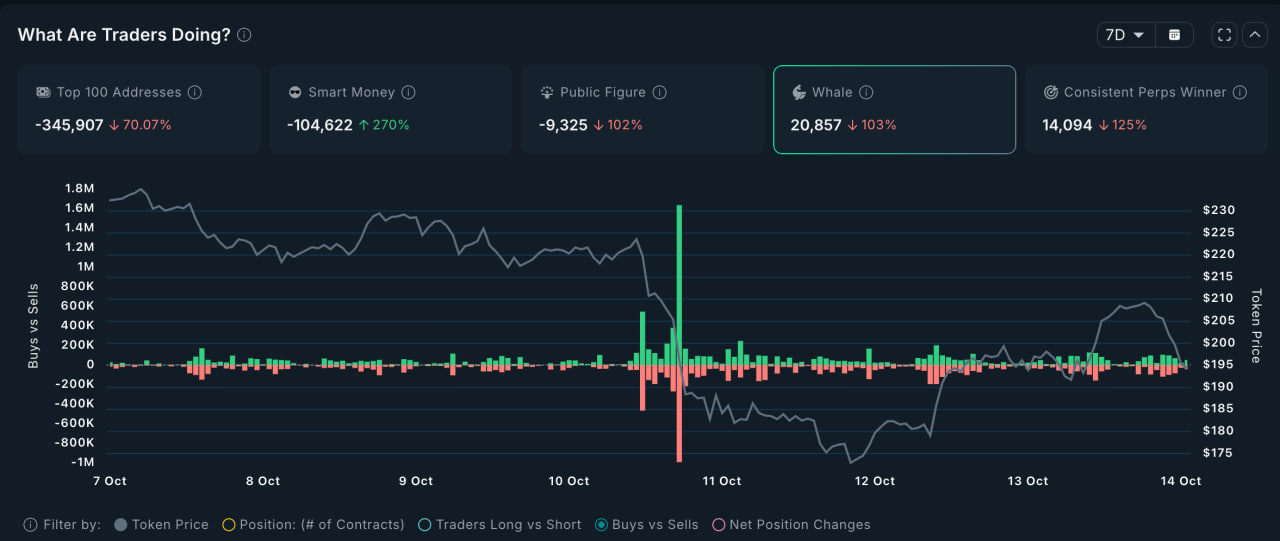
This significant selling pressure from large players creates uncertainty about near-term price direction.
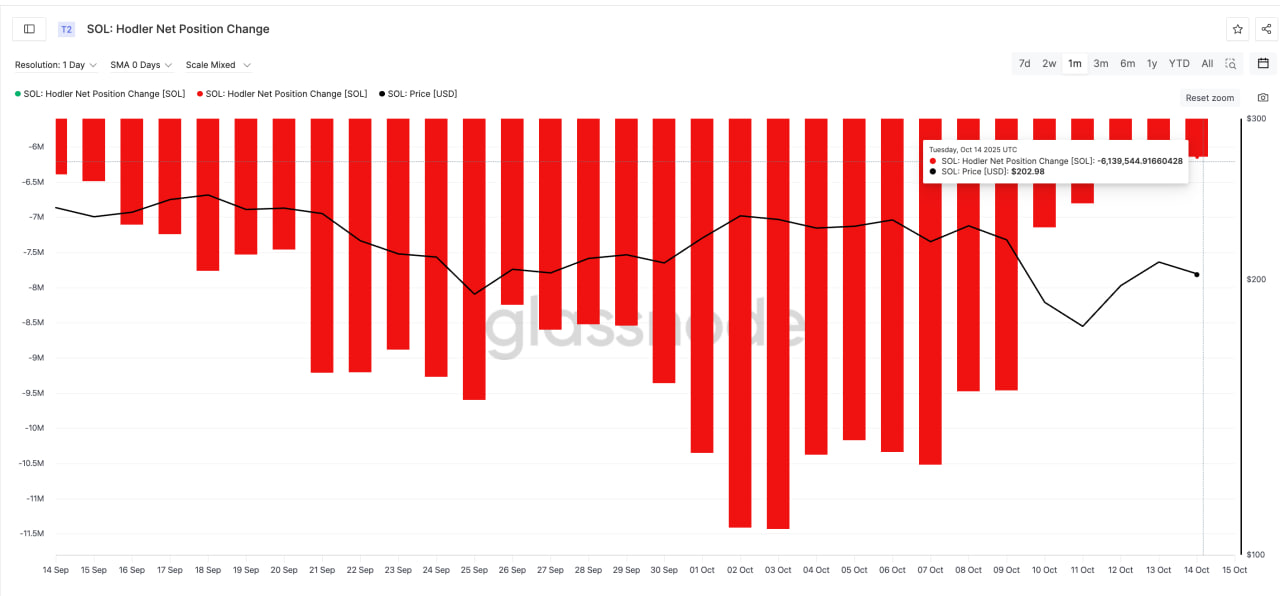
The Balance of Power indicator currently reads -0.65, indicating that sellers maintain control of the market. Despite this bearish signal, long-term holders have reduced their net selling by 46% recently, while short-term traders continue accumulating, with their holdings increasing from 11% to 16% of total supply.
New Liquidity Flows Into Solana
Tether recently brought omnichain versions of USDT and Tether Gold to Solana through Legacy Mesh, an interoperability network that connects stablecoin liquidity across multiple blockchains.
These aren’t regular Tether products but rather omnichain versions that link native USDT liquidity pools across different networks without requiring wrapped tokens.
USDT0 has already processed over $25 billion in bridge volume across more than 32,000 transfers since launch.
This development could position Solana as a more attractive platform for institutional trading and settlement, especially given growing interest from traditional finance players.
Bitwise’s Matt Hougan recently suggested that banks might prefer Solana for stablecoin transactions due to its speed and low costs. The network’s technical capabilities align well with institutional requirements for high-throughput, low-latency trading infrastructure.
What This Means for Traders
Solana finds itself at an interesting crossroads where strong fundamentals meet cautious behavior from major holders. The network continues growing in terms of users, developers, and on-chain activity, but whale confidence needs to return before expecting significant price movements.
For now, Solana maintains its position as the most active smart contract network by usage metrics. Whether this fundamental strength translates into price appreciation will depend on broader market conditions and the return of institutional confidence in the near term.
Interested in learning how to day-trade crypto? Get all the information you’ll need here.