


Nasdaq and CME Seek Safer Digital Asset Access
Estimated Reading Time: 3 minutes
Don’t invest unless you’re prepared to lose all the money you invest. This is a high-risk investment and you are unlikely to be protected if something goes wrong. Take 2 minutes to learn more

It has been noticed that growing institutional demand for digital assets is remolding crypto markets, their structure, and their measure. Meanwhile, on January 8, Nasdaq Inc. and CME Group Inc. announced the relaunch of the Nasdaq Crypto Index under a new name, the Nasdaq CME digital asset Index. This is presenting it as a regulated benchmark designed for institutional investors.
Additionally, the move reflects increasing regulatory clarity in the United States and a shift toward familiar, transparent market standards. Company executives said the redesigned index is intended to provide diversified exposure to digital assets within a framework that meets institutional expectations.
Regulation and Institutional Benchmark Drive the Reboot
Nasdaq and CME Group explained that the updated index is not a simple rebranding exercise. Giovanni Vicioso, Executive Director of Equity and Alternative Products, was reported as saying that the initiative combines two established market standards to deliver regulated diversification that investors now expect. He added that the market is demanding foundational tools that align with traditional finance practices.
Sean Wasserman, Head of Index Product Management, reportedly stated that improving regulatory clarity, especially in the United States, has created room for more structured crypto investment products.
To this end, he noted that investors are increasingly seeking regulated solutions similar to those used in equities and other asset classes. This further brings to the limelight why people are turning away from single-asset strategies towards broader index approaches.
Index Structure, Asset Mix, and Market Coverage
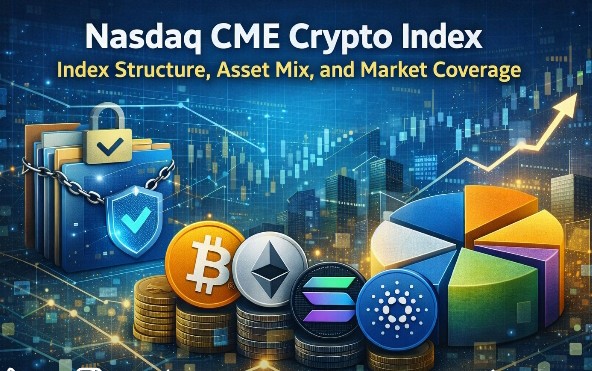
The Nasdaq CME Crypto Index is designed specifically for institutional use. It tracks a diversified basket of U.S. dollar–traded digital assets while applying strict rules on liquidity, exchange quality, and custody. Moreover, the list of assets on the index is weighted using a free-float market capitalization method and is reviewed every quarter under the supervision of the Nasdaq Index Management Committee.
However, pricing and calculation are handled by CF Benchmarks, while Nasdaq publishes a transparent methodology covering eligibility, weighting, governance, and rebalancing.
To this end, as of September 30, pricing data was sourced from major exchanges such as Coinbase, Kraken, Gemini, and Bitstamp. However, Bitcoin remained the largest component, followed by Ethereum, XRP, Solana, and Cardano, offering institutions a regulated gateway into the broader digital token market.
In order to place winning trades with us via Bybit, you can open an account here.