



JPMorgan Just Issued a Warning That Could Shake Two Crypto Giants
Estimated Reading Time: 4 minutes
Don’t invest unless you’re prepared to lose all the money you invest. This is a high-risk investment and you are unlikely to be protected if something goes wrong. Take 2 minutes to learn more
Key Takeaways:
- JPMorgan cut earnings forecasts for Circle and Coinbase over the Hyperliquid-USDC deal.
- Hyperliquid’s revenue-sharing model is squeezing USDC profit margins.
- USDC adoption is growing, but profitability is under pressure.
When a bank the size of JPMorgan cuts earnings forecasts for two of crypto’s most prominent public companies on the same day, the market pays attention — especially when the culprit is a deal both firms signed to grow, not shrink, their business.
CoinMarketCap reported on July 15, 2026 that JPMorgan cut earnings estimates for both Circle and Coinbase, citing pressure from Hyperliquid’s USDC revenue-sharing arrangement. Under the revised structure, Coinbase now classifies USDC held on Hyperliquid as “on-platform,” collecting the reserve income generated by those deposits but paying 90% of it directly to Hyperliquid — a sharp departure from the near-even split Coinbase previously maintained with Circle.

A Deal Meant to Grow USDC Is Now Squeezing Its Own Partners
The arrangement traces back to May 14, 2026, when Circle and Coinbase announced their partnership with Hyperliquid to deepen USDC integration across the exchange’s spot and perpetual futures markets. Since June 11, USDC has held the position of Hyperliquid’s preferred stablecoin.
That adoption came at a cost: analysts led by Kenneth Worthington described the resulting economics as a “prisoner’s dilemma,” one that pushes Circle and Coinbase to compete against each other for USDC distribution rather than share in its growth together.
JPMorgan estimates Hyperliquid now holds roughly $6 billion in USDC — about 8% of the stablecoin’s entire circulating supply. That’s no longer a marginal distribution channel. It’s large enough that the terms Coinbase offered to secure it are reshaping how much revenue both companies can expect to keep.
The Numbers Behind the Downgrade
The pressure isn’t isolated to the Hyperliquid deal. JPMorgan also pointed to a broader slowdown: total crypto market capitalization fell 13% during the quarter, spot trading volume dropped 24% quarter-over-quarter, and USDC’s circulating supply has slipped to around $73 billion from nearly $80 billion in March. That’s part of a roughly $10 billion contraction across the entire stablecoin market since May, as trading activity cooled and regulated competitors chipped away at both USDC and USDT’s dominance.
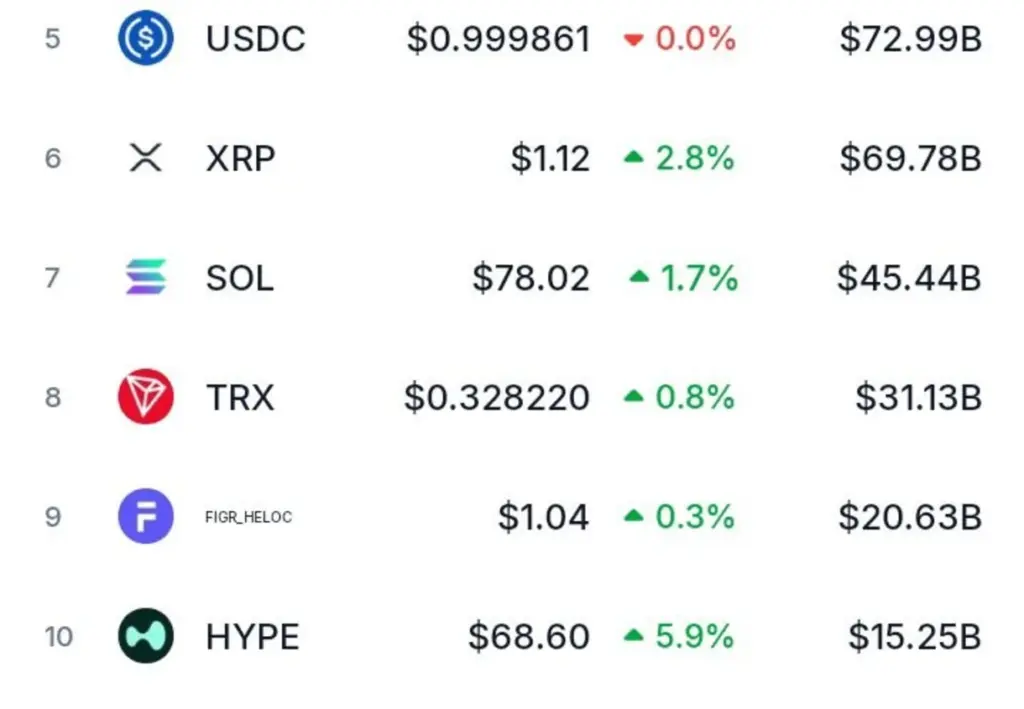
Looking at the market snapshot from CoinMarketCap on July 15, 2026, USDC trades at $0.999861, essentially flat on the day, while HYPE stands out as the strongest mover among major tokens, up 5.9% to $68.60 — a reminder that what pressures Circle and Coinbase’s margins may be doing the opposite for Hyperliquid’s own token.
Growth Versus Margin, Not Growth Versus Decline
JPMorgan isn’t calling USDC’s long-term story broken. The bank still expects USDC-related earnings to grow through 2027, aided by an anticipated 25 basis point Federal Reserve rate increase in October that would boost income on the reserves backing the stablecoin. The concern is narrower and more structural: as more platforms the size of Hyperliquid negotiate similar terms, Circle and Coinbase may keep expanding USDC’s reach while retaining a shrinking share of the profit that comes with it.
Whether this becomes the template other major venues use to negotiate their own USDC terms — or a one-off concession to lock in the largest distribution partner available — is the question that will decide how much of this quarter’s downgrade turns out to be temporary.