


Arbitrum Expands Into Institutional Finance as New Developments Reshape ARB’s Outlook
Estimated Reading Time: 7 minutes
Don’t invest unless you’re prepared to lose all the money you invest. This is a high-risk investment and you are unlikely to be protected if something goes wrong. Take 2 minutes to learn more
Arbitrum is entering a potentially important phase of its development as the network expands beyond its traditional role as an Ethereum Layer 2.
Recent developments involving Robinhood, zero-knowledge settlement and the latest ArbOS upgrade are strengthening Arbitrum’s position as infrastructure for financial applications. For ARB investors, the key question is whether this growing ecosystem can eventually translate into greater economic value for the token.
Robinhood Brings Tokenized Finance to Arbitrum
One of the biggest developments is Robinhood Chain, which went live on mainnet in July using the Arbitrum platform.
Robinhood previously launched tokenized U.S. stocks and exchange-traded products on Arbitrum One. Its dedicated chain now provides a more customized environment for tokenized assets and financial applications, while remaining connected to Ethereum’s security model.
This is significant because Robinhood gives Arbitrum exposure to a large traditional-finance audience.
The development also fits into Arbitrum’s broader strategy of allowing companies to launch dedicated blockchains using its technology. For investors, this creates a potential new source of ecosystem activity beyond Arbitrum One.

The Numbers Show Growing Ecosystem Activity
Arbitrum’s latest first-half 2026 progress report provides some evidence that this strategy is gaining traction.
The network processed 478 million transactions during the first half of the year, while average monthly stablecoin transfer volume exceeded $70 billion. Arbitrum also ranked first for tokenized real-world-asset deployments during the period.
More importantly for ARB investors, ArbitrumDAO recorded $6.19 million in income during the first half of 2026 from transaction fees, Timeboost, expansion-program licence fees and treasury income.
Robinhood Chain became part of this revenue model after its July mainnet launch. Under the Arbitrum Expansion Program, participating chains that settle outside Arbitrum One and Nova return 10% of net protocol revenue to the Arbitrum ecosystem.
That could become an important part of the long-term ARB investment story.
Faster Settlement Could Make Arbitrum More Attractive
Arbitrum is also working on zero-knowledge settlement, which could significantly improve the network’s efficiency.
The current optimistic-rollup model can involve a seven-day challenge period for certain settlements. Arbitrum’s ZK roadmap aims to reduce settlement times from days to potentially hours by using zero-knowledge proofs alongside its existing fraud-proof system.
For financial applications, this matters.
Faster settlement means capital can potentially move more quickly between networks and applications. That could make Arbitrum more attractive to institutions, bridges and protocols where capital efficiency is particularly important.
ArbOS Elara Adds Another Institutional Feature
Arbitrum’s August ArbOS Elara upgrade adds another piece to this strategy.
The upgrade introduced protocol-level compliance filtering for dedicated blockchains, customizable priority fees, and improvements to Arbitrum One, including a fourfold increase in Stylus smart-contract capacity.
The compliance feature could be especially important for traditional financial institutions.
Banks and regulated companies often require greater control over who can interact with their blockchain-based applications. Giving dedicated Arbitrum chains tools for protocol-level compliance could therefore make the platform more appealing for regulated financial products.
But Ecosystem Growth Does Not Automatically Mean ARB Will Rise
This is where investors need to be careful.
Arbitrum’s growing activity is encouraging, but increased network usage does not automatically translate into direct demand for ARB.
For example, Robinhood Chain uses ETH rather than ARB as its gas token. At the same time, Arbitrum’s expansion model can generate revenue for the broader ecosystem without necessarily requiring users to purchase ARB.
ARB’s investment case therefore depends partly on how effectively the Arbitrum DAO can capture and use ecosystem revenue and whether that eventually creates stronger economic demand for the token.
Supply is another consideration. As of August 17, approximately 92.3% of ARB’s total supply had been unlocked or held by the ArbitrumDAO treasury, with the remaining original vesting schedule expected to conclude in March 2027.
What ARB Investors Should Watch
The next phase will be about execution.
Investors should monitor Robinhood Chain’s adoption, Arbitrum’s expansion-program revenue, growth in tokenized real-world assets, progress toward ZK settlement and the number of institutions choosing Arbitrum technology.
If these developments continue to expand Arbitrum’s revenue and financial infrastructure footprint, the network could strengthen its position among Ethereum scaling platforms.
But for ARB itself, the crucial question remains value capture.
Arbitrum is building more infrastructure for the financial system. The investment opportunity will ultimately depend on how much of that growth flows back into the Arbitrum ecosystem—and how effectively that value reaches ARB holders.
Technical Outlook
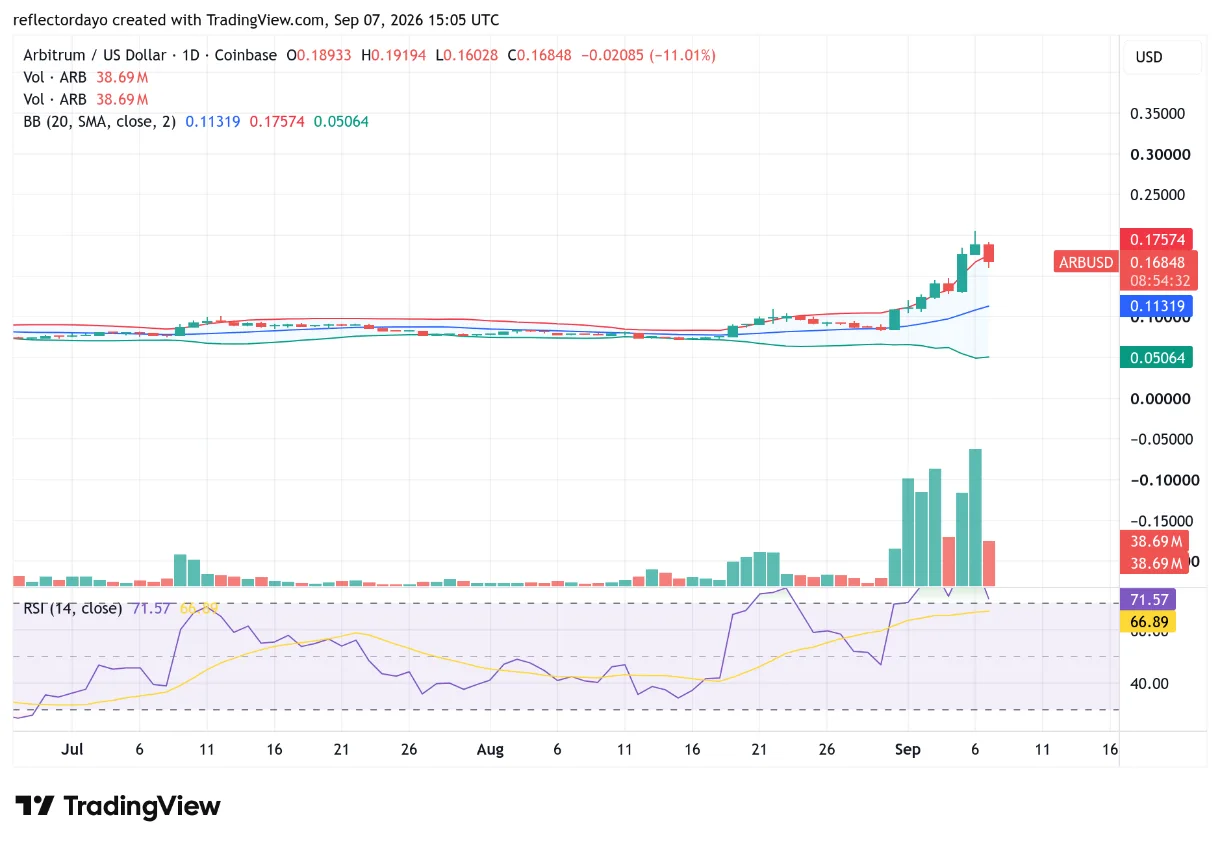
After an extended period of relatively low activity in the Arbitrum market, ARB/USD has recently experienced a sharp increase in buying interest. The price surged from around $0.085 to a peak near the $0.20 level, accompanied by a noticeable increase in trading volume. The larger volume histograms suggest that market participation and investor interest have picked up significantly during the rally.
Following the move toward $0.20, the market has entered a period of profit-taking as some traders lock in gains. However, rather than immediately returning to its previous lows, ARB appears to be searching for a higher support level.
The $0.16 region is emerging as a potential support zone. Recent price action suggests that buyers have begun stepping in around this level. The latest candlestick’s lower shadow, or wick, indicates that sellers pushed the price lower but buyers quickly absorbed the selling pressure and drove the price back up.
If this support holds, it could provide a foundation for another attempt toward the $0.20 resistance area. A sustained break above $0.20, particularly with strong trading volume, could strengthen the bullish outlook. Conversely, a decisive break below the $0.16 support zone could signal that the recent rally is losing momentum and expose ARB to further downside.