Crypto Entry and Exit Strategy: Planning the Full Trade

A trade is not just an entry. It is a full plan.

Many beginners spend all their energy trying to find the perfect buy point, then make the exit up as they go. That is where problems begin.

A complete crypto entry and exit strategy tells you why you are entering, where you are wrong and where you plan to take profit.

Start With the Setup

Before entering, identify the setup. Are you trading a breakout, a pullback, a reversal, or a range bounce?

Each setup has different rules. A breakout trader wants strength through resistance. A pullback trader wants price to return to value in an existing trend.

If you cannot name the setup, the trade may be emotional.

telegram

Free Crypto Signals Channel

More than 50k members
Technical analysis
Up to 3 free signals weekly
Educational content
telegram Free Telegram Channel

Define the Entry Trigger

An entry trigger is the specific event that gets you into the trade.

Examples include:

A candle close above resistance A retest of support A bullish engulfing candle at a key level A moving average reclaim A volume-backed breakout

The trigger stops you from entering too early just because you feel impatient.

Set the Stop Loss

Your stop loss should sit where the trade idea is invalid. If you are buying a support bounce, the stop may sit below support. If you are buying a breakout, the stop may sit below the breakout level or recent swing low.

The stop defines your risk.

Choose Take Profit Levels

Targets should be based on logical areas: resistance, previous highs, measured moves or risk-to-reward levels.

Many traders use multiple targets. Taking partial profit at TP1 and leaving some for TP2 can balance safety and upside.

Cryptocurrency Signals Monthly
£42
  • 2-5 Signals Daily
  • 82% Success Rate
  • Entry, Take Profit & Stop Loss
  • Amount To Risk Per Trade
  • Risk Reward Ratio
Cryptocurrency Signals Quarterly
£78
  • 2-5 Signals Daily
  • 82% Success Rate
  • Entry, Take Profit & Stop Loss
  • Amount To Risk Per Trade
  • Risk Reward Ratio
Cryptocurrency Signals Yearly
£210
  • 2-5 Signals Daily
  • 82% Success Rate
  • Entry, Take Profit & Stop Loss
  • Amount To Risk Per Trade
  • Risk Reward Ratio
arrow
arrow

Write the Plan Down

Before entering, write a simple version of the trade:

Entry trigger Stop loss TP1 and TP2 Risk amount Invalidation reason

If the plan looks weak on paper, it may not be worth trading.

The Bottom Line

A crypto entry and exit strategy turns a guess into a plan.

Do not enter first and think later. Define the setup, trigger, stop and targets before money is at risk. That simple habit can improve your discipline immediately.

Need help applying this to live market conditions? Get instant access to our VIP trading signals here.


Germany’s Banking Giants Bring Crypto to the Masses, Signaling a New Era for Retail Adoption

For years, cryptocurrencies have largely existed alongside the traditional banking system, requiring investors to open separate exchange accounts before they could buy digital assets. That barrier is beginning to disappear in Germany. The country’s largest savings and cooperative banking networks are rolling out crypto trading services through their banking apps, a move that could bring digital assets within reach of millions of everyday customers.

More than just another institutional crypto announcement, the development underscores how traditional finance is increasingly embracing digital assets as part of mainstream banking.

Bringing Crypto Closer to Everyday Investors

According to recent reports, Germany’s savings banks and cooperative banking groups are expanding crypto trading services through their respective financial partners, enabling retail customers to buy and sell cryptocurrencies directly from their banking applications. While the rollout will be implemented across participating institutions over time, the initiative has the potential to significantly expand crypto accessibility in one of Europe’s largest banking markets.

Two bitcoin coins are on the screen of a trading chart via the smartphone.
Two bitcoin coins are on the screen of a trading chart via the smartphone. Source: create.vista.com / cryptosignals

The biggest impact may be the removal of long-standing barriers to entry. Instead of registering with dedicated crypto exchanges, completing separate identity verification processes, and transferring funds between platforms, customers will be able to access digital assets through banking apps they already use for everyday financial transactions. That convenience could encourage more first-time investors to explore cryptocurrencies.

A Shift in Banks’ Attitude Toward Crypto

The move also highlights how dramatically traditional financial institutions’ perception of crypto has evolved. Many banks that once warned customers about the risks associated with digital assets are now integrating crypto trading into their product offerings.

This change reflects growing customer demand as well as increased regulatory certainty across Europe under the Markets in Crypto-Assets (MiCA) framework. Rather than viewing cryptocurrencies solely as speculative assets, banks are beginning to see them as legitimate investment products capable of generating new revenue while helping them remain competitive in an increasingly digital financial landscape.

The development could also reshape competition within the crypto industry. As banks offer seamless access to digital assets through trusted mobile banking platforms, crypto exchanges may face greater pressure to compete through lower fees, broader asset selections, staking opportunities, and more advanced trading features.

X post reporting the expansion of a top bank in Germany expanding into crypto offering.
X post reporting the expansion of a top bank in Germany expanding into crypto offerings. Source: X / cryptosignals

What It Means for Investors

For investors, Germany’s latest banking initiative represents another milestone in crypto’s journey toward mainstream financial acceptance. Easier access through trusted banking institutions could encourage broader retail participation, improve market liquidity, and strengthen confidence in the long-term growth of the digital asset ecosystem.

While widespread adoption will likely take time, the direction is becoming increasingly clear: cryptocurrencies are steadily moving from the financial sidelines into everyday banking. If similar initiatives gain traction across Europe and other major markets, they could accelerate global crypto adoption and reinforce digital assets’ position as an increasingly important component of the modern financial system.

Note:
Cryptosignals.org is not a financial advisor. Do your research before investing your funds in any financial asset, product, or event. We are not responsible for your results.

Bitcoin Cash (BCH) Breaks Out as Expected

Summary:

  • BCH has confirmed a bullish breakout above the 9-day EMA.
  • Short-term momentum is slowing as the SRSI enters overbought territory.
  • Medium- and long-term targets remain at $300 and $400, respectively.

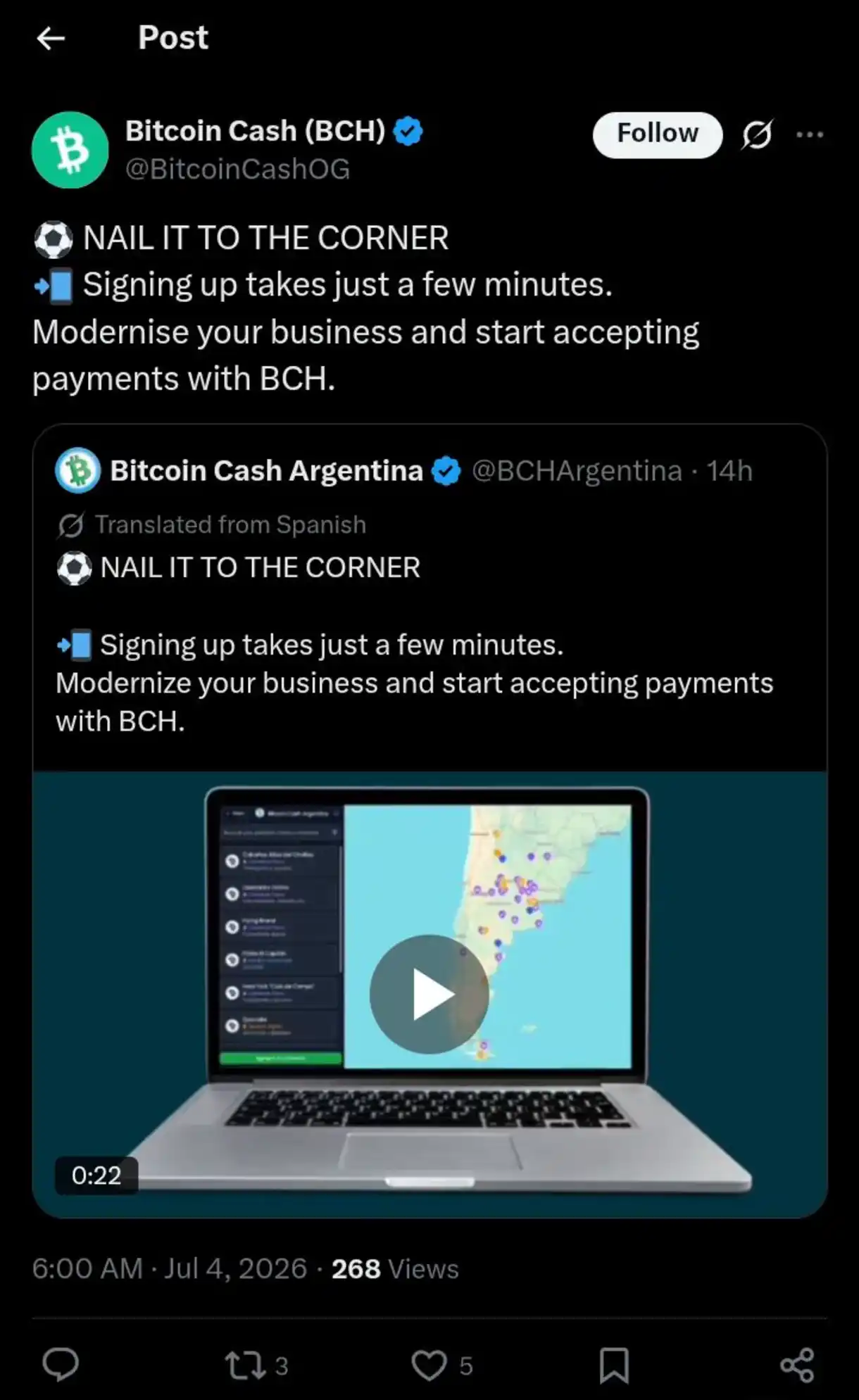
As the cryptocurrency market continues its broader recovery, Bitcoin Cash (BCH) has also joined the rally. In addition, efforts to promote BCH as a legal payment option for goods and services could further strengthen investor interest and support the token’s long-term price outlook.

BCH on the Daily Chart

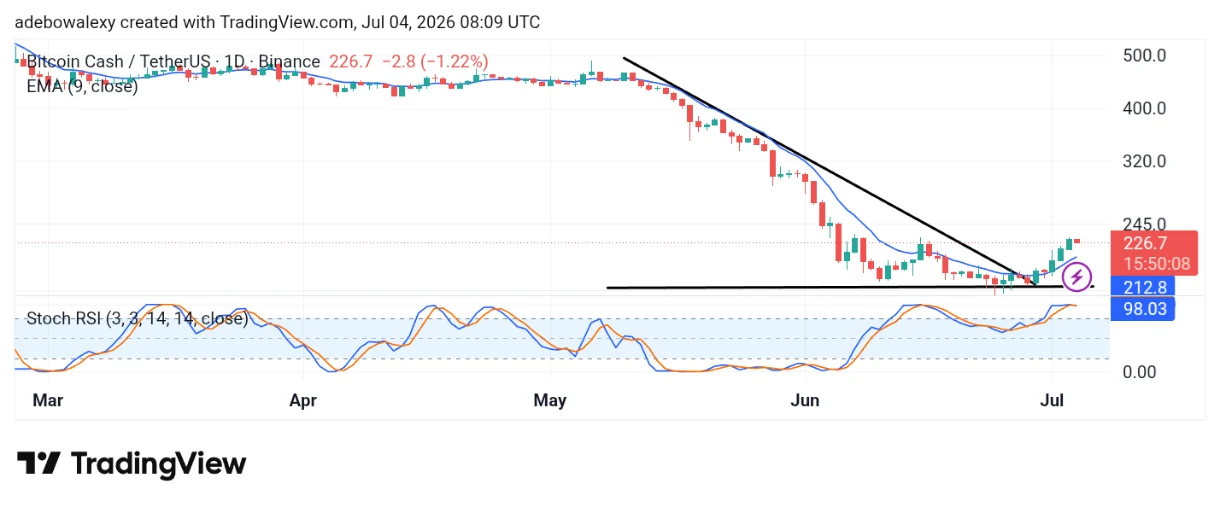
The Bitcoin Cash daily chart shows that price action has finally broken out, as anticipated a week ago. Earlier, the market formed a falling wedge pattern, a technical formation that often signals a bullish breakout. Price has now moved above the 9-day Exponential Moving Average (EMA), confirming improved bullish momentum.

Bitcoin Cash (BCH) Breaks Out as Expected
Bitcoin Cash (BCH) Breaks Out as Expected. Source / Cryptosignals : TradingView

However, the latest daily candle is bearish, while the Stochastic Relative Strength Index (SRSI) has begun to flatten after reaching overbought territory, suggesting that bullish momentum may be slowing.

What Could Happen Next?

The appearance of a red candle during the current session indicates that the recent rally may be pausing. This could either be a temporary pullback or the beginning of a deeper correction.

The SRSI has reached the 100 level and is now turning lower toward the 80 mark, indicating that selling pressure may gradually increase. Nevertheless, price action remains comfortably above the 9-day EMA, suggesting that the broader bullish trend is still intact.

BCH Outlook Remains Positive

Although the recent breakout has been followed by a bearish candle, the overall technical outlook remains constructive. Price continues to trade well above the 9-day EMA, even as the SRSI signals that the market may be entering a short-term consolidation phase.

Bitcoin Cash (BCH) Breaks Out
Bitcoin Cash (BCH) Breaks Out as Expected. Source / Cryptosignals : X.com

At the same time, ongoing efforts to expand Bitcoin Cash’s use as a payment method could provide additional long-term support. As a result, traders may continue targeting a recovery toward the $300 level in the medium term, with the $400 region remaining a longer-term bullish objective if momentum continues to build.

Disclaimer:
Note: Cryptosignals.org is not a financial advisor. Do your research before investing your funds in any financial asset, product, or event. We are not responsible for your results.

Cardano (ADA) Surges Over 13%

Summary:

  • ADA jumped over 13% on strong buying.
  • Price is above the 9-day EMA, but momentum is overbought.
  • $0.2500 remains the next key target.

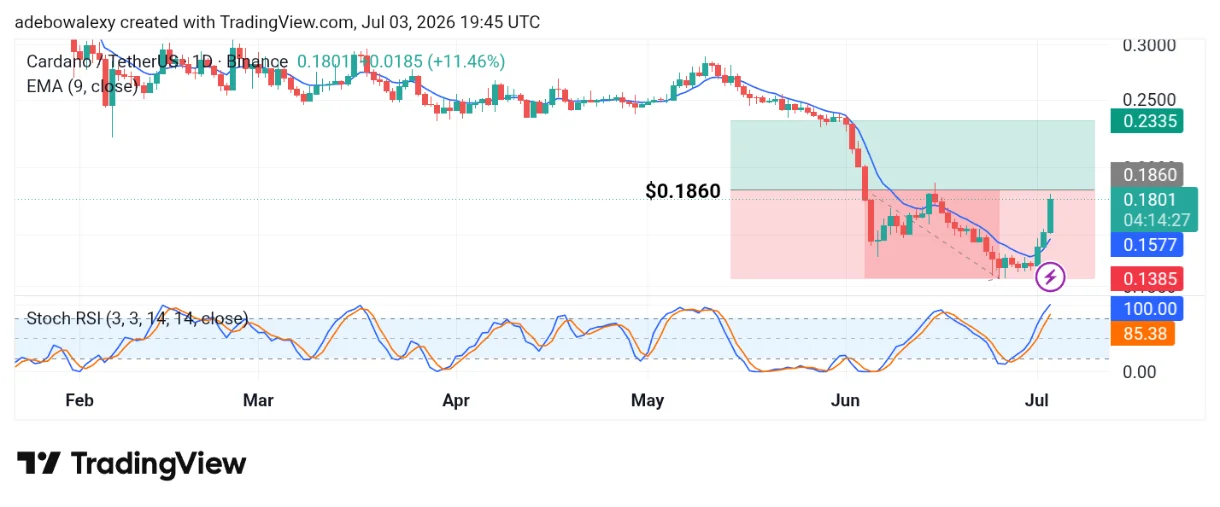
While the broader cryptocurrency market has experienced a recovery following Bitcoin’s move back above the $60,000 level, Cardano has delivered an even stronger performance. This rally appears to be supported by growing institutional interest and increased buying activity.

What the ADA Daily Chart Is Saying

The Cardano market has gained significant bullish momentum. The current session is represented by a long green candlestick with a relatively small upper shadow, suggesting that buying pressure remains dominant.

Cardano (ADA) Surges
Cardano (ADA) Surges Over 13%. Source / Cryptosignals : TradingView

Price action is now trading comfortably above the 9-day Exponential Moving Average (EMA), reinforcing the bullish outlook. Meanwhile, the Stochastic Relative Strength Index (SRSI) has moved into the overbought region. Despite this strong momentum, the market remains below the major bullish zone indicated on the chart.

Cardano Bulls Appear Slightly Strained

Although ADA/USDT continues to perform strongly, there are signs that bullish momentum may be approaching exhaustion. The SRSI lines are deep within the overbought region, which typically indicates that the market may be due for a pullback.

At the same time, price action remains firmly above the 9-day EMA, highlighting the strength of the current uptrend. However, the market continues to trade below the long-term bullish region, suggesting that some resistance may still lie ahead. Nevertheless, strong fundamental developments could allow ADA to maintain its upward momentum despite these technical warning signs.

ADA May Reach Higher Targets

As of the time of writing, bullish momentum in the Cardano market remains impressive. The token has recorded an intraday gain of more than 13%, outperforming many of the top cryptocurrencies, which have posted gains of less than 10%.

Cardano (ADA) Surges
Cardano (ADA) Surges Over 13%. Source / Cryptosignals : YouTube

This strong buying activity supports a positive short-term outlook and could drive the market toward nearby resistance levels. However, traders may also consider the longer-term implications of increasing institutional interest, which could provide a foundation for sustained growth. As a result, ADA may continue its advance toward the $0.2500 price level over time.

Disclaimer:
Note: Cryptosignals.org is not a financial advisor. Do your research before investing your funds in any financial asset, product, or event. We are not responsible for your results.

The Hidden Risk of Tokenized Stocks in DeFi

  • The Edel exploit exposes hidden risks in tokenized-stock lending.
  • Tokenized assets need stronger security as DeFi evolves.
  • The future of DeFi depends on safer collateral management.

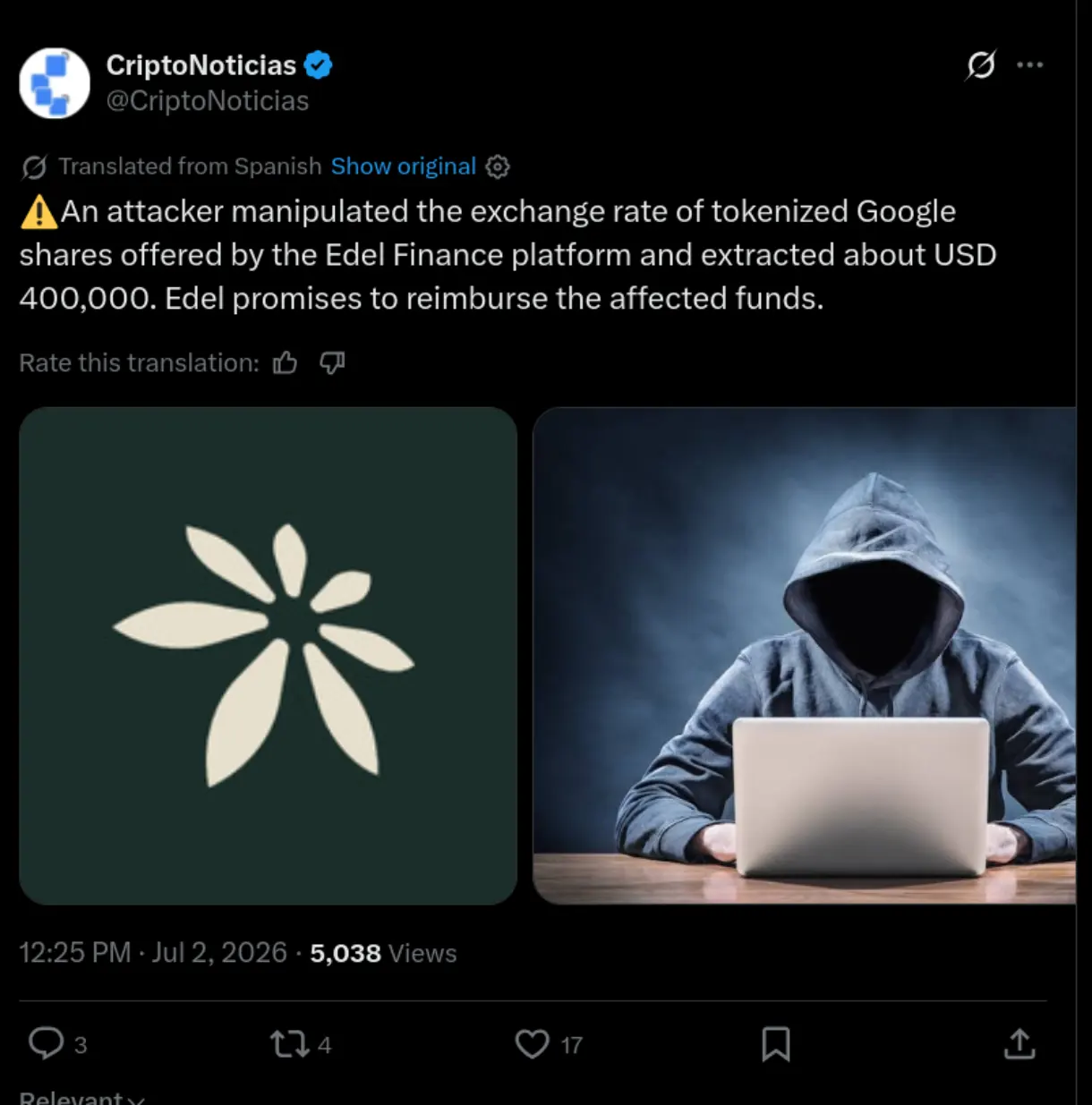
The recent exploit of Edel Finance has put tokenized stocks under an uncomfortable spotlight. An attacker manipulated the protocol’s wrapped Google stock collateral, leaving hundreds of thousands of dollars in bad debt despite the use of trusted pricing infrastructure. While the protocol has pledged to make users whole, the incident raises a much bigger question: Are tokenized stocks introducing new security risks that DeFi has yet to fully solve?

As tokenized assets continue to gain momentum, this exploit serves as an early warning that innovation must be matched with stronger safeguards.

How attacks like this happen

Unlike traditional crypto lending, tokenized stocks rely on multiple layers of infrastructure, including wrapped assets, collateral valuation models, and exchange-rate mechanisms. If a protocol incorrectly calculates the value of these assets, attackers can exploit the discrepancy.

Bad actors often combine flash loans with rapid borrowing and repayment cycles to inflate collateral values temporarily. Once the protocol recognizes the manipulated collateral as more valuable than it actually is, the attacker can borrow assets far beyond their legitimate limit before the system corrects itself.

These attacks typically unfold within a single blockchain transaction, making them extremely difficult to stop in real time.

Image depicting blockchain and cybersecurity.
Image depicting blockchain and cybersecurity. Source: create.vista.com / cryptosignals

Why tokenized stocks face unique risks

Tokenized stocks are designed to bring traditional financial assets onto the blockchain, unlocking around-the-clock trading, global accessibility, and integration with DeFi applications. However, every additional layer—whether wrapping, tokenization, or collateral management—creates another potential point of failure.

The Edel incident demonstrates that even if an external price feed remains accurate, weaknesses in a protocol’s internal valuation logic can still expose users and liquidity providers to significant losses.

As more tokenized assets enter DeFi, protocols must ensure that every component of the valuation process is as secure as the underlying asset itself.

How DeFi is likely to evolve

The good news is that incidents like Edel often accelerate security improvements across the industry.

Future DeFi lending protocols are expected to adopt stronger collateral verification, more resilient exchange-rate models, tighter borrowing limits for newly listed assets, and automated circuit breakers that pause abnormal activity before losses escalate. Developers are also likely to introduce multiple layers of validation instead of relying on a single pricing mechanism.

These improvements will make it increasingly difficult for attackers to exploit valuation gaps while helping protocols respond more quickly to suspicious activity.

The Edel finance exploit is reflected on an X post.
The Edel finance exploit is reflected on an X post. Source: X / cryptosignals

Final thoughts

The Edel exploit should not be viewed as a failure of tokenized stocks themselves but as an important lesson for the next generation of DeFi infrastructure. As tokenized assets become more common, security must evolve alongside innovation.

For investors, the takeaway is simple: attractive yields should never replace careful risk assessment. Understanding how a protocol values and secures its collateral may prove just as important as choosing which asset to invest in.

Crypto Fear and Greed Index: How to Use Market Sentiment

Crypto is driven by emotion. When prices rise, greed takes over. When prices fall, fear spreads quickly.

The Crypto Fear and Greed Index tries to measure that emotion in one simple number.

What Is the Fear and Greed Index?

The index tracks market sentiment using factors such as volatility, momentum, social interest and other market data. It usually runs from 0 to 100.

Low readings suggest fear. High readings suggest greed.

Cryptocurrency Signals Monthly
£42
  • 2-5 Signals Daily
  • 82% Success Rate
  • Entry, Take Profit & Stop Loss
  • Amount To Risk Per Trade
  • Risk Reward Ratio
Cryptocurrency Signals Quarterly
£78
  • 2-5 Signals Daily
  • 82% Success Rate
  • Entry, Take Profit & Stop Loss
  • Amount To Risk Per Trade
  • Risk Reward Ratio
Cryptocurrency Signals Yearly
£210
  • 2-5 Signals Daily
  • 82% Success Rate
  • Entry, Take Profit & Stop Loss
  • Amount To Risk Per Trade
  • Risk Reward Ratio
arrow
arrow

Why Sentiment Matters

Markets often become most dangerous when everyone feels certain. Extreme greed can appear near overheated rallies. Extreme fear can appear near panic lows.

This does not mean you should blindly buy fear and sell greed. But sentiment can warn you when the crowd may be leaning too far in one direction.

Using Fear Readings

When fear is high, many traders are defensive. Prices may be down, headlines may be negative and social media may feel hopeless.

Sometimes this creates opportunity. But fear can also continue for longer than expected, especially in bear markets.

The key is to combine sentiment with price structure. Fear at major support is more interesting than fear during a clean breakdown.

Using Greed Readings

When greed is high, traders often chase. Coins may pump quickly, leverage may increase and people may assume the market can only go higher.

This can be profitable while the trend lasts, but it also raises risk. Extreme greed near resistance may be a reason to tighten stops or take partial profit.

telegram

Free Crypto Signals Channel

More than 50k members
Technical analysis
Up to 3 free signals weekly
Educational content
telegram Free Telegram Channel

Do Not Use It Alone

The index is a broad tool. It does not tell you exactly when to buy or sell. It should be used with technical analysis, market structure and risk rules.

Sentiment can stay extreme. A market can remain greedy during a strong bull trend or fearful during a long bear trend.

The Bottom Line

The Crypto Fear and Greed Index helps traders understand market mood.

Use it as a warning light. Extreme fear may signal opportunity, and extreme greed may signal risk. But always confirm with price action before making decisions.

Need help applying this to live market conditions? Get instant access to our VIP trading signals here.
McAfee Warns of Silent Swap Crypto Malware Exploiting Human Mistakes

You may spend hundreds of dollars securing your crypto with a hardware wallet, two-factor authentication, and strong passwords. Yet one careless copy-and-paste could still send your Bitcoin to a scammer.

That is the alarming reality highlighted by cybersecurity researchers at McAfee, who recently uncovered Silent Swap—a sophisticated malware campaign that silently replaces copied cryptocurrency wallet addresses with those controlled by attackers.

Rather than breaking blockchain security or stealing private keys, the malware exploits a simple moment of trust between copying and pasting, potentially diverting funds without the victim realizing anything has gone wrong until it is too late.

How the Silent Swap Scam Works

Contrary to what many people assume, Silent Swap doesn’t hack the blockchain or crack wallet encryption. Instead, it exploits one of the weakest links in any security system: human trust.

Once installed—typically through unofficial or cracked software disguised as legitimate applications—the malware silently injects a fake browser extension into Chromium-based browsers such as Chrome, Edge, Brave, and Opera. From there, it patiently waits in the background for the right opportunity.

That opportunity comes when a user copies a cryptocurrency wallet address to send funds.

A list of threats to be aware of while using the web.
A list of threats to be aware of while using the web. Source: create.vista.com / cryptosignals

Instead of stealing private keys or breaking into a crypto wallet, Silent Swap monitors the clipboard for copied wallet addresses. The moment it detects one, it quietly replaces the copied address with another controlled by the attacker. To the victim, everything appears normal. The pasted address looks legitimate, and unless it is carefully checked before the transaction is confirmed, the funds are sent directly to the scammer’s wallet.

The blockchain itself isn’t compromised—it simply processes the transaction exactly as instructed. Because blockchain transactions are irreversible, recovering the funds after they have been sent is extremely difficult, if not impossible.

This is what makes Silent Swap particularly dangerous. It doesn’t rely on defeating advanced cryptography; it relies on something much simpler: the assumption that what you paste is exactly what you copied. By exploiting this brief moment of trust, attackers can steal digital assets without ever gaining access to a victim’s wallet or private keys.

How to Protect Yourself from Clipboard-Hijacking Malware

As cybercriminals continue to devise more sophisticated ways to target crypto users, vigilance remains one of the most effective defenses. While security tools such as hardware wallets and two-factor authentication are essential, they cannot protect against every form of deception.

To reduce the risk of falling victim to attacks like Silent Swap, users should adopt the following best practices:

  • Download software only from official sources. Avoid cracked software, unofficial installers, and suspicious downloads, as these are common vehicles for malware.
  • Review your browser extensions regularly. Remove extensions you no longer use and install new ones only from trusted developers.
  • Always verify wallet addresses before sending funds. Take a few extra seconds to compare the first and last several characters of the pasted address with the intended destination.
  • Keep your operating system, browser, and antivirus software up to date. Security updates often patch vulnerabilities that malware exploits.
  • Use reputable security software capable of detecting malicious applications and browser extensions before they can cause harm.
  • Be cautious of unexpected prompts to install software or browser extensions, especially when downloading free tools from unofficial websites.

Ultimately, attacks like Silent Swap serve as a reminder that cybercriminals are increasingly targeting users rather than blockchains. Cryptocurrency networks remain secure by design, but a single overlooked detail can still lead to irreversible losses.

In an ecosystem where transactions cannot be reversed, taking a few extra moments to verify every transaction may be the simplest—and most valuable—security habit a crypto investor can develop.

Ethereum (ETH) Rebounds from Strong Support

Summary:

  • ETH is rebounding from the $1,550 support with a bullish double-bottom pattern.
  • Price has moved above the 9-day EMA, signaling strengthening momentum.
  • $1,800 and $2,000 are the next key upside targets.

The broader cryptocurrency market is showing signs of recovery after recent bearish pressure. As a result, Ethereum has begun to rebound from a strong support level. In addition, market indicators suggest that ETH could record a significant upward move this month as bullish sentiment continues to strengthen.

ETH on the Daily Price Chart

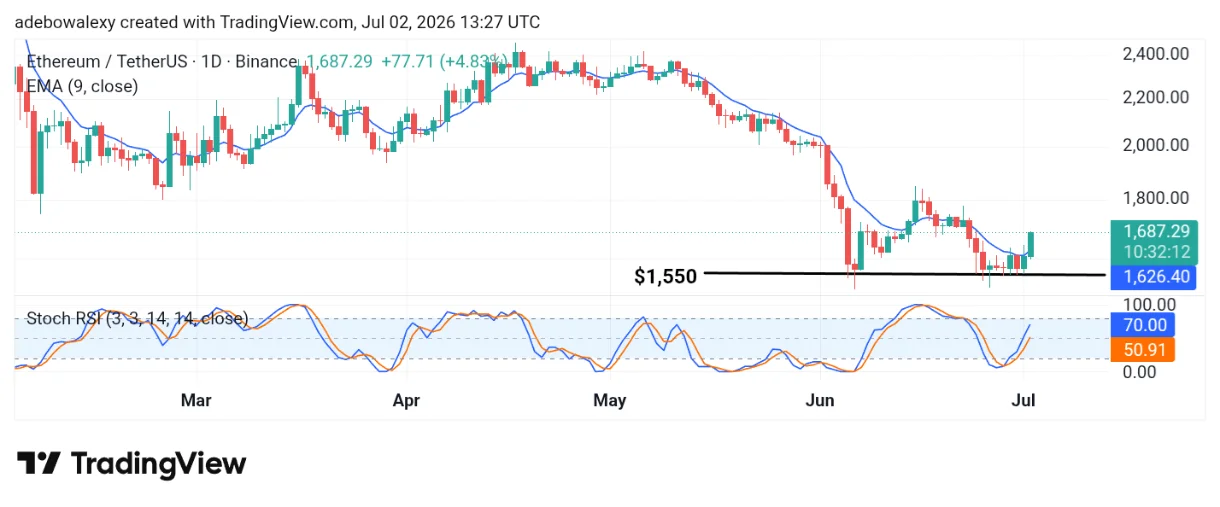
Ethereum has been rebounding from a strong support zone around $1,550. Price action appears to have formed a double-bottom pattern, a bullish reversal formation, before staging its current recovery.

Ethereum (ETH) Rebounds
Ethereum (ETH) Rebounds from Strong Support / Cryptosignals : TradingView

The ongoing session has pushed the market above the 9-day Exponential Moving Average (EMA), strengthening the bullish outlook. Meanwhile, the Stochastic Relative Strength Index (SRSI) is climbing steadily toward the overbought region. The lead line has reached the 70 level, and the indicator’s movement remains consistent with the recent price recovery.

Ethereum Bulls Remain Optimistic

Bullish momentum in the ETH market continues to strengthen. Over the past few sessions, buying pressure has gradually increased, and a strong bullish candle supports the current session. by a strong bullish candle.

Ethereum (ETH) Rebounds from Strong Support
Ethereum (ETH) Rebounds from Strong Support. Source / Cryptosignals : YouTube

Furthermore, the fact that ETH is now trading above the 9-day EMA reinforces bullish conviction. The SRSI continues to trend higher toward the overbought region, suggesting that buyers remain firmly in control of the market.

Possible Trend for Ethereum

Based on the current technical outlook, Ethereum appears well-positioned for further gains. The recently formed double-bottom pattern typically signals the potential for a sustained bullish reversal.

With price now holding above the 9-day EMA, buying interest could continue to increase. In the short term, ETH may target the $1,800 level, with the $2,000 price level emerging as the next major upside objective if bullish momentum persists.

Disclaimer:
Note: Cryptosignals.org is not a financial advisor. Do your research before investing your funds in any financial asset, product, or event. We are not responsible for your results.

Why Elon Musk Still Works — And What It Means for Traders

Elon Musk’s 2007 Interview & Trading Parallels – Part 3


Key Takeaway:

  • Consistency and discipline drive long-term trading success.
  • Superior risk management separates winning traders.
  • Passion fuels better execution and lasting results.

Lesson three came up because, at the time of the interview, Elon Musk was already a multimillionaire worth hundreds of millions of dollars. So he was asked why he was still working. The truth is that some people, if they were as rich as that, would never work again. 

They would just take vacation upon vacation—seen on a beach on a sunny day, drinking beer, having a nice time with their wife or girlfriend, or relaxing on a yacht. But Musk said he was not cut out for that.

Even if he wants to rest, he cannot rest for more than two or three days maximum; otherwise, it will affect him. This means Elon Musk is a workaholic. He is not a lazy man. He works very hard, and being a hardworking person has paid off for him enormously.

The Trading Parallel

Likewise in trading, whatever you want to do to become a successful trader, do it diligently. Do it with utmost commitment and perseverance. Be loyal to your career as a trader. 

Why Elon Musk Still Works — And What It Means for Traders
Market Chart on computer screen. Source: Pixabay.

Even when you reach financial freedom—when you finally become financially free as a trader and achieve financial independence—it doesn’t mean you simply relax.

You won’t say, “Okay, let me take a break from trading, I want to go on vacation.” Even when you go on vacation, you can still be trading. Anywhere you go, you can still be trading. 

Successful trading doesn’t mean staying glued to your screen for most of the day. It means that even if it is only one hour that you spend trading on a daily or weekly basis, you stay true to your aims and ambitions.

Innovation vs. Execution: The Elon Musk Approach

Elon Musk did not necessarily invent the industries he operates in. His early business ventures before PayPal were not the first of their kind. When he joined PayPal, it wasn’t the first payment processor. When he joined Tesla, it wasn’t the first electric car company. The same applies to SpaceX, Solar City, and Starlink — none of these were entirely new concepts.

However, what makes Elon Musk stand out is his ability to do it better than his competitors. While other companies may have started before him, he eventually finds a way to optimize, scale, and outperform everyone else in the industry.

Applying the “Musk Principle” to Trading

There are millions of traders all over the world, which raises the question: how do you become a better trader and do it better than others? The key to standing out and achieving superiority in the market lies entirely in risk management. It is about how you manage your risk, how efficiently you cut your losses, and how you psychologically and tactically deal with losing trades.

Why Elon Musk Still Works — And What It Means for Traders
A trader faced with the decision to either buy or sell. Source: Pixabay.

To excel, the goal is to handle losing trades better than the average trader and master the art of cutting losses quickly when a trade goes against you. Just as Elon Musk enters established industries and outperforms the incumbents through superior execution, a trader must enter the markets and outperform others through superior risk discipline.

Passion vs. Profit

This ties back to a previous point: you should pursue something because you love it, not strictly for the money. While the ultimate goal of trading is financial return, focusing purely on the money can be counterproductive. 

If you genuinely love the process of trading and market analysis, you will execute your strategy perfectly. When you focus on doing the job well, money naturally becomes a byproduct of your excellence.