XRP is benefiting from renewed market optimism, with bullish momentum pushing the price higher.
Technical indicators remain positive, with price action above the 9-day EMA and SRSI trending upward.
Traders could target $1.20 short term, with $2.00 possible if momentum continues.
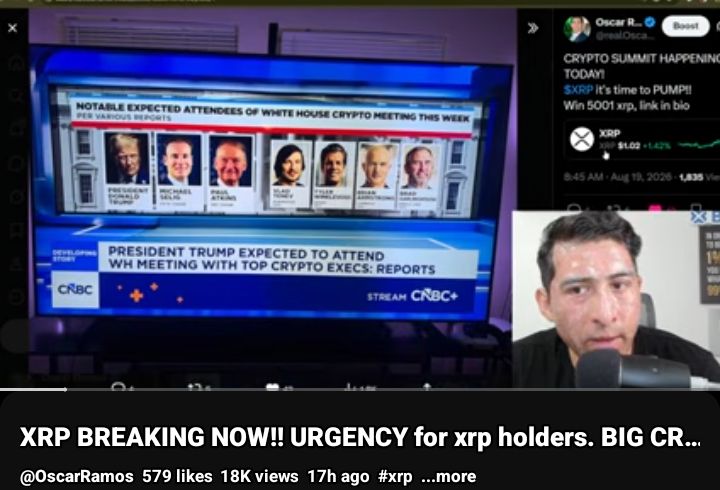
The broader cryptocurrency market is experiencing renewed bullish momentum, and XRP has not been left behind. This is partly driven by anticipation surrounding Trump’s meeting with global crypto executives. The development has improved market sentiment and brought renewed activity to the wider crypto market.
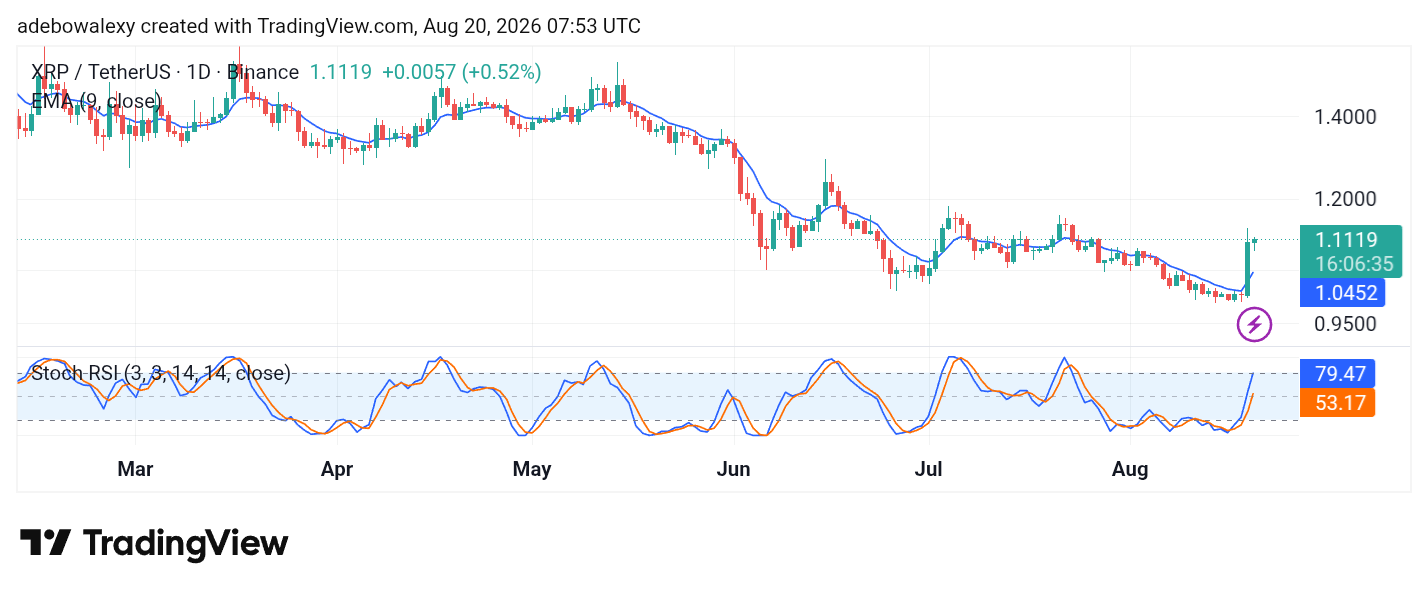
XRP Joins the Broader Market Rally. Source: TradingView
XRP 24-Hour Price Chart
The XRP market recorded a significant price increase during the previous session, as reflected by the corresponding bullish candle.
The ongoing session has maintained the upward trend, although the smaller candle suggests that buying pressure has weakened somewhat. Nevertheless, the market remains above the 9-day Exponential Moving Average (EMA).
Meanwhile, the Stochastic Relative Strength Index (SRSI) lines continue to move upward toward the overbought region.
Buying Pressure Persists
Today’s trading activity has so far produced only modest upward movement, judging by the size of the current price candle. Nevertheless, there are sufficient signs to support a bullish outlook.
First, the latest price candle remains green and above the 9-day EMA. Likewise, the SRSI lines continue to move upward toward the overbought region without indicating a trend reversal. This suggests that further upside movement may still occur.
XRP Joins the Broader Market Rally. Source: YouTube
XRP Traders Target Higher Price Levels
The XRP/USDT market presents both short- and long-term bullish opportunities. At present, the market is heading toward a near-term target of $1.20.
However, the available technical indicators suggest that this token could potentially reach higher levels. As a result, traders may set their sights on the $2.00 price level if the bullish momentum continues.
Monad, an Ethereum rival, recently gave some of its earliest investors a chance to cash out before their MON tokens became freely tradable. Almost all of those approached rejected the offer.
The Monad Foundation had set aside up to $60 million to buy locked MON from selected early investors at a discount. The program essentially offered investors a choice: take cash now at a lower price or keep their tokens locked and wait for the normal unlocking schedule.
Monad has not disclosed how much it ultimately spent, how many investors accepted, or the size of the discount.
That makes the decision interesting, but it should not automatically be viewed as a bullish signal. Investors may believe MON will be worth more later, but they may also have simply considered the proposed discount too low. Without knowing the offer price, it is difficult to determine exactly why most investors chose to hold.
Still, the timing is worth watching because Monad’s network is showing signs of growing activity.
What Makes Monad Different?
Monad is a Layer-1 blockchain designed to run applications compatible with Ethereum while offering much higher transaction-processing capacity.
Its main attraction is performance. Monad uses parallel execution and other architectural changes to process transactions more efficiently than traditional Ethereum-style execution. The network targets up to 10,000 transactions per second, with sub-second block times and finality.
The important point is that Monad is not simply trying to become another blockchain disconnected from Ethereum.
Its EVM compatibility means developers familiar with Ethereum can build and deploy applications on Monad using familiar tools and smart contracts.
That could give Monad an advantage in areas such as decentralized finance, gaming and consumer applications where speed and transaction costs can become important.
But technology alone is not enough.
A fast blockchain still needs developers, users, liquidity and applications. That is why the growth of Monad’s ecosystem may be more important than its technical specifications.
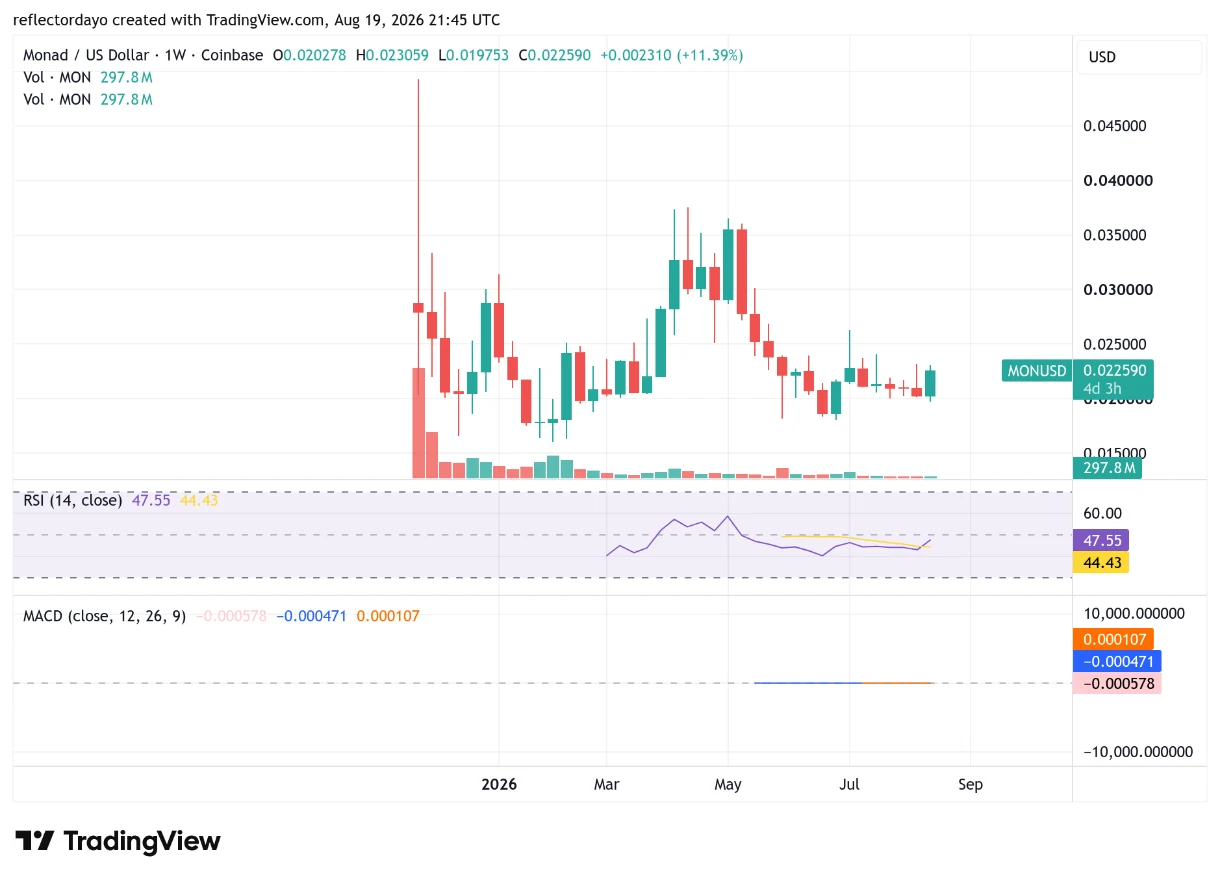
The chart illustrates the recent price activities of the Monad market. Source: TradingView / cryptosignals
Mon Price Struggles While Network Activity Grows
MON has been trading below its $0.025 public-sale price, with the token around $0.021 in the figures reported.
Yet activity on Monad has been moving in the opposite direction.
The amount of money deposited into Monad-based DeFi applications increased from roughly $360 million on July 2 to about $895 million. That represents an increase of almost 150% in roughly six weeks.
Stablecoins on the network were worth approximately $707 million, while decentralized exchanges handled around $79 million in trading over the preceding day.
This creates an interesting situation:
MON’s price has struggled, while activity on the blockchain has grown rapidly.
That does not necessarily mean MON is undervalued. Growing TVL and trading activity do not automatically translate into higher demand for a blockchain’s native token.
However, sustained ecosystem growth could eventually change the market’s perception of the network.
Mon Price Struggles While Network Activity Grows MON?
The investment question is not simply whether Monad can process more transactions than Ethereum.
The bigger question is whether it can turn that technical advantage into lasting adoption.
MON is the native token of the Monad network. It is used to pay transaction fees and help secure the blockchain. If more developers build applications on Monad and more users transact on the network, the economic importance of the ecosystem could increase.
That creates a potential path for MON.
If network activity continues growing, liquidity remains on the blockchain and developers continue choosing Monad, investors could eventually begin assigning greater value to the network and its native token.
But there are significant risks.
Monad is competing not only with Ethereum but also with numerous other high-performance blockchains. Ethereum itself continues to improve its scalability, while competing networks are also trying to attract developers and users.
There is also no guarantee that Monad’s recent growth will continue. A temporary increase in TVL or trading volume is not the same as sustainable adoption.
For investors, the more important metrics to watch are therefore users, TVL, stablecoin liquidity, transaction activity and developer adoption.
Source: create.vista.com
The Bigger MON Question
The $60 million exit offer provides an interesting glimpse into how some early investors are positioning themselves, but it is not enough to predict where MON is heading.
The more significant development may be happening underneath the token price.
Monad is attempting to combine Ethereum compatibility with higher performance, while its DeFi ecosystem is already attracting substantial capital.
If that growth continues and translates into real, sustained usage, the current MON price could eventually look different.
That does not mean a rally is guaranteed.
Instead, Monad presents an interesting possibility for investors: a relatively young blockchain whose token has struggled even as activity across its ecosystem has expanded.
The question now is whether that network growth can become strong enough to change the market’s view of MON.
For now, that is something worth watching rather than assuming.
LINK remains bullish, supported by Chainlink adoption and strong investor interest.
Technical indicators are positive, with price above the 9-day EMA, though SRSI remains overbought.
Potential targets: LINK could break $10 and move toward $15–$20 if momentum continues.
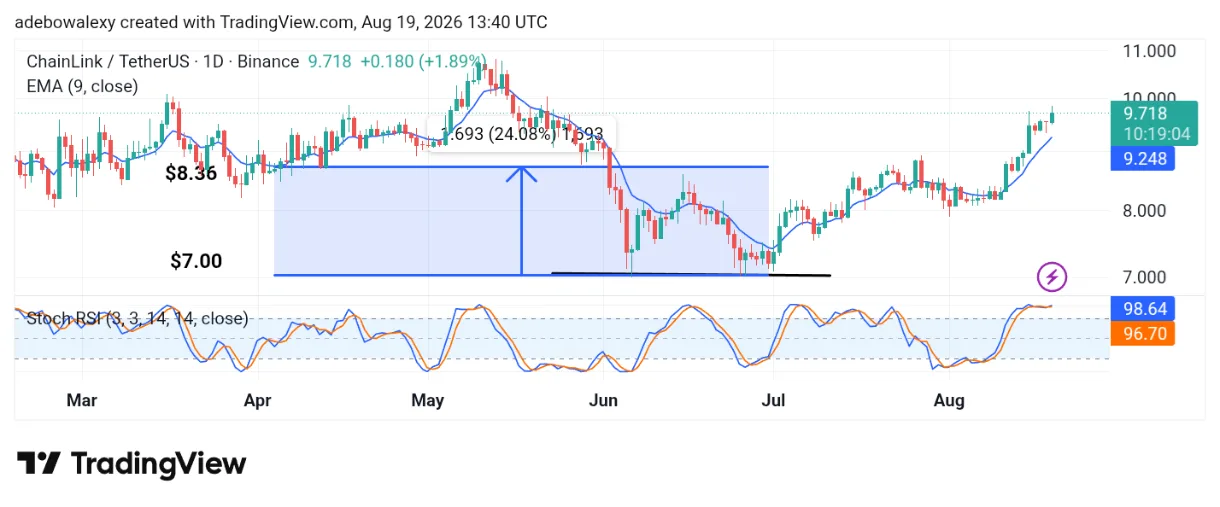
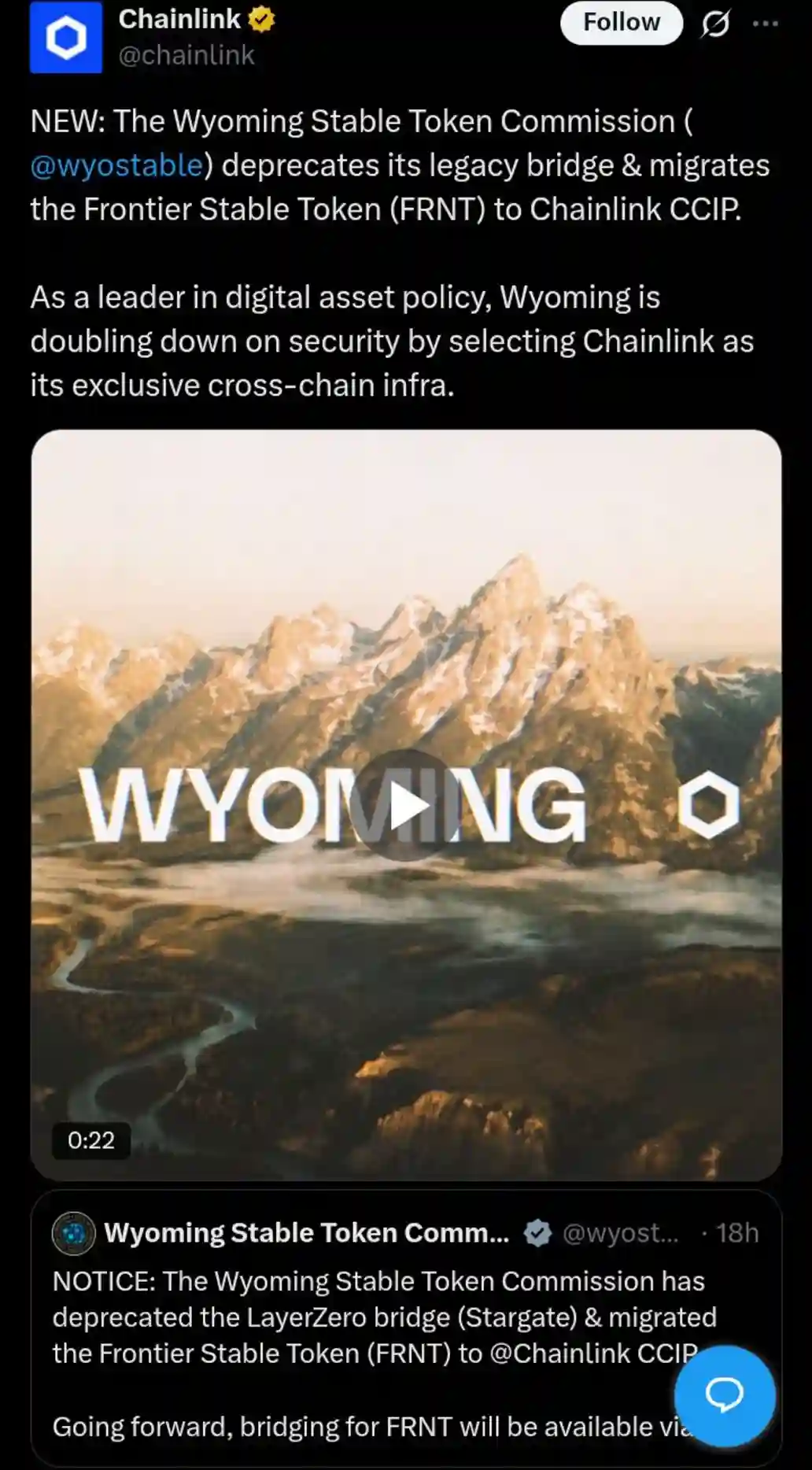
The Chainlink token has shown a significant correlation between its price and the favorable fundamentals surrounding the project. Wyoming Stable Token has adopted Chainlink as its cross-chain infrastructure, which has had a positive influence on the token’s price movement.
Chainlink (LINK) Keeps Attracting More Attention from Investors. Source: TradingView
What Is the Chainlink 24-Hour Price Chart Telling Us?
Looking at the LINK/USDT daily price chart, we can see that price action has been strongly bullish over the past nine sessions. The ongoing session also remains under the influence of bullish forces. The latest price candle on the daily chart is positioned above the 9-day Exponential Moving Average (EMA).
Meanwhile, the Stochastic Relative Strength Index (SRSI) lines remain in the overbought region and are moving sideways, although the leading line continues to point upward.
LINK Bullish Momentum Remains Strong
As the Chainlink project continues to attract investors’ attention, sentiment surrounding the token remains strongly bullish. This Recent price action reflects this In its recent price action. Buying pressure has dominated most sessions, as shown by the bullish price candles.
The SRSI lines have also remained in the overbought region, despite the potential for a pullback under such conditions. This suggests that bullish momentum remains strong, likely fueled by growing investor interest.
Chainlink (LINK) Keeps Attracting More Attention from Investors. Source: X com
Chainlink May Be Difficult to Read Currently
Since the SRSI has remained in the overbought region for some time, it is difficult to determine when a bearish reversal crossover may occur. As a result, traders using this indicator may need to pay closer attention to the 9-day EMA for additional confirmation.
Nevertheless, if the current bullish momentum continues, LINK could break through $10 and advance toward $15 and $20.
Crypto signals often mention timeframes such as scalp, intraday, or swing. Understanding the timeframe is important because it affects entries, stops, targets, and expectations.
A scalp trade is very short term. It may last minutes to a few hours. Scalpers look for quick moves and tight execution. Because crypto can move fast, scalping requires attention and discipline. It is not ideal for people who cannot monitor the trade.
An intraday trade usually lasts several hours up to around a day. It may use 15-minute, 1-hour, or 4-hour charts. Intraday signals often aim to capture a meaningful move without holding through too many overnight risks.
A swing trade lasts longer, often one to five days or more. Swing traders focus on larger levels, broader trend structure, and catalysts. Stops are usually wider because the trade needs room to develop. Targets may also be larger.
The biggest mistake is mixing timeframes. A trader may enter a scalp, ignore the stop, and then call it a swing trade when it goes wrong. That destroys discipline. Every trade should have its timeframe defined before entry.
Timeframe also affects position size. A wider swing stop may require a smaller position to keep risk controlled. A tight scalp stop may allow a different size, but slippage and volatility must be considered.
Signals should match the follower’s lifestyle. If you are busy during the day, scalps may be difficult. If you can only check the market a few times per day, swing signals may be more suitable.
Multiple timeframe analysis can improve decisions. A long setup on the 1-hour chart is cleaner if the 4-hour trend supports it. A short-term breakout against a major daily resistance level may be more risky.
Key takeaway:
Scalping, intraday, and swing signals are different tools. Know the timeframe before entering, size the trade properly, and do not change the plan mid-trade to avoid taking a loss.
Educational content only. Not financial advice. DYOR.
NFT hype declined due to speculation, scams, oversupply, and limited utility.
Complexity and economic changes also reduced adoption.
NFTs still have potential if they develop practical real-world uses.
Some years ago, Non-Fungible Tokens (NFTs) took the world by storm. They appeared to hold the promise of revolutionizing digital ownership across gaming, music, art, real estate, and collectibles. Nevertheless, much of this excitement has fizzled out. The decline in NFT hype was driven by several factors, as discussed below.
Non-Fungible Tokens Defined
Non-Fungible Tokens are a separate class of digital assets recorded on a blockchain. They can represent ownership or proof of authenticity of something, such as artwork, virtual property, music, or collectibles. Unlike cryptocurrencies, NFTs cannot be exchanged on a one-to-one basis because each NFT is unique.
In 2021, NFTs attracted enormous attention, with some digital artworks selling for millions of dollars. However, by 2023, much of the excitement had faded.
1. When the NFT Speculation Faded
The NFT boom was largely fueled by speculation, with many buyers entering the market hoping to resell digital assets at much higher prices. This pushed valuations to extraordinary levels, as demonstrated by Beeple’s Everydays: The First 5000 Days, which sold for $69 million.
However, as more NFT collections entered the market, supply began to outpace genuine demand. Prices fell sharply, and once-popular projects such as Bored Ape Yacht Club lost much of their market value. Investors who purchased NFTs at the peak were left facing significant losses.
What Caused the Loss of Hype Around Non-Fungible Tokens (NFTs). Source: Google Images
2. The Utility Problem
Another major weakness was that many NFTs struggled to offer meaningful benefits beyond digital ownership. Although developers explored applications in gaming, virtual worlds, and digital collectibles, these use cases did not achieve widespread adoption as quickly as expected.
Virtual property platforms such as Decentraland experienced a similar problem. Initial enthusiasm attracted buyers and investors, but interest declined when the promised long-term utility failed to match the early hype.
3. Environmental Concerns
The fact that many NFTs were initially created and traded on Ethereum, which used an energy-intensive proof-of-work blockchain, attracted significant criticism. As a result, some brands, artists, and consumers were discouraged from participating in the NFT market because of environmental concerns.
4. Fraudulent Activities
The NFT ecosystem experienced numerous intellectual property disputes, artwork theft, scams, and rug pulls. In some cases, unidentified developers raised millions of dollars before abandoning their projects. Such incidents discouraged investors and contributed to the decline in confidence and enthusiasm surrounding NFTs.
5. An Overcrowded NFT Market
As the NFT trend gained momentum, creators began tokenizing almost everything imaginable. The rapid growth in NFT collections created an oversupply, making it increasingly difficult for worthwhile projects to attract attention. With so many options available, the perceived uniqueness and value of many NFTs declined.
6. Changing Economic Conditions
NFTs flourished when investors were comfortable taking risks and interest rates were relatively low. However, rising inflation and growing economic uncertainty changed investor behavior. Many investors began moving their money toward more established and less volatile assets, reducing demand for speculative investments such as NFTs.
What Caused the Loss of Hype Around Non-Fungible Tokens (NFTs). Source: Google Images
7. A Complicated Buying Process
For newcomers, getting involved with NFTs could be intimidating. Users often had to create crypto wallets, acquire digital currencies, understand blockchain transactions, and navigate unfamiliar marketplaces. These technical hurdles made NFTs less accessible to the average consumer and slowed their path toward mainstream adoption.
8. Lack of Long-Term Value
Many NFT projects were launched primarily to capitalize on immediate hype rather than provide long-term utility. When the excitement disappeared, these projects lost relevance because they lacked strong communities, practical applications, or sustainable business models.
Are NFTs Really Finished?
Not quite. Although the intense speculation that once surrounded NFTs has declined, the underlying technology still has potential. NFTs could become useful in areas such as gaming, digital identity, intellectual property, event ticketing, and ownership of real-world or digital assets.
For the sector to regain broader adoption, the focus must shift away from short-term speculation toward practical value, simplicity, security, and sustainable use cases. Ultimately, the future of NFTs will depend less on another wave of hype and more on their ability to provide solutions to genuine real-world problems.
The upgrade could make Solana more attractive for developers and large-scale applications.
For investors, growing network usage—not the upgrade itself—could be the key to SOL’s long-term value.
Solana is not simply trying to process transactions faster. It is quietly making the network cheaper, more capable and better prepared for the next wave of blockchain applications.
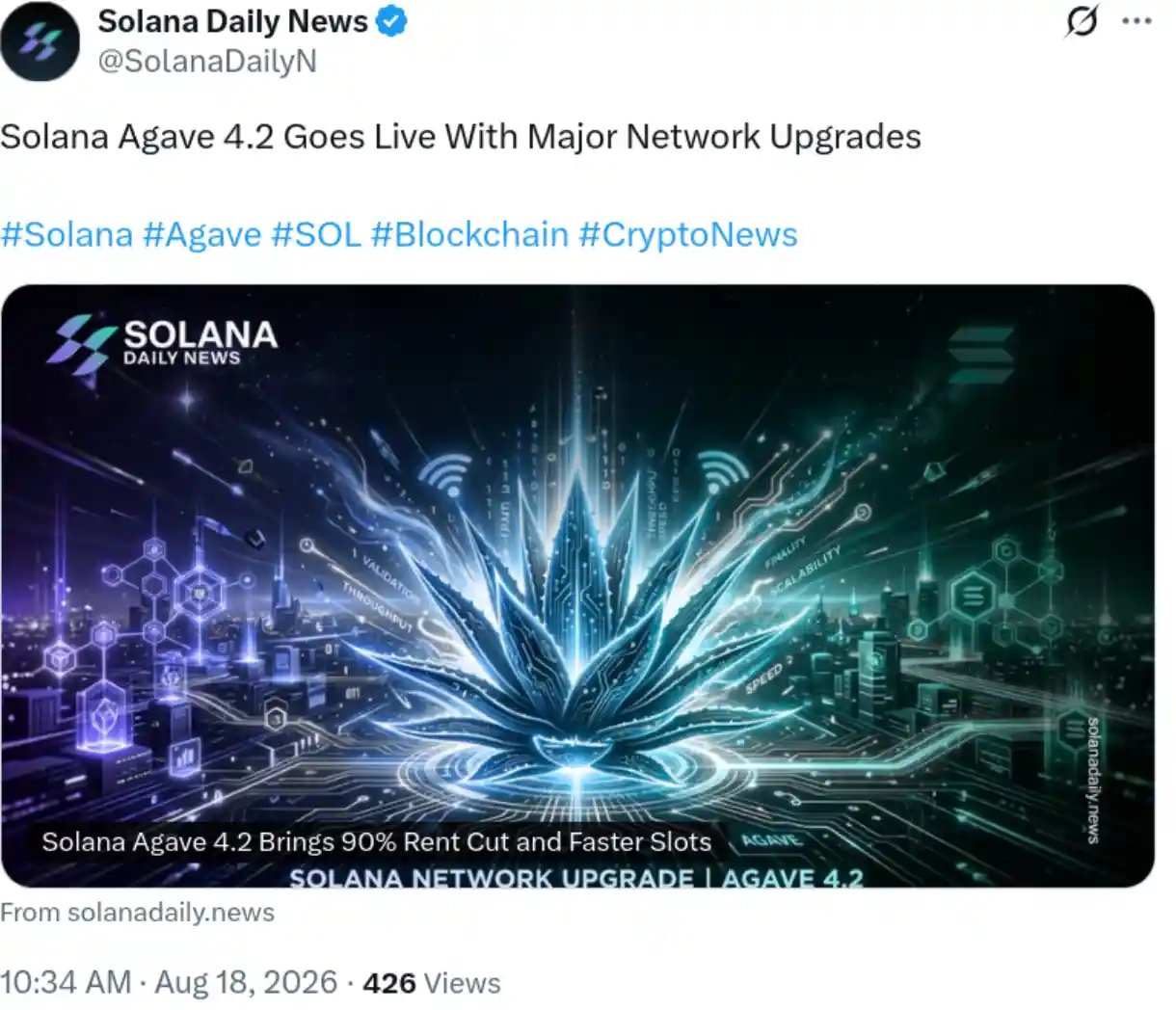
On August 17, Solana began activating its Agave 4.2 upgrade, bringing several changes to the network, including a dramatic reduction in on-chain storage costs and a much larger transaction capacity.
For SOL investors, however, the bigger question is not whether the upgrade sounds impressive. It is whether these technical improvements can translate into more users, more applications and ultimately greater economic activity across the Solana ecosystem.
Among the most notable changes is an estimated 90% reduction in on-chain rent costs. The upgrade also increases the maximum transaction size by roughly 3.3 times, allowing developers to pack more complex operations into a single transaction.
The network is also moving toward shorter slot times, which could further improve responsiveness as the upgrade rolls out.
These may sound like technical changes that only developers should care about. But they could have a much broader effect because blockchain infrastructure determines what applications can realistically be built on a network.
The most interesting part is the 90% reduction in storage costs.
On-chain data can become expensive when applications need to create and maintain large amounts of information. Lowering those costs could make it more economical for developers to build applications that require greater amounts of persistent blockchain data.
The larger transaction capacity is equally important.
Instead of forcing complex operations into multiple transactions, developers can potentially combine more instructions into a single transaction. Solana itself notes that larger transactions can improve composability and reduce the need for awkward multi-step execution patterns.
In simple terms, Solana is giving developers more room to build.
What Is the Deeper Story Beneath the Headline?
The real story is not simply that Solana has become faster or cheaper.
It is that blockchain competition is increasingly moving from marketing to infrastructure.
During previous crypto cycles, networks often competed for attention through token prices, incentives and headline-grabbing applications. But as the industry matures, the networks that can provide reliable, inexpensive and scalable infrastructure may have an important advantage.
Solana’s roadmap reflects this broader strategy.
Agave 4.2 is only one part of a much larger upgrade cycle. Another major development, the Alpenglow consensus upgrade, is targeting much faster finality, potentially around 150 milliseconds, later in 2026.
That suggests Solana is preparing for applications that require something closer to Web2-style responsiveness while retaining blockchain settlement.
And there is another important signal: Solana says its July 2026 ecosystem activity included $3.73 billion in tokenized real-world assets and payments reaching more than 330,000 merchants, while block capacity increased 66%.
Taken together, these developments point toward a network attempting to move beyond speculation and into financial infrastructure.
For SOL investors, the potential benefit is indirect but significant.
A better-performing network can attract more developers. More developers can create more applications. More useful applications can bring more users and transaction activity. And greater economic activity could strengthen demand for the network’s native asset.
But investors should not assume that an upgrade automatically means a higher SOL price.
The real metrics to watch are network usage, developer activity, transaction demand, stablecoin and tokenized-asset growth, fees and the number of applications generating sustainable economic activity.
If these improve alongside the technical upgrades, Solana’s investment case could become stronger.
The Investor Takeaway
The most important lesson is that infrastructure upgrades should be judged by what they enable—not simply by how impressive the technical specifications sound.
Agave 4.2 gives Solana cheaper storage and more room for complex transactions. Future upgrades could push the network’s performance even further.
For investors, the opportunity lies in watching whether developers and users actually take advantage of that improved infrastructure.
The upgrade is the foundation. Adoption is what ultimately determines its value.
An exchange can look perfectly functional on the surface while problems are already building underneath.
That concern is now hanging over BitMart after its Chinese-language X account was reportedly hijacked and used to publish demands for proof of reserves, explanations for frozen withdrawals and a repayment plan for affected users. The development comes as BitMart approaches its Aug. 26 final trading day and planned closure in January 2027.
For investors, however, the bigger story is not the hacked social-media account.
It is what the episode reveals about counterparty risk and the danger of leaving assets on centralized exchanges.
What Happened?
Multiple reports say individuals claiming to be BitMart staff gained control of the exchange’s Chinese-language X account and published a five-point ultimatum directed at founders Sheldon Xia and Yi Li.
The demands reportedly include:
Audited disclosure of wallets, assets and liabilities
Proof of usable reserves
An explanation for ongoing withdrawal restrictions
Payment of overdue employee salaries
A detailed plan for repaying affected users
The post reportedly gave BitMart until Aug. 19 to respond, while threatening escalation to regulators and law enforcement.
BitMart founder Sheldon Xia has rejected the claims, saying the account was hacked and describing the allegations as fabricated.
At the same time, users continue to report difficulties withdrawing funds.
That creates a difficult situation: the exchange disputes the claims, but users are still concerned about access to their assets.
Metaverse, Non-Fungible Token, Stock Market and Exchange, Cryptocurrency, Data Mining
The Most Interesting Part of the Story
The hacked X account is certainly dramatic.
But it isn’t the part investors should focus on most.
The real issue is the question being asked underneath the controversy:
Can users independently verify that an exchange has enough liquid assets to honor withdrawals when they need them?
An exchange can report billions of dollars in assets, but that doesn’t necessarily tell users how much is actually available to meet withdrawals immediately.
There is also a difference between having assets and having liquid assets that can actually be returned to customers.
That distinction becomes particularly important when withdrawals begin slowing or stopping.
Why Frozen Withdrawals Matter
Imagine depositing $10,000 into a bank and seeing the balance on your account.
You may technically own the money, but if the institution suddenly prevents you from withdrawing it, the balance on your screen doesn’t solve the problem.
Crypto exchanges create a similar counterparty risk.
When you leave coins on an exchange, you are effectively trusting the exchange to:
Safeguard your assets
Maintain sufficient liquidity
Process withdrawals
Manage its liabilities responsibly
Keep its infrastructure secure
If any of those fail, the fact that your account still displays a balance offers little comfort.
That is why withdrawal problems can be more significant than temporary price movements.
Exploiters look for a small breach. Source: create.vista.com / cryptosignals
Lessons for Investors
1. Don’t confuse exchange balances with ownership
Seeing Bitcoin, XRP or USDT displayed in your exchange account doesn’t provide the same control as holding assets in a wallet whose private keys you control.
For long-term holdings, investors should carefully consider whether keeping everything on a centralized platform is necessary.
2. Treat withdrawal problems as a serious warning
A temporary technical issue doesn’t automatically mean an exchange is insolvent.
But repeated withdrawal restrictions should trigger questions.
Investors should ask:
Why are withdrawals restricted?
How long have they been restricted?
Has the exchange provided verifiable information?
Are other users experiencing the same problem?
These questions matter far more than an exchange’s marketing claims.
3. Look beyond proof-of-reserves headlines
Proof-of-reserves can provide useful information, but investors should understand what is actually being verified.
A meaningful assessment should ideally provide transparency around assets, liabilities, ownership and liquidity—not simply a wallet address showing that an exchange controls certain coins.
4. Don’t keep everything in one place
Diversification isn’t only about holding different cryptocurrencies.
It can also mean diversifying custody risk.
An investor who holds every asset on one exchange is exposed to the operational, regulatory and financial problems of that single institution.
What Investors Should Watch Next
The Aug. 19 deadline could provide an important test of BitMart’s transparency.
Investors should watch for whether the exchange provides independently verifiable reserve information, explains the withdrawal situation and presents a credible repayment strategy.
They should also watch what happens after Aug. 26, when BitMart is expected to reach its final trading day, and whether the planned January 2027 closure proceeds smoothly.
Most importantly, investors should distinguish between statements and evidence.
A social-media post can be hacked.
An executive can deny allegations.
A user can make accusations.
But verifiable wallet data, audited financial information and successful withdrawals provide much stronger evidence.
The Bigger Lesson
The BitMart controversy is a reminder that crypto investors face a risk that has nothing to do with whether Bitcoin goes up or down.
You can be right about the asset and still lose access to it if you choose the wrong intermediary.
That is why exchange risk deserves the same attention as market risk.
As the crypto industry matures, investors will likely demand greater transparency from centralized platforms—especially around reserves, liabilities, custody and withdrawals.
The enduring lesson is simple:
Don’t only ask how much your crypto is worth. Ask who controls it, whether you can withdraw it, and what evidence proves that it is actually there.
BIP-110 failed after gaining only about 2.5% miner support, leading to a minority chain split.
The failure sparked a governance debate over miner influence and node sovereignty.
The episode showed that broad ecosystem consensus is crucial for successful Bitcoin protocol changes.
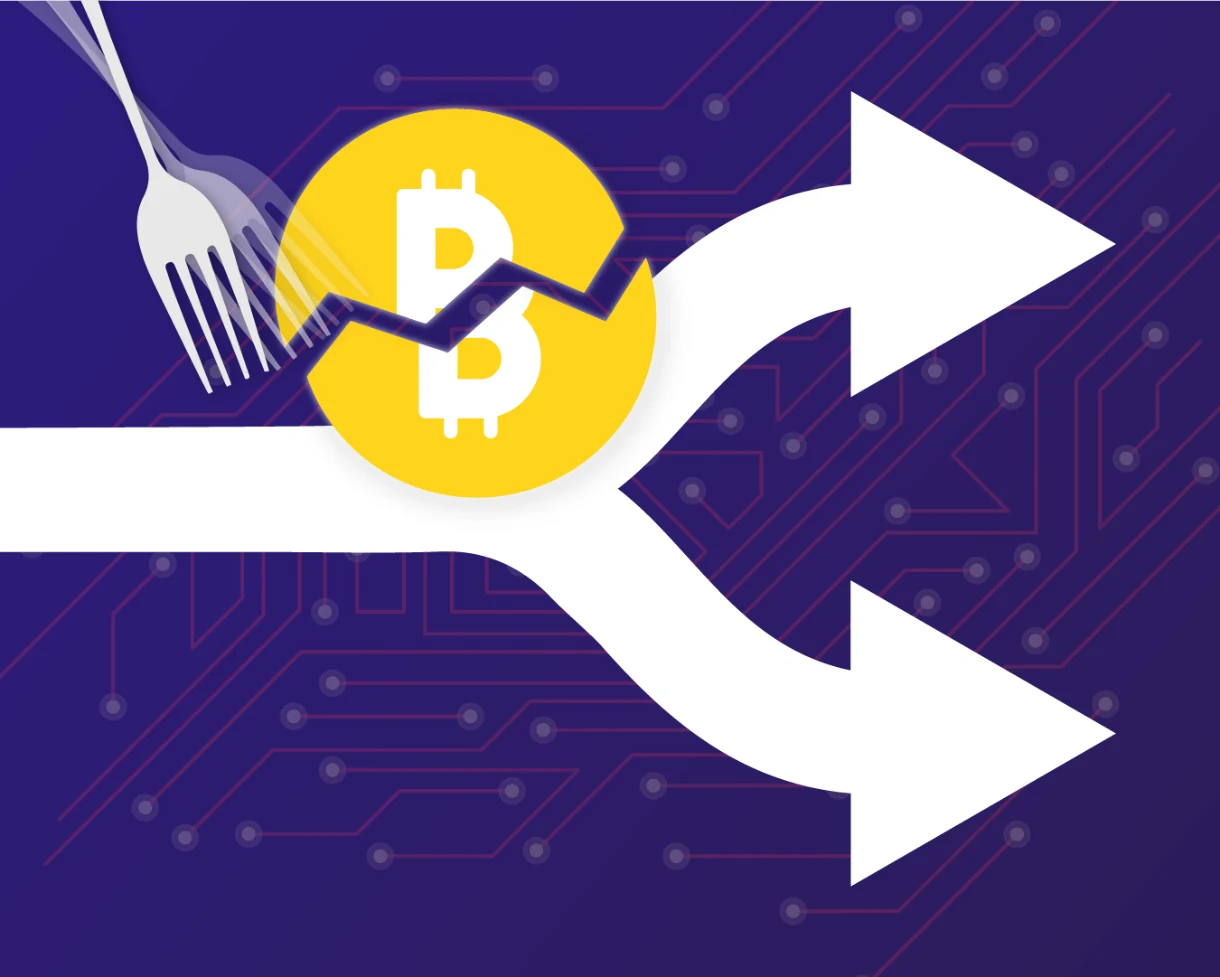
A key governance debate: The failed effort to restrict non-financial data on Bitcoin’s chain stirred up a key governance debate. Stirred up by the failed effort to restrict non-financial data on Bitcoin’s chain. Just around 2.5% of hash power support was allocated to BIP-110 before its August 8 activation deadline. The nodes pushing the proposal broke away from the base network at block 962,632. This allowed the formation of a minority blockchain that continued to operate.
Bitcoin Mechanic, a supporter of BIP-110, viewed the episode as evidence of increasing “protocol capture” by powerful mining pools. In his view, the outcome undermined the long-standing idea that Bitcoin’s decentralized node operators ultimately hold enough influence to safeguard the network’s consensus rules from miners.
He argued that the major mining pools effectively operated as a coordinated group by rejecting the proposal, raising questions about the balance of power within Bitcoin’s proof-of-work system. According to his perspective, PoW loses some of its intended value when a small number of miners can exert significant influence over which protocol changes gain traction. He also warned that growing involvement from large corporations and institutional players could gradually shift Bitcoin further away from its original decentralized ideals.
Is It an Error in Soft Fork Design or Miner Capture What Caused the Failure of BIP-110. Source: Google Images
The Struggles of the Minority Blockchain
The key effect of the failure of BIP-110 was immediate. The nodes enforcing the proposal, which consisted of a customized variant of BTC Knots, rejected blockchains that went against the proposed rule. However, because the minority blockchain had access to less than 3% of BTC’s overall hash power, block production effectively paused.
Bitcoin Mechanic pointed out that the BIP-110 minority chain retained Bitcoin’s original mining difficulty despite having access to only a small portion of the network’s total computing power. This imbalance made block production extremely slow and effectively left the chain struggling to progress.
As a possible solution, some BIP-110 supporters have proposed replacing Bitcoin’s current proof-of-work algorithm with a new one that would render existing ASIC mining equipment ineffective. Bitcoin Mechanic supports this approach, arguing that changing the PoW system could help reduce the dominance of concentrated mining power. However, he has also stressed that he is not interested in having the resulting chain adopt the Bitcoin name.
Is It Really Governance or a Design Error?
Some industry participants refused to accept that the failure of BIP-110 attested to Bitcoin being captured by miners. The founder of Cysic, Leo Fan, disputed this, arguing that the result instead demonstrated how Bitcoin’s current governance system works.
Leo Fan emphasized that it is the nodes that decide which rules are enforced, while miners determine whether or not a blockchain will continue producing new blocks. However, users and exchanges influence which blockchain retains liquidity and the BTC identity.
He viewed BIP-110’s mandatory activation mechanism as one of its biggest weaknesses. With support at only around 2.5%, forcing the proposal into effect made a chain split highly likely. From this perspective, activation thresholds should confirm genuine ecosystem consensus rather than attempt to manufacture it.
The lack of backing from major mining pools, therefore, did not necessarily indicate manipulation. Instead, it could simply show that the proposal had failed to secure enough support across the network.
The anonymous owner of 1win shared a similar assessment, arguing that BIP-110 failed because it never achieved the broad consensus needed to alter Bitcoin’s established rules. With miners signaling roughly 2.53% support against a 55% activation threshold, the proposal clearly lacked sufficient backing.
The network’s difficulty adjustment also functioned as intended under this view. Once a minority chain splits from Bitcoin, it retains the existing mining difficulty while operating with significantly less hash power. Without enough computational support, block production becomes extremely slow and costly, making controversial forks difficult to sustain without meaningful backing from miners and other major participants in the ecosystem.
Is It an Error in Soft Fork Design or Miner Capture What Caused the Failure of BIP-110. Source: Google Images
The Revelation Presented by the BIP-110 Failure
The BIP-110 controversy exposes a deeper disagreement over how Bitcoin should be governed. Critics argue that the episode demonstrates how powerful mining pools can exert influence over node-level decision-making. Supporters, however, interpret the outcome differently, viewing it as evidence that Bitcoin’s decentralized structure can prevent any single group from imposing changes without broad consensus.
Ultimately, meaningful changes to Bitcoin’s protocol depend on broad cooperation among miners, node operators, exchanges, custodians, developers, and other economic participants. BIP-110 failed to secure that level of support and coordination.
Although the main Bitcoin network continues to operate normally, the controversy highlights a growing ideological divide within the ecosystem. On one side are those who favor institutional adoption, network stability, and established mining structures; on the other are advocates for stronger individual control and greater node sovereignty.
Stablecoins are a major part of crypto liquidity. Traders use them to move in and out of positions without returning to traditional banking rails. Watching stablecoin supply can help traders understand whether buying power may be entering or leaving the market.
When total stablecoin supply grows, it can suggest more capital is available inside crypto. New USDT, USDC, or other stablecoins may eventually be used to buy Bitcoin, Ethereum, or altcoins. This does not guarantee a rally, but it can create a supportive liquidity backdrop.
When stablecoin supply shrinks, it can suggest capital is leaving crypto or becoming less active. In weak markets, falling stablecoin supply may confirm reduced appetite for risk.
Exchange stablecoin balances are also useful. If stablecoins are flowing onto exchanges, traders may be preparing to buy. If stablecoins are leaving exchanges, capital may be moving to storage, DeFi, or off-platform use.
Context is everything. A rise in stablecoin supply during a strong uptrend may support continuation. A rise during panic may simply mean traders are selling crypto into stablecoins. Traders must compare supply data with price, volume, and sentiment.
Stablecoin regulation can also affect confidence. News about reserves, audits, banking access, or legal action can influence whether traders feel comfortable holding certain stablecoins. That can spill into wider market liquidity.
Beginners should not use stablecoin supply as a timing tool. It moves slowly compared with intraday charts. Instead, treat it as a background indicator. It helps answer whether the market has fuel available for risk-taking.
For example, if Bitcoin is consolidating below resistance, stablecoin supply is rising, and exchange stablecoin balances are increasing, a breakout may have better support. If supply is contracting and sentiment is weak, breakouts may fail more easily.
Key takeaway:
Stablecoin supply is a liquidity indicator. Rising supply can suggest more potential buying power, while falling supply can suggest reduced market fuel. Use it as context, not as a standalone signal.
Educational content only. Not financial advice. DYOR.






 Free Telegram Channel